
The strikes on Russian oil refineries cost the Russian Federation's budget more than $15 billion
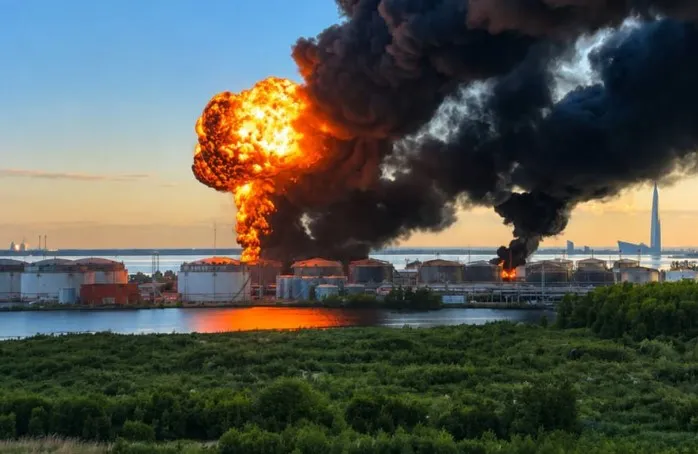
For the fourth month in a row, the Russian federal government has been paying out hundreds of billions of rubles in subsidies to oil companies due to widespread accidents, fires, and shutdowns at oil refineries.
According to data from the Russian Ministry of Finance, 192.8 billion rubles (over 2.38 billion U.S. dollars) were transferred to oil companies in July under the shock-absorption mechanism and the reverse excise tax rate.
A month earlier, these payments totaled 312.5 billion rubles (about 3.86 billion U.S. dollars); in May, they amounted to 357.3 billion rubles (about 4.41 billion U.S. dollars); and in April—359.3 billion rubles (about $4.44 billion). The total volume of budget payments for April–July reached 1.221 trillion rubles (approximately $15.08 billion), which is equal to the annual budget of the Moscow Region (1.38 trillion rubles or $17.04 billion).
Experts at Raiffeisenbank attribute these record-breaking subsidies to the deep crisis in the industry. Throughout July, at least 18 major Russian oil refineries came under drone attacks, and at least 8 of them completely halted production. Among them are the country’s largest refinery, the Omsk Refinery, as well as the Ryazan Refinery and Nizhegorodnefteorgsintez, which are among the five largest.
As of the end of July, at least 7 damaged refineries remained completely shut down (including “Kinef” in the Leningrad Region—the second-largest in Russia). Another 11 facilities were able to resume operations only partially, operating at 30–70% of their capacity. Total oil refining volumes in Russia fell to 3.6 million barrels per day, the lowest level since 2002.
According to estimates by the Center for Macroeconomic Analysis and Short-Term Forecasting (CMASF), this significantly exacerbates Russia’s budget deficit, which is already suffering from a strong ruble, falling corporate sector profits, and bloated defense spending. In the first half of the year, the budget “shortfall” reached 5.7 trillion rubles (about 70.39 billion U.S. dollars), exceeding the annual target by one and a half times. It is expected that by the end of the year, the total deficit could rise to 7 trillion rubles (over 86.44 billion U.S. dollars).
As a reminder, on the night of July 29, the Ukrainian Armed Forces carried out strikes on a number of military and infrastructure targets on the territory of Russia and in the temporarily occupied Crimea. Among the targets hit were the Ryazan Oil Refinery, a base for Russian Black Sea Fleet vessels, a radar station, and military logistics facilities.
On July 29, Ukrainian President Volodymyr Zelenskyy announced new results from the strikes on Russian facilities used to support and prolong the war against Ukraine.


