
Ukrainian strikes are pushing Russia toward a painful crisis – Politico
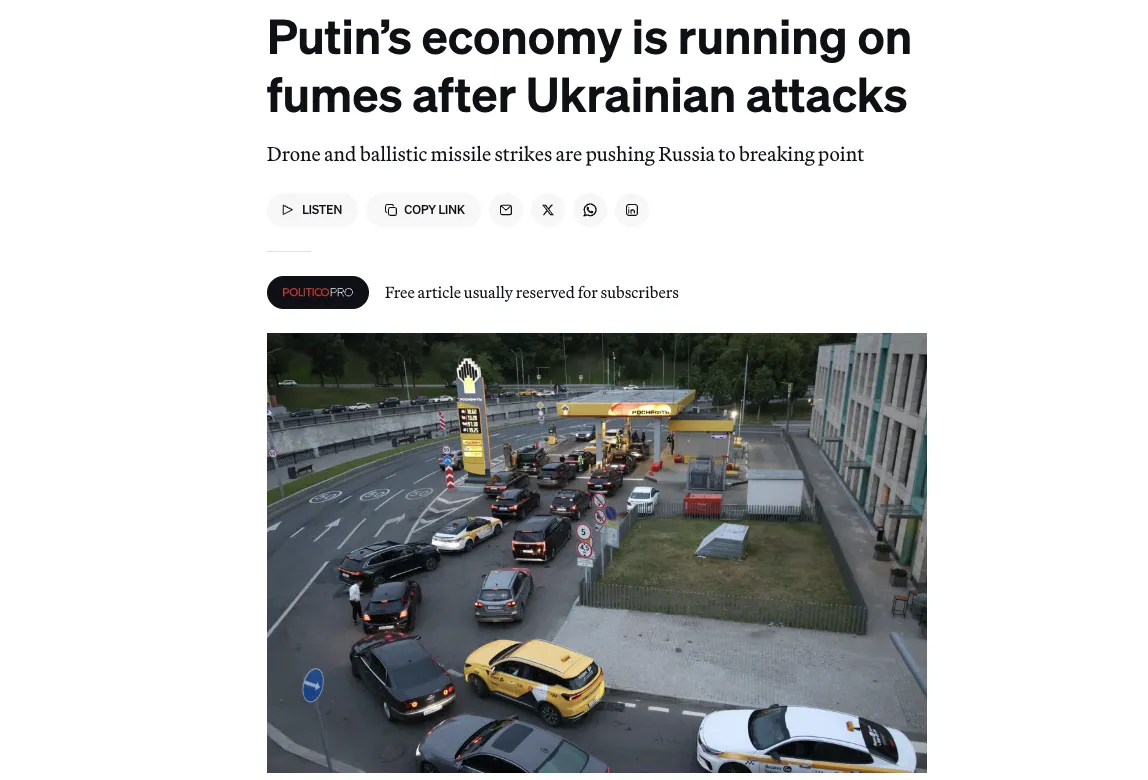
Ukrainian strikes on Russia’s key energy infrastructure are increasingly disrupting fuel supplies and military logistics, bringing the country closer to a major fuel crisis.
Currently, two-thirds of Russia’s 83 regions are reporting fuel supply problems, causing serious inconvenience for millions of citizens and threatening the viability of businesses. The situation is particularly acute in occupied Crimea, where authorities have declared a state of emergency, completely banned the sale of fuel, and where the tourism sector has collapsed.
Putin was forced to acknowledge the problem by summoning high-ranking officials to Moscow, although he publicly claims that the shortage is not “critical.” The Kremlin has classified the official extent of the losses and domestic fuel prices, preventing their publication. Videos showing conflicts and stampedes at gas stations are spreading widely on social media.
The crisis has led to a paradoxical situation: India, which is the largest buyer of Russian crude oil, will now export some of its refined fuel back to Russia. These imports have become necessary because Ukraine has deliberately targeted technologically complex catalytic cracking units, which Russia cannot repair or replace on its own due to sanctions.
Serhiy Vakulenko, an analyst at the Carnegie Endowment for International Peace, notes that gasoline supplies in Russia are currently determined by a race between Ukrainian UAVs and Russian repair crews, and as long as the intensity of the attacks remains high, the advantage lies with Kyiv. The only relative silver lining for the Kremlin is the availability of diesel fuel for trucks and farmers; however, the government has already banned the export of gasoline and jet fuel and is considering a ban on diesel exports to ensure the harvest can proceed.
The fuel crisis has fueled the growth of a black market with steep markups, creating additional inflationary risks. As a result, the Central Bank of Russia cut its key rate by only a quarter of a percentage point in June—to 14.25%—despite pressure from the government and the business community, which had demanded a more drastic reduction.
The cautious policy of Central Bank Governor Elvira Nabiullina, who had previously raised rates to 23% to curb economic overheating, has drawn criticism from Sberbank CEO Herman Gref. Nabiullina is firmly opposed to a rapid rate cut, warning of the risk of stagflation. At the same time, both Gref and Nabiullina openly link economic problems to the war, and Gref has explicitly stated the general desire to end hostilities as soon as possible.
The economic situation in Russia is being exacerbated by the depletion of financial reserves. According to Janis Klug, an analyst at the German Institute for International and Security Affairs, following a significant increase in the first half of 2026, military and intelligence spending now accounts for nearly half of all government expenditures. At the same time, the liquid assets of Russia’s National Welfare Fund have fallen from 7% of GDP at the beginning of 2022 to just 1.7% of GDP as of April, which indicates that the Kremlin’s financial resources—not just its fuel reserves—are running dry, writes Politico.
As a result of a massive Russian strike on the capital, a leased humanitarian warehouse belonging to the Ukrainian Red Cross was completely destroyed; it had stored over 320,000 units of cargo and equipment with a total value of more than 79 million hryvnias.
As a result of Russian shelling and a fire at one of the capital’s enterprises, fuel and lubricants flowed into Kyrylivske Lake in Kyiv through the storm sewer system.


