
September 15, 2026 — the Feast of Our Lady of Sorrows and Her Seven Sorrows
On September 15, Christians of the Western tradition honor the Sorrowful Virgin Mary—the Mother of God who endured the suffering of her Son, Jesus Christ. This day is dedicated not only to Mary’s sorrow but also to her compassion, maternal love, and faithfulness during the most difficult moments. In 2026, the feast falls on Tuesday, September 15.
The feast of the Blessed Virgin Mary of Sorrows, or Our Lady of Sorrows, is dedicated to Mary’s experiences during the earthly life of Jesus Christ. In the Catholic tradition, this day is called the Memorial of Our Lady of Sorrows—a commemoration of the Blessed Virgin Mary of Sorrows. It is celebrated annually on September 15, the day after the Feast of the Exaltation of the Holy Cross.
At the heart of the feast is the image of a mother who witnesses her own child’s suffering and does not abandon him even in the most difficult moments. This is especially true of the events of Christ’s Passion and the crucifixion of Jesus. Mary stood by the cross as her Son was dying, and that is why, in Christian tradition, she is called the Sorrowful Mother. The feast reminds believers that pain and suffering are part of human life, but even in the most difficult moments, a person can remain close to those who need support.

This day is not somber but rather a time for prayer. Christians reflect on Mary’s sorrows and contemplate her strength, patience, and trust in God. A special place is given to prayer for people experiencing loss, illness, war, loneliness, or other difficult circumstances. Therefore, for many believers, the image of Our Lady of Sorrows is associated not only with pain but also with hope and comfort.
Where Does the Tradition of Honoring Mary of Sorrows Come From?
The veneration of Mary’s sorrows has ancient origins. It grew out of the biblical accounts of Jesus’ life and the Christian understanding of what Mary experienced alongside her Son. Particularly significant for this tradition were the words of the elder Simeon, who, upon meeting the infant Jesus, told Mary that “a sword will pierce your very soul.” It was this image of the sword that later became one of the main symbols of the Mother of God’s sorrow.
Devotion to Our Lady of Sorrows became particularly widespread in the Middle Ages. The Cistercians contributed to its development, as did, in particular, the Order of the Servants of Mary, also known as the Servite Order. In the 13th century, its founders made Mary’s sorrows one of the central themes of their spirituality. In the 14th and 15th centuries, this devotion spread throughout various parts of Europe, and brotherhoods dedicated to the Sorrowful Mother began to emerge.
In 1482, a feast dedicated to the Sorrows of Mary appeared in liturgical books under the name “Our Lady of Sorrows.” Later, the tradition gained wider ecclesiastical recognition. In 1727, Pope Benedict XIII included the feast in the Roman Calendar, though at that time it was celebrated on a different day—the Friday before Palm Sunday. Over time, a separate date was established in the church calendar to honor Our Lady of Sorrows. In 1913, Pope Pius X fixed its celebration for September 15. Thus, the current date has a history spanning more than a century.
Why Is the Feast Celebrated on September 15?
The date of September 15 was not chosen at random. It falls on the day after the Feast of the Exaltation of the Holy Cross, which is celebrated on September 14. This connection has a clear symbolic explanation: after honoring the Cross, the Church commemorates the Mother who stood beside it during Jesus’ crucifixion. This creates a unique sequence in the liturgical calendar. First, Christians honor the Cross of Christ, and the next day they commemorate Mary, who witnessed her Son’s suffering. Therefore, September 15 is particularly associated with the biblical scene at Golgotha.
There is another interesting detail. The feast falls one week after the Nativity of the Blessed Virgin Mary, which is celebrated on September 8. Because of this, in the Catholic spiritual tradition, September is particularly associated with devotion to Mary. In Catholic devotion, the entire month of September is traditionally devoted to reflecting on her seven sorrows. Thus, September 15 is not a random date, nor is it simply another Marian feast day. It is logically linked to two important events in the church calendar—the Exaltation of the Cross and the Nativity of the Virgin Mary. That is precisely why this day holds a special place among the feasts of September.
What Are the Seven Sorrows of Mary?
One of the most well-known traditions of this day is to commemorate the Seven Sorrows of the Blessed Virgin Mary. These are seven biblical events that Christian tradition regards as particularly painful moments in the life of the Mother of God. They illustrate the trials, fears, and losses she had to endure. Simeon’s prophecy about Jesus’ future sufferings is usually counted among the seven sorrows. The second sorrow is considered to be the Holy Family’s flight to Egypt due to a threat to the child’s life. The third is associated with Mary and Joseph’s search for the twelve-year-old Jesus, who had remained in the Temple in Jerusalem. The fourth sorrow is Mary’s encounter with Jesus on the way to Calvary.

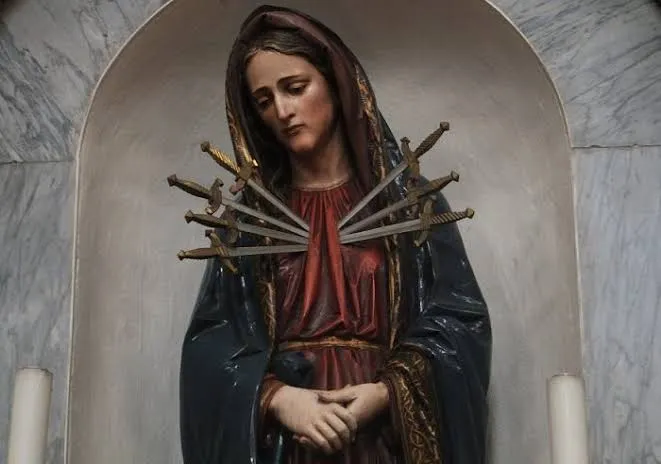
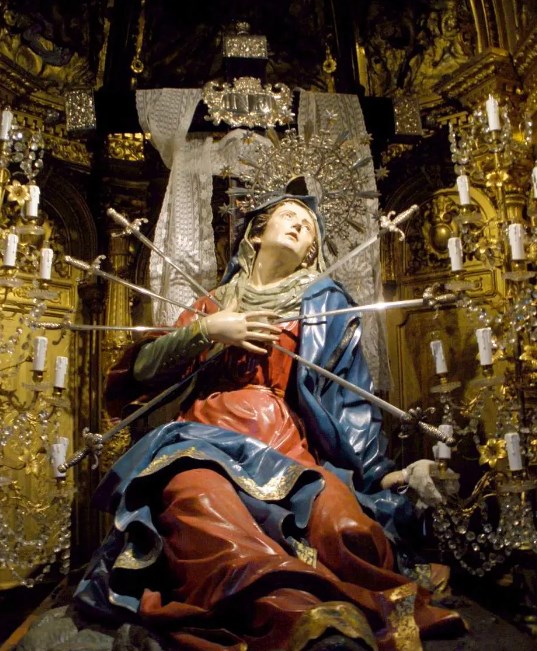
The fifth is considered to be the death of Jesus on the cross, which Mary witnessed while standing beside Him. The sixth is associated with the removal of Christ’s body from the cross and its presentation to His Mother. The seventh is the burial of Jesus. Together, these events form the traditional image of the Seven Sorrows of the Virgin Mary. In art, the Seven Sorrows are often symbolized by seven swords piercing Mary’s heart. This is why many depictions of Our Lady of Sorrows show a heart pierced by swords. This is not a literal biblical description but an artistic symbol that has developed within the Christian tradition. It serves as a reminder of the depth of a mother’s grief and of all the trials Mary endured.
What Does the Image of Our Lady of Sorrows Mean?
The image of Mary the Sorrowful holds special significance for people who are themselves experiencing loss or pain. In it, the Mother of God appears not as a distant and unattainable figure, but as a mother who knows what it means to fear for a child, to face separation, and to experience the death of a loved one. That is why people turn to her with prayers for comfort and support. Church tradition emphasizes that Mary did not try to avoid suffering when it became part of her life. She remained by Christ’s side until the very end. For believers, this serves as an example of love, faithfulness, and inner strength.
The feast also serves as a reminder of compassion for others. When a person witnesses another’s pain, it is important not to turn away from it. Sometimes help does not lie in finding a solution right away, but simply in being there. This is precisely how Mary’s presence at the cross is understood in the Christian tradition. Therefore, September 15 often becomes a day of special prayer for those going through difficult times. These may be people who have lost loved ones, are battling illness, are suffering the consequences of war, or are going through personal crises. In this context, the image of Our Lady of Sorrows takes on a very human meaning—it speaks of pain that cannot always be taken away, but which can be shared.
How the Feast Is Observed
On September 15, Catholic churches celebrate a liturgy in honor of the Most Holy Virgin Mary of Sorrows. During the service, biblical passages related to the sufferings of Christ and Mary are read. The faithful pray, reflect on the Seven Sorrows of the Virgin Mary, and ask for her intercession. The liturgy on this day includes special prayers and readings dedicated to the themes of suffering and compassion. One of the distinctive features of the service may be the performance of the ancient Christian hymn “Stabat Mater.” Its title comes from the Latin words meaning “The Mother Stood.” The text is dedicated to Mary, who stands at the foot of the cross and witnesses her Son’s suffering. In the liturgy for September 15, this hymn may be performed as a sequence before the Gospel.
Believers may also pray privately at home. One common form of devotion is a prayer or rosary dedicated to the Seven Sorrows of Mary. Such prayers help us not only to recall historical events but also to reflect on our own lives, our fears, our losses, and the people who need support right now. Traditions may vary from country to country and from parish to parish. In some places, prayer processions are held; in others, special services are organized; and in still others, the day is spent more quietly, in family prayer. There is no single, universal way to observe this day. What remains most important is the spiritual meaning of the feast—to remember Mary, her suffering, and her presence at Christ’s side.
What Prayers Are Said on This Day
On this day, special attention is given to prayers to Our Lady of Sorrows. People ask her to support those going through difficult circumstances, to help them cope with loss, and to keep hope alive. They also pray for families, children, the sick, and those who are lonely. In some traditions, people pray through the Seven Sorrows of Mary, meditating on each one separately. This approach involves reading the prayers slowly rather than hurriedly, focusing on each event. Believers may reflect on how Mary experienced fear, separation, pain, and loss, and then ask for strength to face their own trials.
The prayer on this day can also be very simple. A person can address the Mother of God in their own words, share what is troubling them, and ask for help for themselves or their loved ones. In the Christian tradition, what matters is not just knowing a specific text, but the sincerity of such an appeal.
Interesting Facts About the Feast
The first interesting fact is that the feast did not have just one date. Throughout history, there were various liturgical celebrations dedicated to the sorrows of Mary. One was observed before Easter, while another was associated with the month of September. Over time, these traditions were standardized, and September 15 became the primary date in the modern calendar.
The second fact is that the feast has very ancient roots. Devotion to the Sorrows of Mary began as early as the Middle Ages, and monastic orders played a special role in this. The Servites made the Sorrows of the Virgin Mary a central part of their spirituality as early as the 13th century. It was thanks to such communities that the tradition gradually spread to other parts of Europe.
The third fact is that September is traditionally associated with the Seven Sorrows of Mary. In Catholic devotion, this month is dedicated to reflecting on Our Lady of Sorrows. Particular attention is given to this theme around September 15.
The fourth fact is that September 15 is closely associated with the Exaltation of the Cross. This feast is celebrated the day before, on September 14. Therefore, these two consecutive days in the church calendar form a thematic sequence: first, the focus is on the Cross of Christ, and then on Mary, who witnessed his death.
Fifth fact—on this day, you can hear the “Stabat Mater.” It is one of the most famous Christian texts dedicated to the Sorrows of the Virgin Mary. It describes Mary standing at the foot of the cross and her pain during Jesus’ crucifixion. In the modern liturgy, its performance on September 15 is permitted as part of the service.
Sixth fact: the current date of the feast was established in 1913. It was then that Pope Pius X moved the celebration to September 15. This was part of the reorganization of the church calendar. Since then, this date has been universally accepted for the liturgical commemoration of Our Lady of Sorrows in the Roman Rite.
What the Feast Teaches
The Feast of Our Lady of Sorrows speaks first and foremost to a person’s ability to remain close to loved ones even when they cannot change the situation. Mary could not take away Jesus’ suffering, but she did not leave him alone. It is precisely this presence that has become one of the central themes of the feast. For people today, this message remains just as relevant. We often cannot solve others’ problems or restore what has already been lost. But we can support a loved one, listen to them, help in a concrete way, or simply not leave them alone.

That is why, for many believers, September 15 is a day not only of sorrow but also of compassion. It is an opportunity to remember those who are currently going through difficult times and to pray for them. And the icon of the Mother of God reminds us that even amid pain, love, faith, and hope can remain. In 2026, the Sorrowful Virgin Mary will be honored on September 15, a Tuesday. On this day, the faithful can visit a church, participate in the Divine Liturgy, pray before the icon of Our Lady of Sorrows, or devote time to quiet, personal prayer. The main purpose of the feast is to commemorate Mary’s seven sorrows, her love for Christ, and her compassion for human suffering.


