
Biologists have discovered a new species of walking shark off the coast of Papua New Guinea
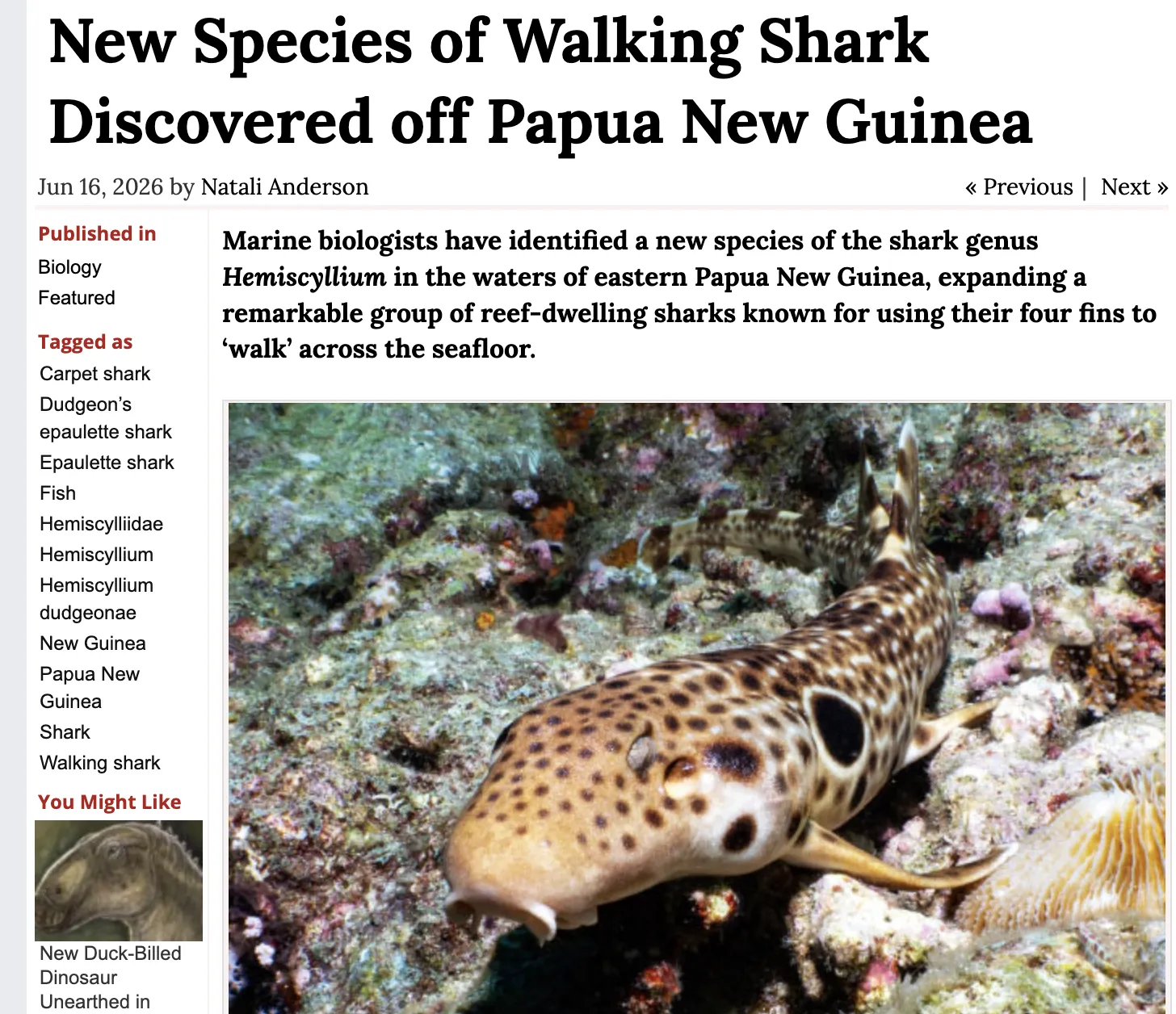
Marine biologists have discovered a new species of shark of the genus Hemiscyllium in the waters off eastern Papua New Guinea. Members of this group are known for their unusual ability to move across the seafloor using four fins, in a manner resembling walking.
Walking or epaulette sharks comprise ten similar species, which are identified based on distinctive color patterns, genetic markers, and geographically restricted distributions.
The genus is endemic to Australia and the island of New Guinea, a region that coincides with a global hotspot of diversity for bottom-dwelling sharks, shaped by a complex tectonic and marine history.
Epaulette sharks are small, predominantly nocturnal, bottom-dwelling sharks, typically reaching a total length of 70–80 cm, with the largest reported specimen measuring 107 cm. They are usually found in shallow coastal habitats, including coral reefs, seagrass beds, and mangrove forests, typically at depths of less than 10 m, but there have been recorded sightings at depths of up to 50 m.
These sharks have very limited home ranges, ranging from just a few hundred square meters to a few square kilometers, due to their limited mobility and bottom-dwelling lifestyle. In addition, these sharks are oviparous, laying small oval egg capsules on the seafloor, which further limits their ability to disperse. Although our understanding of the distribution of walking sharks has improved over the past two decades, species endemic to eastern Papua New Guinea remain poorly studied.
In a new study, Dr. Christine Dagen of the University of the Sunshine Coast and her colleagues addressed these gaps by investigating the distribution of epaulette sharks of the genus Hemiscyllium in eastern Papua New Guinea.
“New shark species don’t come along very often, and this is definitely the first one named after me,” said Dr. Dagen.
The new Hemiscyllium species was discovered during research conducted between 2023 and 2025 in Milne Bay Province, Papua New Guinea. The animal has been named Dudgeon’s epaulette shark (Hemiscyllium dudgeonae), and is distinguished by a unique pattern of brown spots interspersed with white spots and streaks across its body, as well as a prominent eye-like mark behind its head. Genetic data indicate that the new species is closely related to Hemiscyllium michaeli.
The researchers also warn that Hemiscyllium dudgeonae may be highly vulnerable due to its apparently limited range.
“We hope to collect more data during our next research trip in October to help the IUCN Red List assess the species as vulnerable or endangered,” said Jess Blakeway, a doctoral student at the University of the Sunshine Coast, according to Sci.news.
As a reminder, dozens of animal species potentially new to science have been discovered in Angola.


