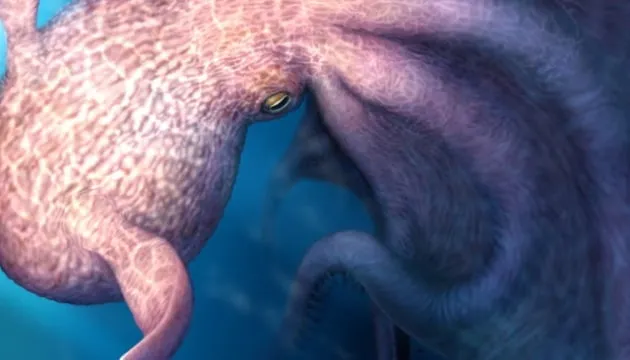
Japanese scientists have discovered that tens of millions of years ago, giant octopuses existed in the oceans and may have played an important role in marine ecosystems. The study indicates that these ancient cephalopods were significantly larger than their modern counterparts and likely dominated the marine environment of their time.
This is reported by The Guardian.
“Our research shows that these were not just larger versions of modern octopuses. They were giant predators at the very top of the Cretaceous marine food web. This challenges the notion that only large vertebrate predators dominated the Cretaceous seas,” said Yasuhiro Iba, a paleontologist at Hokkaido University (Japan) and lead author of the study.
It is noted that the team of scientists re-examined 15 large fossilized jaws that were previously thought to belong to vampire squids.
However, according to the latest analysis, they belonged to a group of ancient octopus relatives known as Nanaimoteuthis.
Using digital imaging, the team of scientists also discovered 12 more octopus jaws buried in chalk formations dating back 72–100 million years.
One species—Nanaimoteuthis haggarti—was found to have a jaw larger than that of the modern giant squid, a creature that reaches about 12 meters in length and was previously considered the largest known invertebrate.
Modern octopuses do not swallow their prey whole, but use their long, flexible tentacles to grab and subdue it, then crush it with their jaws.