
The Swedish Foreign Minister highlighted the weakness of the Russian economy and called for tougher sanctions
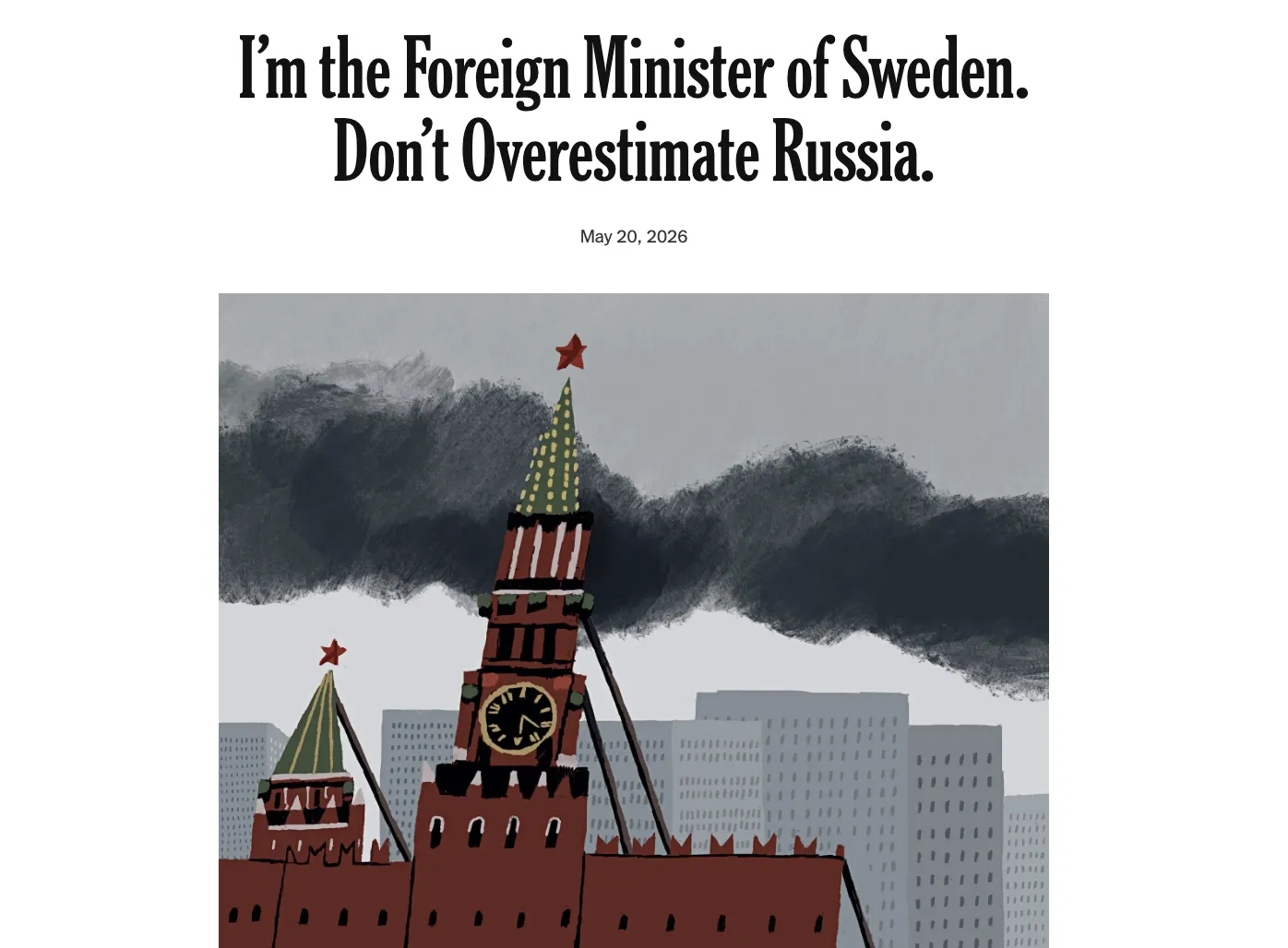
Russia’s economy is significantly weaker than the Kremlin’s official statistics suggest, Sweden’s foreign minister said. According to him, the European Union should intensify sanctions pressure on Russia, in particular by banning the provision of maritime services to ships transporting Russian oil, gas, and coal.
Swedish Foreign Minister Maria Malmér Stenergård expressed this view on May 20 in a column for The New York Times.
According to the foreign minister, the Swedish government commissioned a series of studies from leading economists and intelligence agencies to verify Russia’s official economic indicators. The results of the analysis point to systematic data manipulation by the Kremlin and the overall fragility of the Russian economy.
“Since Russia launched a full-scale invasion of Ukraine four years ago, the Kremlin has been trying to convince the world that the Russian economy is strong and that sanctions are ineffective… Having an accurate picture of the state of the Russian economy is extremely important. We cannot afford to underestimate Russia’s strength and its ability to harm Ukraine and NATO allies, for example by providing intelligence to Iran, but we must also not overestimate it,” Stenergard emphasizes.
According to her, Russia claimed that its economy grew by approximately 13% between 2020 and 2024; however, according to Swedish estimates, it contracted by approximately 8%. Sweden also believes that the real inflation rate in Russia is higher than official figures. This means that Russia is overstating its purchasing power, and its capacity for military spending is weaker than it appears, the Swedish Foreign Minister noted.
She also cites data from a study published by the British government, which states that international sanctions since February 2022 have cost the Russian economy at least $450 billion. In particular, Russia’s revenues from the energy sector in January 2026 were 50% lower than a year earlier.
Stenergard also points to Russia’s strategic failures in Ukraine—the offensive on the front lines has practically stalled, and Ukraine is recapturing some territories. Furthermore, Russia’s losses on the front lines are catastrophic, and replenishing the army is becoming increasingly costly for Moscow.
“Ukraine is in a stronger position than at any time in recent years. It has provided assistance in countering drones to Gulf countries in response to Iran’s attacks and has strengthened cooperation between Ukrainian and Western defense entities, particularly weapons manufacturers, to develop and produce entirely new types of defense equipment,” the column states.
The Swedish Foreign Minister called on the EU to tighten sanctions against Russia, specifically by imposing a ban on the provision of maritime services to ships transporting Russian oil, gas, and coal.
“One specific measure would be of immense significance: imposing a ban on the provision of maritime services—insurance, port access, financing, and so on—to any vessels leaving Russian ports with oil, gas, or coal. A shift from price caps to a complete ban would deal a serious blow to the Kremlin’s military budget. Sweden would like the EU, and ideally the rest of the G7 countries, to implement this measure,” Stenergard emphasized.
According to her, the weakness of the Russian economy demonstrates just how effective Western sanctions have already proven to be. Stenergard emphasized that increasing economic pressure on Moscow is the only effective tool for compelling Russia to engage in genuine peace talks.
“We cannot change Putin’s desire to control Ukraine, but we can change how much it will cost him,” the Swedish foreign minister concluded.
Read also:
Russia changed its polling methodology, and Putin’s approval rating immediately rose
Putin spoke of “ending the war” due to serious problems on the home front and at the front
Ukraine is ready for dialogue with Russia provided Moscow is genuinely committed to serious talks, but such meetings require careful preparation. Any direct contacts between the leaders of the warring states do not occur spontaneously or via ordinary telephone communication.


