
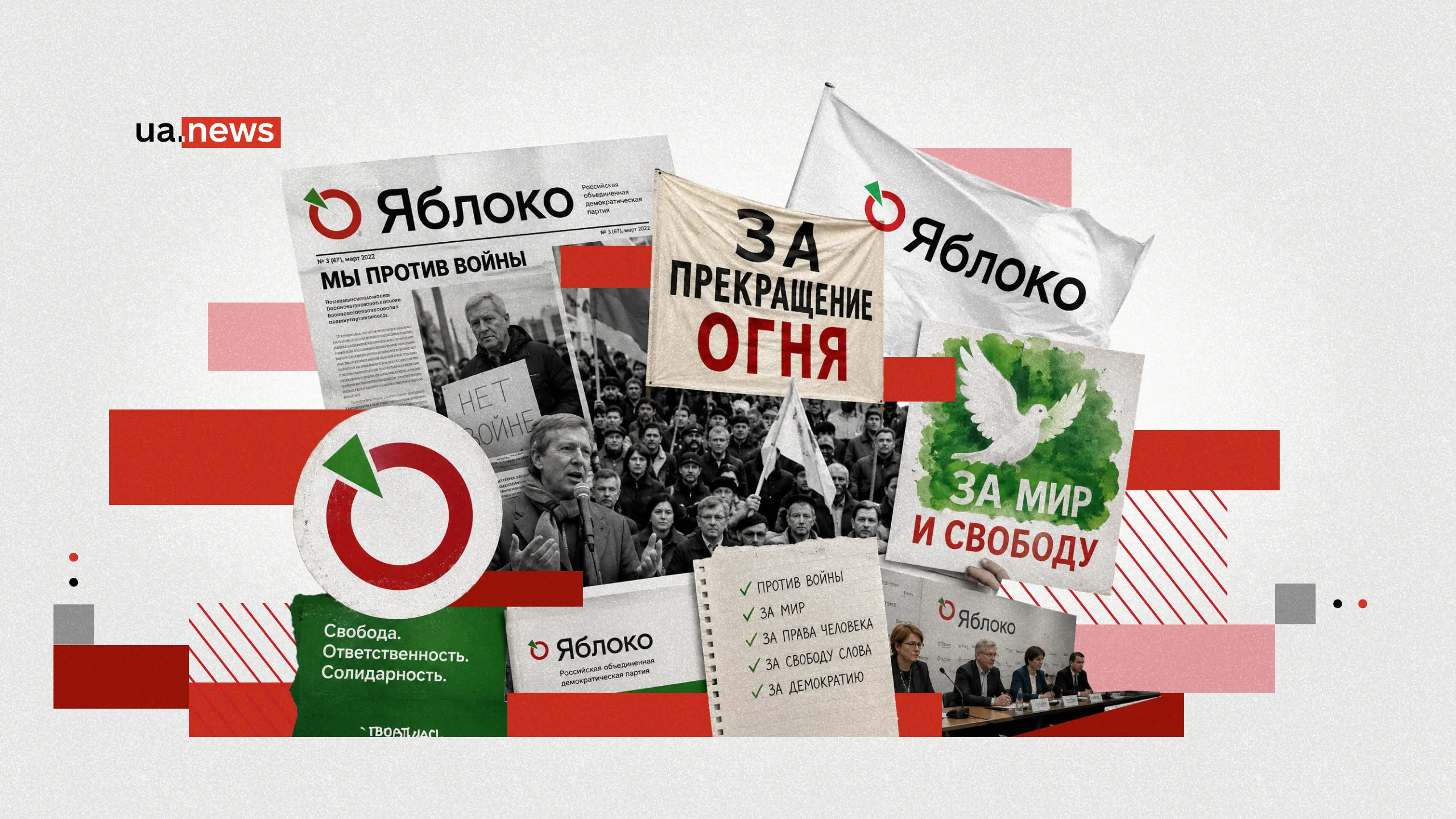
In the political theater of modern Russia, where the script is written in advance in the spacious offices of the presidential administration, the emergence of any political force bearing the word “peace” on its banner is perceived either as an unprecedented sensation or as yet another elaborate charade. When the Central Election Commission of the Russian Federation finally registered the Yabloko party’s list to participate in the 2026 parliamentary elections, many were quite surprised. After all, this is a political force that has directly and unambiguously advocated for an immediate ceasefire in Ukraine, for negotiations with Kyiv, as well as “for freedom,” against the Kremlin’s senseless bans, and “against political repression.”
For a moment, it seemed as though some kind of valve had suddenly opened within the authoritarian Russian machine to let off some pacifist steam. However, this “valve” closed just as abruptly as it had opened. First, all well-known party representatives were pushed out of the electoral process, leaving the candidate lists filled with complete “nobodies,” and then the court removed “Yabloko” from the election altogether—amid scandal, violations, and a sense of utter absurdity, which is, after all, characteristic of Russian legal arbitrariness.
For Ukraine, this brief episode is of fundamental importance. After all, this is not simply a matter of internal Russian strife, but of the existence in the Russian Federation of at least some kind of legal anti-war force.
Is there really a political entity in the aggressor country that is willing to call the war a war and, more importantly, to directly call for its immediate end, a ceasefire, and negotiations? Why was “Yabloko” first allowed into the game and then kicked out under a flimsy pretext? What kind of party is “Yabloko” anyway—and isn’t this just another cunning “multi-step maneuver” by the Kremlin? UA.News political analyst Mykyta Trachuk looked into the matter.
Is the “Yabloko” party a Kremlin project?
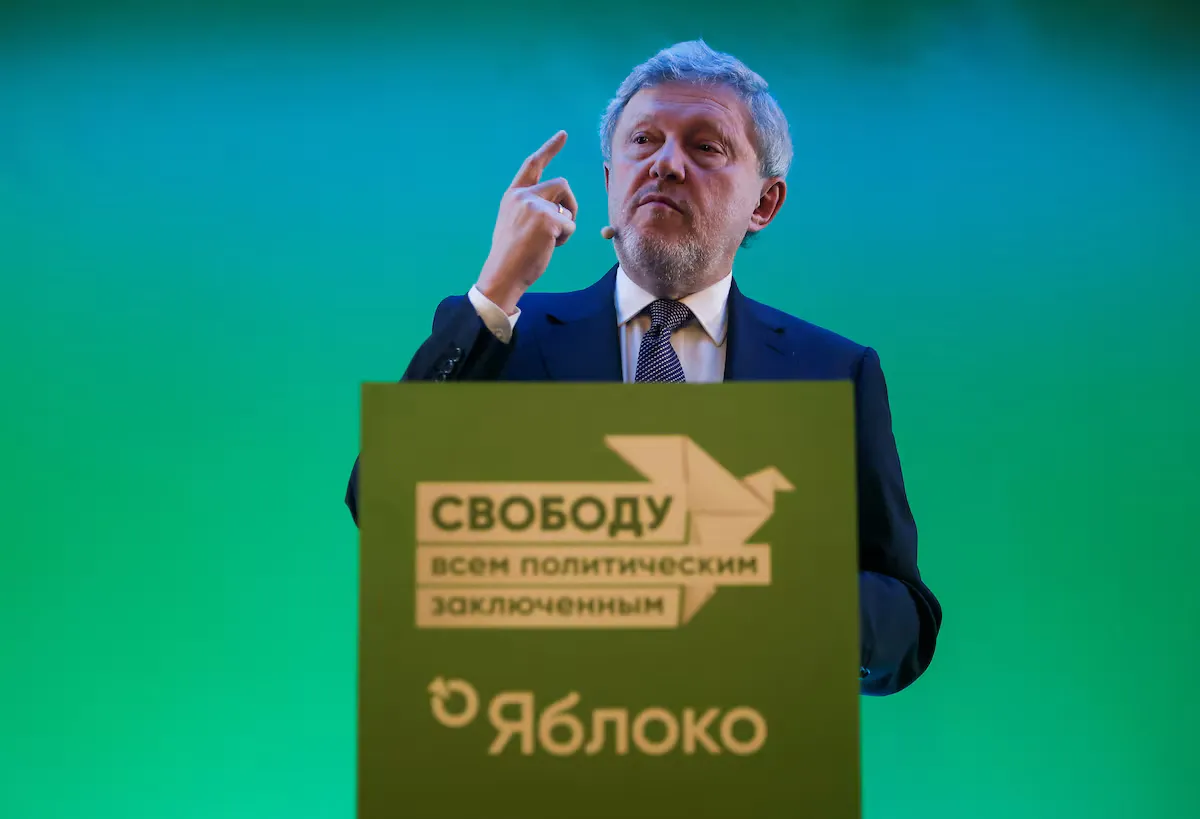
To understand the nature of this political force, it’s worth delving into recent Russian history, going back nearly four decades to 1990–93. The Yabloko Party is not a creation of the Putin era, nor is it an artificial construct cobbled together by Kremlin political strategists for any specific election. It was founded back in 1993 as an alliance of radical democrats, liberal idealists, and intellectuals who sincerely believed in the possibility of building a European-style rule-of-law state in Russia. At a time when the future Russian dictator was still serving as chief of staff to the then-mayor of St. Petersburg, Anatoly Sobchak, the founder and leader of “Yabloko,” Grigory Yavlinsky (who has now somewhat stepped back from active politics, serving more as the party’s honorary ideologue) was already proposing large-scale market-based economic reform programs to the government, lecturing at universities, and participating in high-level politics. This is an important reminder that the party’s key figure is a politician who came of age long before the Putin era began.
Yavlinsky’s figure is, in fact, the key to understanding why it is extremely difficult to classify “Yabloko” as a “pocket opposition” or a Kremlin project. He is a man who has always been criticized—from all sides and without mercy. In liberal circles, he was criticized for a tendency toward excessive academicism, for political egocentrism, for a reluctance to join broad coalitions, for being too cautious in his criticism of the authorities at certain times, and so on. Pro-government, pro-Kremlin circles, for their part, have always regarded Yavlinsky as a “liberal bought by the West” and a “foreign agent.”
Criminal cases are regularly brought against active participants, members, and activists of “Yabloko”; they are persecuted, intimidated, and sometimes even sent to prison to serve actual sentences. In various regions of the Russian Federation, local “Yabloko” activists and deputies have faced outright repression: ranging from accusations of extremism for reposting photos of Navalny to criminal prosecution for anti-war statements.
Finally, it’s worth mentioning an interesting biographical fact: Grigory Yavlinsky was born in Lviv and lived there until he was 17. He literally grew up in a Ukrainian cultural environment. Yavlinsky understands the Ukrainian language perfectly and
?t=53">speaks it fluently, and this experience of direct familiarity with Ukraine—not through propaganda clichés, but through his personal history—gives him a fundamentally different perspective than that of the vast majority of the Russian elite.All of this combined allows us to conclude that the theory that “Yabloko” is a Kremlin project seems highly unlikely. And this makes the story of their removal from the election even more revealing and instructive.
Not a Friend of Ukraine
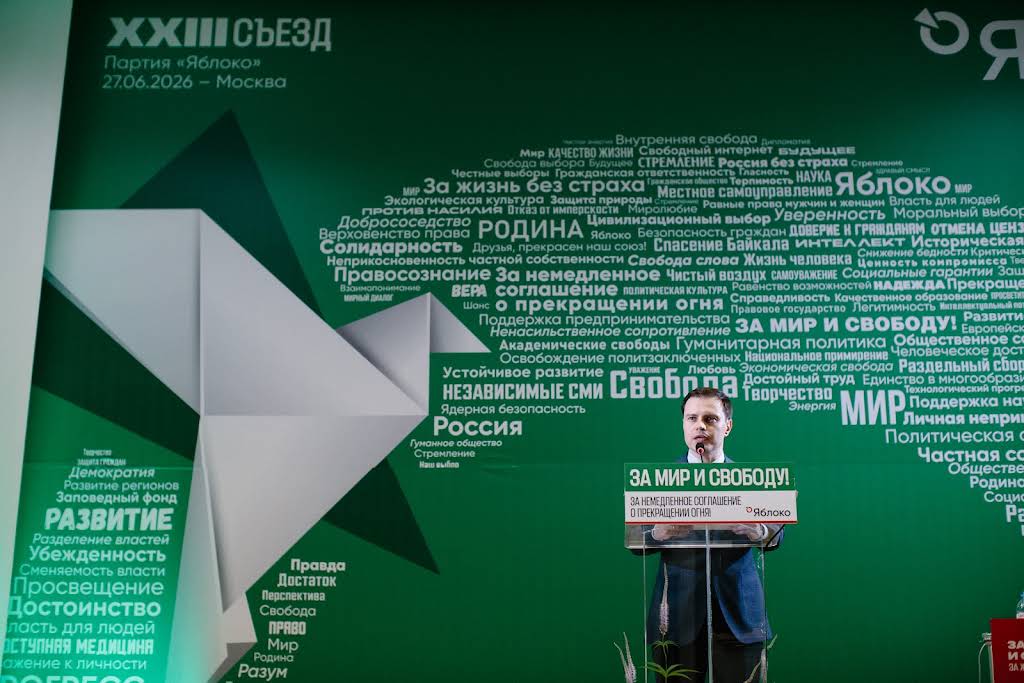
However, it is important to understand one key point: any Russian political force, no matter what slogans it puts forward, remains precisely that—a Russian political force. This means that it operates within the Russian political arena, is embedded in the Russian framework, plays by the rules established by the Russian state, and, ultimately, seeks to influence Russia within the parameters that the state sets for it.
In other words, for Ukraine, any anti-war Russians—whether individual activists or entire organizations like “Yabloko”—are nothing more than temporary allies on a limited stretch of the historical trajectory. They should not be pushed aside or demonized, since they at least dare to speak out—something for which others in Russia face actual prison terms. However, it would be politically naive to consider them friends or allies. Their struggle is an internal Russian matter; their goals are tied to shaping the future of Russia, not to restoring justice for Ukraine.

The Yabloko
Party: Genuine Pacifism or a Fiction?
Why, then, is Yabloko’s anti-war stance—despite the sincere intentions of its members—essentially a fiction in reality? Here we come up against the very nature of Putin’s regime.
“Yabloko” may indeed not be a direct Kremlin project. Neither Yavlinsky nor his colleagues, in all likelihood, receive envelopes of cash from curators at the Presidential Administration nor do they write their statements under dictation. They may be entirely sincere in their desire to end the war. But the problem is that, without exception, all Russian elections at the federal level are a meticulously staged “special electoral operation”—a special event where every actor has a clearly defined role, and any unwanted incidents are ruthlessly eliminated through administrative or coercive measures. Yes, the system may allow for a little improvisation or deviation from the script, but only within limits that do not threaten the final outcome.
And this is where the key question arises: if “Yabloko” was allowed to run, and if “suddenly” during the ballot draw they were assigned the prestigious second spot on the ballot—right after number one, which is traditionally held by “United Russia”—then this was absolutely no coincidence. It was part of the plan. And if they were subsequently removed amid a scandal, it means either the situation has changed, or the original plan was carried out and there was no longer a need for this tool.
“Yabloko” advocates for peace, and it is quite likely that it does so sincerely. But in modern Russia, people receive actual prison terms in maximum-security facilities simply for using the word “peace.” Those who call for a ceasefire are driven out of the country, forced to emigrate, stripped of their citizenship, labeled “foreign agents,” hounded, and sometimes even physically eliminated. As for “Yabloko,” even if with enormous caveats and restrictions, they are still allowed to speak this way. They were permitted to do so; it was sanctioned for them. And thus, the system had some separate, special plan for them. And this plan, clearly, did not in any way envisage the actual entry of pacifists into the Russian parliament.
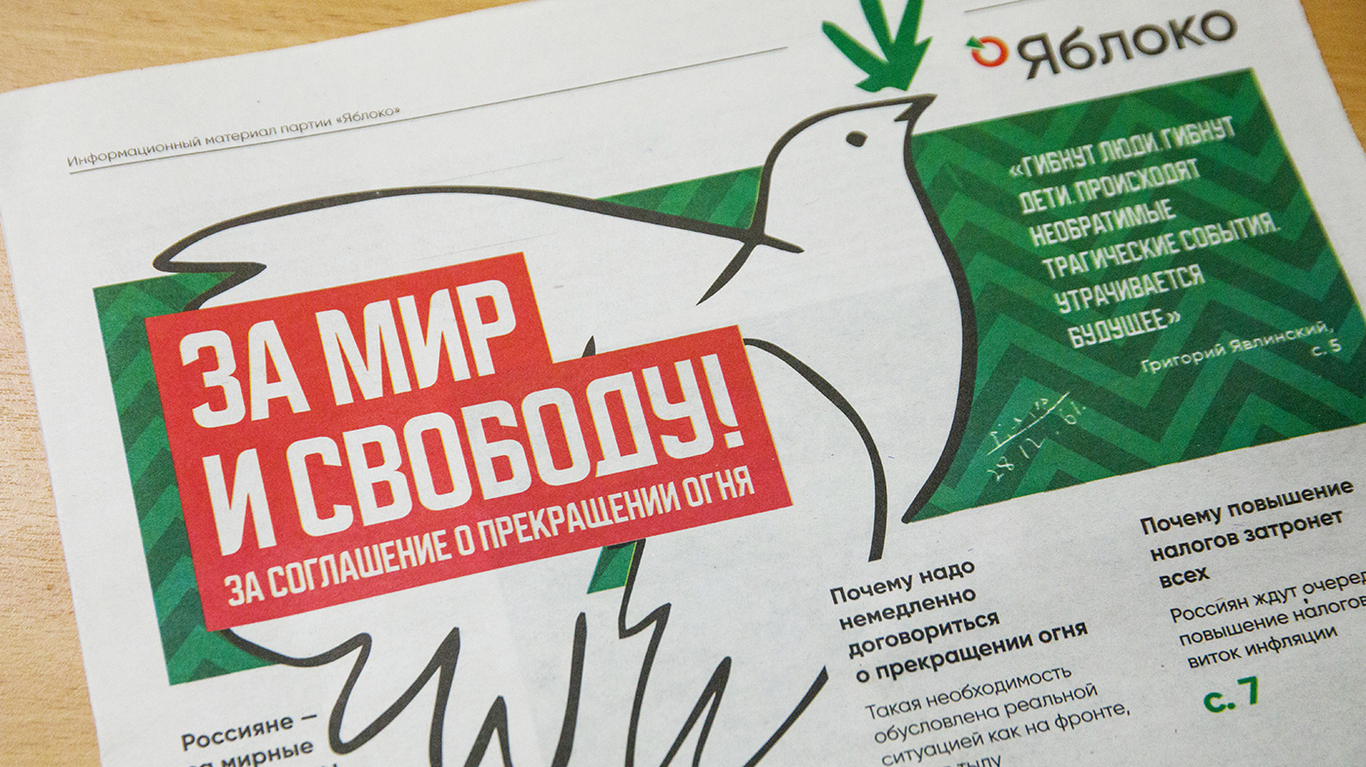
Why was “Yabloko” first allowed to participate in the elections and then disqualified?
A precise and comprehensive answer to this question remains unclear. However, based on known facts and many years of experience observing Russian politics, it is possible to reconstruct the most likely scenarios. And the main one is this: most likely, this “multi-step maneuver” was designed to bring the maximum number of Russian pacifists, opponents of the war, and supporters of peace “out into the open.”
Amid an atmosphere of total fear and repression, a significant portion of the Russian Federation’s anti-war citizens have gone into hiding. They do not attend rallies, sign open letters, or donate money to various funds, and so on. They simply remain silent, and this “silent majority” (or minority—it doesn’t really matter now) is a “gray zone” for the regime, one it seeks to eliminate.
And this is where “Yabloko” enters the scene. A party that has, ostensibly, been quite legally admitted to participate in the parliamentary elections. Everything seems legal and legitimate. For the average Russian, weary of war but frightened by repression, this looks like a window of opportunity.
“Oh, look, it turns out it’s possible! It turns out there’s a party that advocates for peace, and they’ve been allowed to run in the election. So I can join them as a volunteer. I can sign a petition in support of their candidate. I can serve as a poll watcher. I can even donate a little money—after all, it’s an officially registered party, so no one will punish me for it,”—this is likely how the target audience of this operation reasoned.
In other words, “Yabluko” was most likely used as a massive “mousetrap.” Activists, bloggers, petition signers, campaigners, volunteers, election observers, and donors—all of them began to reveal themselves, step out of anonymity, leave digital traces, register themselves in databases, and so on. The regime gained an invaluable opportunity to “mark” all these people. And once the elections are over, when there is no longer any need for this cover story, it will be possible to calmly and methodically go through this list using the punitive and repressive apparatus, rooting out the remnants of those in Russia who are not yet afraid to express their anti-war views. Under this logic, the party’s exclusion from the election is a fully expected final act—the information-gathering operation is complete.
It is
worth noting that another, less gloomy version is circulating among the Russian opposition in exile. It does not contradict the first, but rather complements it. According to this version, political strategists from the Presidential Administration did indeed initially devise some complex schemes involving “Yabloko.” But later, FSB agents approached them and declared that there was no need to play at democracy, so the anti-war political force had to be urgently removed from the election—which is exactly what happened. In principle, this also sounds plausible: when security forces—whose “subtlety” and flexibility resemble a century-old oak tree—interfere in the delicate business of political strategy, all plans usually go haywire. This may explain the haste, carelessness, and absurdity of the trial against “Yabloko.”
The fact that this party was ultimately removed from the election anyway once again lays bare the true nature of the Russian regime better than any analytical report. The disqualification of “Yabloko” is a public admission by the Kremlin that there is no such thing as legitimate politics in Russia, and that elections remain more like a “referendum on confidence” and an act of acclamation of the Russian Federation’s state policy for another five years.
At the same time, paradoxically, this situation also benefits Ukraine. First, it’s wonderful that even in 2026, there remains a fully legal party in Russia that openly advocates for peace as soon as possible, a ceasefire, a freeze on the war, and negotiations with Kyiv, and its key leader and ideologue is, in fact, a native of Lviv. Second, the emergence of this party has sparked considerable revitalization in the traditionally stagnant political landscape of the Russian Federation and generated widespread resonance on social media, confirming that: a significant portion of Russian society has a well-established demand for peace and an end to this nearly five-year-long nightmare with Putin’s “madness.” Third, it has once again become clear to everyone just how utterly artificial and superficial Russia’s “special electoral measures” are—after all, it’s quite difficult to call this farce an election.
However, we must not delude ourselves. Decisions in this war are not made by Russian voters, anti-war activists, party leaders, or even the Russian elite. Decisions are, in essence, made by one person—Vladimir Putin. In autocratic systems of the type represented by the modern Russian Federation, wars do not stop simply because some inconvenient party has garnered, say, 5 or even 15–20% of the vote in an election. Such systems never change as a result of elections. This is the very essence of autocracy: it mimics the process to legitimize power, but will never relinquish that power based on the outcome of a popular vote.
Therefore, one shouldn’t pin hopes on the idea that a powerful anti-war electoral movement will suddenly emerge within Russia, come to power, and change everything—and official Kyiv, it seems, has been pinning considerable hopes on something like that all along. This will not happen simply because it will not happen. The “Yabloko” case is more of a symptom of the disease than a cure for it. And we should observe its fate with a cool head and without any illusions that anything might change in the Russian “elections.”




