
Japanese scientists have documented an evolutionary experiment in the Fukushima area
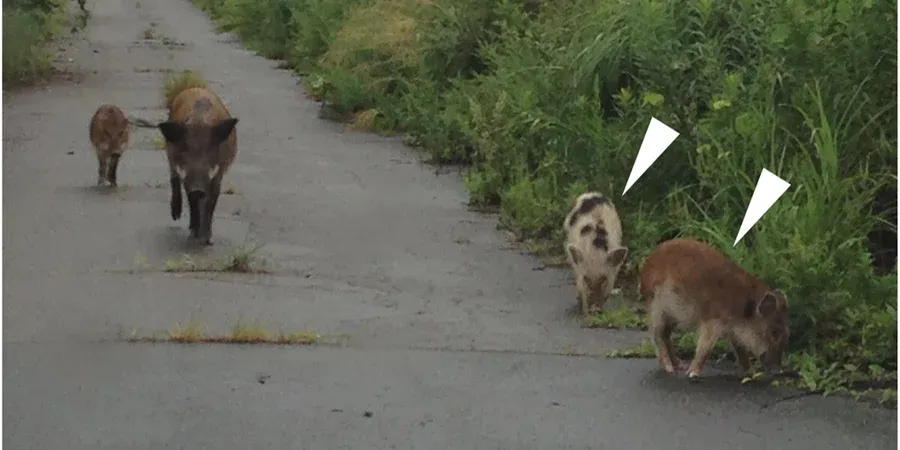
In the exclusion zone near Fukushima, scientists have observed the emergence of a hybrid population of wild boars and domestic pigs, which has inherited characteristics of both species and is rapidly spreading throughout the area. Researchers warn that such a mixed population could seriously impact the ecosystem and complicate wildlife management. This is reported by Interesting Engineering.
Following the 2011 accident at the Fukushima Daiichi Nuclear Power Plant and the mass evacuation of residents around the plant, the area was left uninhabited. It was at this point that domestic pigs, having escaped from abandoned farms, began actively interacting with wild boars, forming a new hybrid population that eventually established itself in the natural environment.
Research conducted by scientists from Fukushima University and Hirosaki University showed that these animals do not simply interbreed but pass on an important biological trait of domestic pigs to their offspring—the ability to reproduce year-round, which gives them a significant advantage over wild boars. “We hypothesized that a unique trait of domestic pigs—namely, a rapid, year-round reproductive cycle—might be key,” explained study co-author Dr. Donovan Anderson of Hirosaki University.

For the analysis, the scientists examined the DNA of 191 wild boars and 10 domestic pigs, and the results showed that despite a gradual decrease in the proportion of “domestic” genes in new generations, the key ability to reproduce rapidly persists and continues to influence population dynamics. “Although it was previously assumed that hybridization between feral pigs and wild boars could contribute to population growth, this study demonstrates that the rapid reproductive cycle of domestic pigs is inherited through the maternal line,” noted Shingo Kaneko, a professor at Fukushima University.
The researchers emphasize that this situation poses new challenges for wildlife management, as invasive and hybrid species can alter natural ecosystems, displace other species, and cause damage to agriculture, particularly by destroying crops.
The study’s findings were published in the Journal of Forest Research and have already sparked debate among ecologists regarding the long-term consequences of such biological changes in exclusion zones.
Authorities and farmers in Japan have begun actively using special wolf robots to scare away wild bears in order to protect the population from aggressive predators.
YouTube is expanding access to its AI-powered deepfake detection tool
An overclocker set a world record by overclocking an Intel processor to 9.2 GHz


