
Indris in Madagascar open their mouths wider for high notes — Daily Maverick
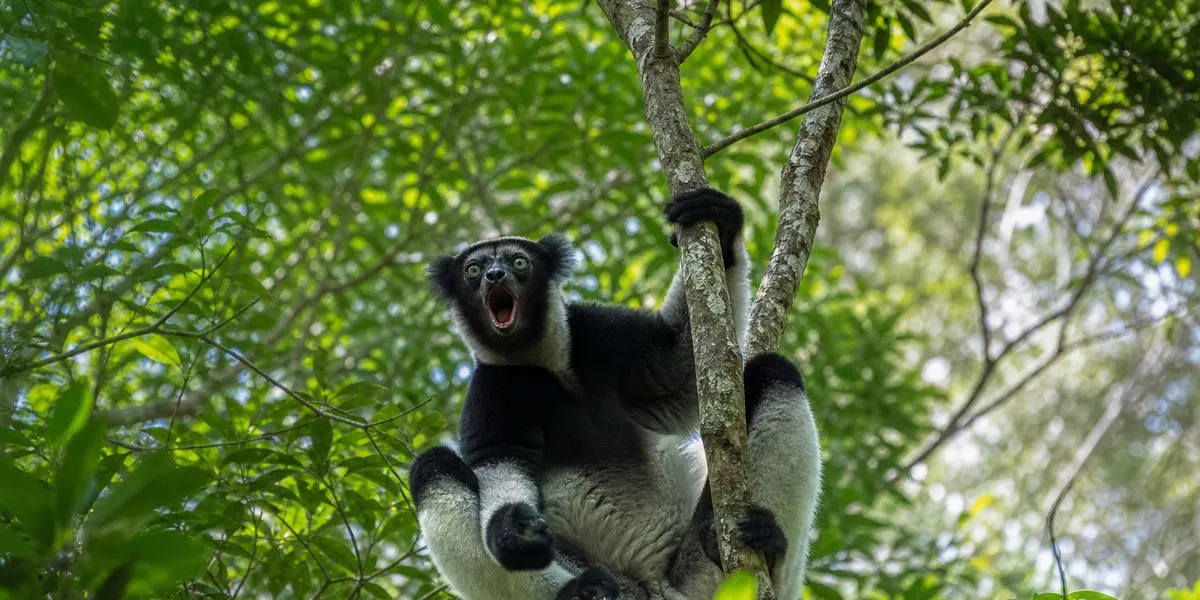
Researchers have found that indris in Madagascar open their mouths wider when they reach higher notes. This change in the shape of the mouth and throat may amplify the voice and help sound travel farther through dense forest, Daily Maverick reports.
Analysis of indri singing
The authors of the study, published in the journal PLOS Computational Biology, analyzed 83 videos of 19 wild indris from the Maromizaha forest and the Mitsinjo reserve in Madagascar. They tracked features of the animals’ faces in every frame and compared these data with synchronized audio recordings.
The analysis showed a consistent link between the degree of mouth opening and pitch. The study’s lead author, Filippo Carugati of the University of Turin, explained that changing the shape of the mouth and throat affects the frequencies that naturally resonate in the vocal tract. This mechanism is consistent with the phenomenon of formant tuning, used in particular by trained opera singers.
More current news is available on the UA.News Telegram channel Telegram.
Signals in the dense forest
Singing is important for indri family groups, as dense vegetation makes visual contact difficult even at a distance of several meters. The main function of vocalizations is to mark territory: the animals signal their presence to other groups. When groups can directly see one another, their territorial songs usually become longer.
Indris may also sing to find members of their group again after becoming separated in the forest. In such cases, they use slower songs with longer pauses. Similar mechanisms of changing the vocal tract to carry sound over greater distances have previously been described in singing gibbons, gray wolves, and grasshopper mice.
Indris are the only lemurs known to sing. According to the Lemur Conservation Network, they are the largest living lemur species, and their population is declining because of forest clearing and fragmentation. Study co-author Chiara De Gregorio noted that indris are difficult to keep and breed in captivity, so their survival depends on protection in their natural habitat.


