
Iran and the U.S. are nearing the final stage of negotiations — Reuters
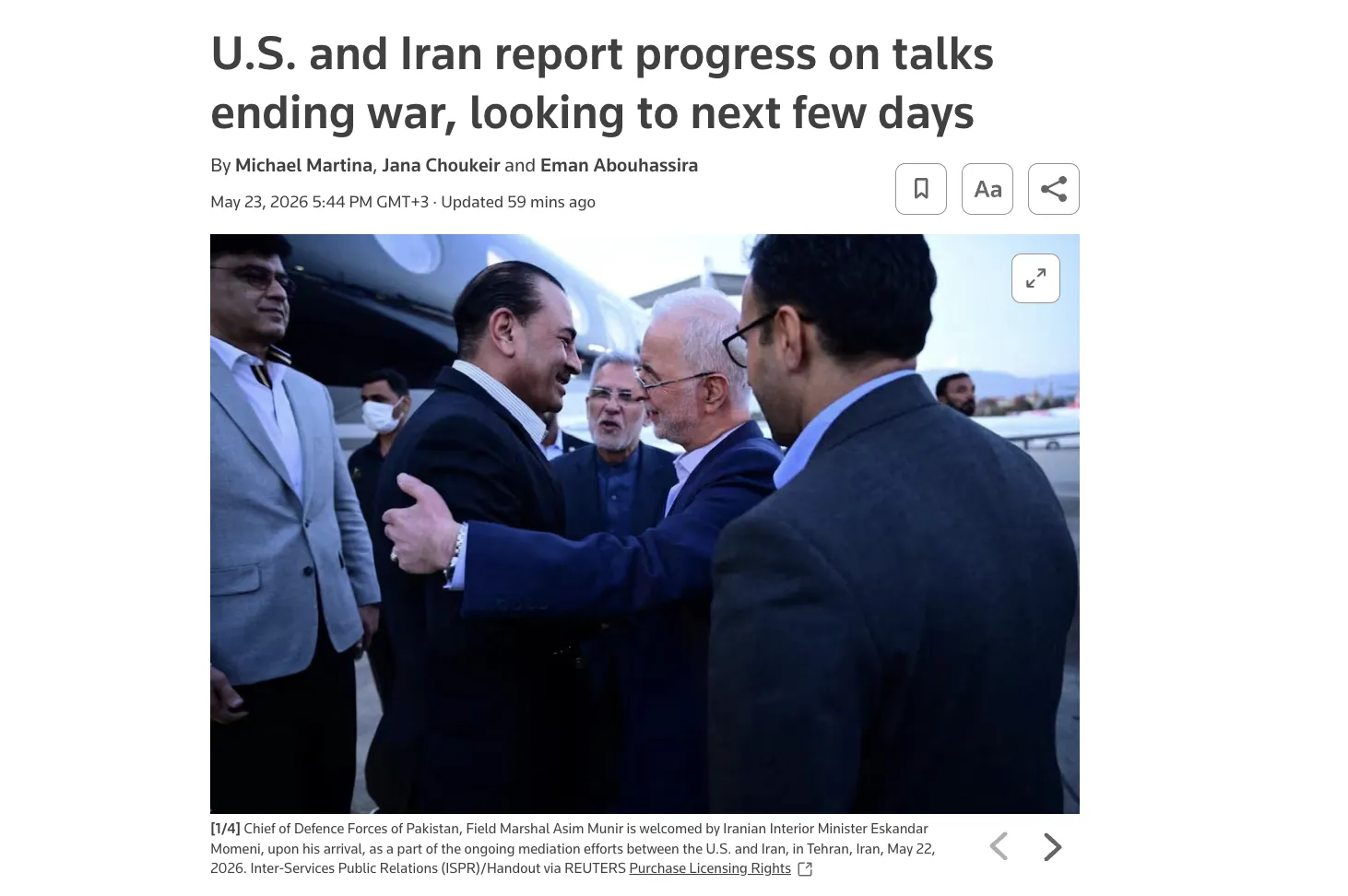
Iran and the United States are in the final stages of negotiations regarding a possible end to the conflict. A framework agreement could be reached in the coming days, which would serve as the basis for a subsequent final agreement that could potentially be reached within two months.
This is reported by The Times of Israel and Reuters.
U.S. Secretary of State Marco Rubio stated that there is a possibility that Iran will agree to a deal to end the war as early as today or in the coming days. This refers to a memorandum of understanding.
“There is a possibility that today, tomorrow, or in a couple of days, we will have something to say. Some progress has been made, and work is underway. Even as I speak to you now, the work continues,” Rubio told reporters, adding that he hopes for “good news.”
He also reiterated that the U.S. is demanding that Iran fully open the Strait of Hormuz and that Tehran hand over its highly enriched uranium.
“U.S. President Donald Trump prefers to resolve such issues through negotiations and diplomatic talks. That is exactly what we are working on right now. But this issue will be resolved, as the president has made clear, one way or another. We hope it will be done through diplomatic channels,” the secretary of state added.
Following the conclusion of Pakistani Army Chief of Staff Asim Munir’s visit to Tehran aimed at bridging the differences between the U.S. and Iran, Iranian Foreign Ministry spokesman Esmail Baghai stated that Iran is in the final stages of drafting a framework agreement to end the war.
“Within a reasonable period of 30 to 60 days, the details of these points will be discussed, and ultimately a final agreement will be concluded. We are currently in the process of finalizing these memorandums of understanding,” he told the state-run IRIB television channel.
According to him, the parties initially intended to draft a 14-point framework agreement (memorandum of understanding).
Based on the official’s remarks, there is currently a trend toward convergence, but this convergence does not mean that the parties will reach a mutual understanding on key issues. Here, “the goal is to reach an agreement acceptable to both sides, based on a number of elements.”
Meanwhile, Al Hadath cites another statement by Ismail Baghai, according to which the nuclear issue will not be part of the agreement proposed by the U.S. He asserts that the issue of the war will be resolved first.
“At this stage, we will not discuss the details of the nuclear issue. We have decided to give priority to the issue that is most urgent for us: ending the war on all fronts, including Lebanon,” he emphasized.
According to him, Iran wants the nuclear issue and certain other matters to be discussed later, within the aforementioned 30–60 days.
Earlier, Iranian Foreign Minister Abbas Arakchi, during a conversation with UN Secretary-General António Guterres, stated that the United States is putting pressure on Tehran within the framework of the negotiation process. According to The Times of Israel, the Iranian diplomat criticized the American side for “unreasonable demands” and an approach that Tehran described as an attempt to impose its own terms.
Earlier, Iran announced a new “control” zone in the Persian Gulf, which, according to its version, partially covers the waters of the United Arab Emirates. Abu Dhabi sharply rejected these claims, calling them unrealistic and provocative. Against this backdrop, tensions in the region have noticeably risen again.
Trump is willing to wait a few more days for Iran to provide the right answer.


