
Chinese police are testing smart glasses with facial recognition — China Daily
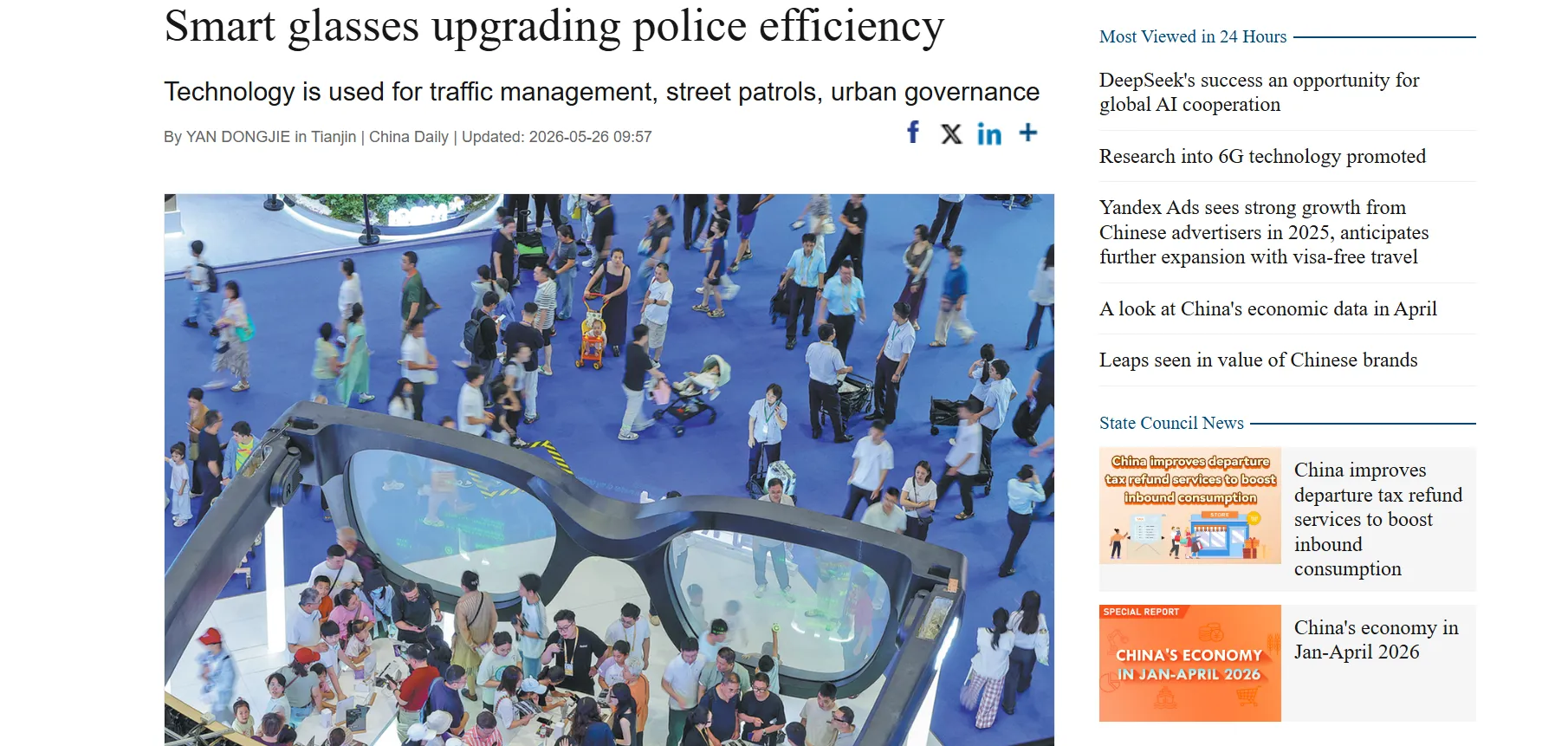
China's patrol police have begun large-scale field testing of the country's first domestically produced smart glasses, equipped with micro-cameras and facial recognition systems.
This was reported by China Daily.
The latest device allows law enforcement officers to instantly identify individuals, vehicles, and road objects while on duty.
The new smart glasses are the first specialized optical device for law enforcement agencies to be entirely independently developed and manufactured by China’s public security system.
All software and hardware are domestically produced.
“These glasses make our patrols and inspections much more effective, helping us proactively identify and respond to emergencies,” said Zhao Baoxin, a police officer with the Heping District Police in Tianjin.
According to Sun Yinhua, a specialist with the Tianjin Public Security Bureau’s Mobile Police Unit, the accuracy of the glasses’ automatic object recognition exceeds 95%.
Moreover, thanks to the integration of optical character recognition (OCR) technology and large artificial intelligence models, the device is capable of processing data and delivering verification results in a matter of milliseconds—faster than a person can blink.
The device weighs only 40 grams, making it even lighter than standard sunglasses.
Unlike traditional body cameras, smart glasses provide a clear first-person perspective—the video feed does not shift when the officer bends over or turns their head.
The second-generation model features an optimized battery that lasts 2–3 times longer than the previous version and provides 1.5–2 hours of continuous operation, which is more than enough for a standard patrol shift.
The glasses’ temples are equipped with special sensors: the device automatically turns on when the officer puts it on and instantly switches to standby mode when removed.
The device is fully connected to a cloud platform, recognizes voice commands, and supports voice control.
Since the level of violent crime in the country is extremely low, the glasses are used primarily to provide civilian assistance to residents and optimize traffic.
Officer Zhao Baoxin recalls a real-life incident where, while patrolling an intersection, they encountered an elderly man who was disoriented and unable to provide his name or address.
Thanks to smart glasses, the police instantly identified the man, obtained his family’s contact information, and safely escorted him home within 20 minutes.
Another successful example is the resolution of a chronic traffic congestion problem near Middle School No. 21 in Tianjin during the morning drop-off.
Parents of students register their cars in a special government app, linking their license plates to the Ministry of Public Security’s system.
Police officers wearing smart glasses at the school entrance instantly scan “authorized” license plates and promptly direct drivers to make a brief stop and leave quickly, significantly reducing traffic congestion.
The drive to digitize law enforcement agencies is officially supported at the state level by the Chinese government.
According to a 2026 analytical report by Zhiyan Consulting, the Chinese market for public security IT systems has shown rapid growth: while in 2015 its volume was 10.8 billion yuan ($1.59 billion), by the end of 2025 this figure reached 25.5 billion yuan (an average annual growth rate of 8.96%).
Currently, AI glasses, drones, and robotics are being actively scaled up across various provinces.
For example, in Zhejiang, the use of smart glasses by traffic police has increased the efficiency of vehicle inspections on the roads by 300%. In Haikou, the entire process—from scanning an object with the glasses to displaying an alert on the screen—takes less than 30 seconds.
In Chengdu, smart glasses have been integrated into a unified three-dimensional surveillance ecosystem alongside humanoid robots and robotic dogs.
In Guangdong Province, expanding the practical use of AI glasses has been included in the 2026 public safety strategic plan.
At the UN, China accused the US of undermining the international system
China sent an astronaut to the space station for a year


