
The Polish city of Sopot has passed a resolution in support of Ukrainians and against xenophobia
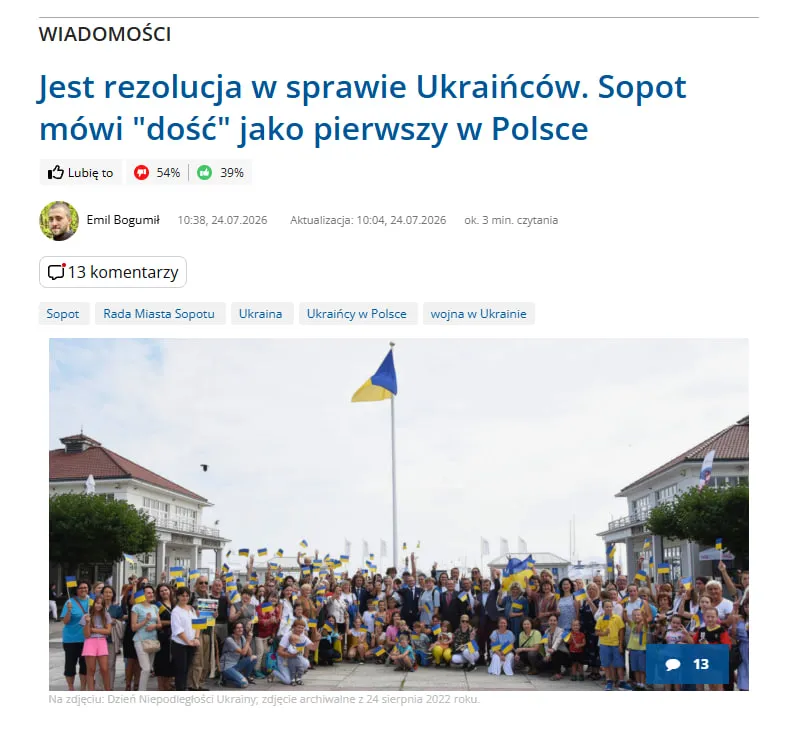
The City Council of Sopot, Poland, adopted a resolution expressing concern over the rise of anti-Ukrainian sentiment and hate speech. Council members called on the national government to counter disinformation and xenophobic narratives.
The document was adopted on July 23. It notes that following the start of Russia’s full-scale invasion of Ukraine, the residents of Sopot actively supported Ukrainians who were forced to leave their homes due to the war.
At the same time, the city council emphasized that incidents of hostility toward Ukrainians have recently become more frequent in Poland, which, according to the council members, are largely linked to the spread of disinformation online and in the media.
The resolution also specifically addressed the situation in Sopot’s schools. According to the city council, Ukrainian children make up about 17% of all students. Council members emphasized that children should be able to study in a safe environment free from discrimination and hatred.
In the document, the city council called on the Polish government to launch a nationwide information campaign highlighting the contribution of Ukrainians to the country’s economy, particularly regarding their participation in the labor market and tax payments.
Sopot also called on the authorities to resolutely counter xenophobic and nationalist sentiments, which, according to the council members, could be exploited by external forces to destabilize Poland.
“We note with concern that, for the sake of short-term political gains, some politicians are harming Polish-Ukrainian relations, which runs counter to Poland’s national interests,” the resolution states.
The city council also called for Poland’s and Ukraine’s complex historical past not to be used to incite hatred between the two nations. The council members emphasized that historical memory should promote reconciliation and strengthen cooperation between the two countries.
The Sopot City Council stated that the city will remain open and safe for all residents, regardless of their origin, nationality, or language.
This was reported by the local publication Esopot.
As a reminder, the Consulate General of Ukraine in Kraków announced the launch of a free online guide for Ukrainians residing in Poland. The resource is designed to help users navigate local legislation and resolve crisis or conflict situations.
In Legnica, Poland, a 26-year-old woman was detained on suspicion of assaulting two 13-year-old Ukrainian girls and a boy near a swimming pool. According to the investigation, the conflict arose after the children spoke in Ukrainian.
In Poznań, Polish law enforcement officers detained two people suspected of brutally beating a man. The victim had come to the defense of a Ukrainian citizen.


