
Russia has increased its maritime oil exports amid a decline in attacks on ports
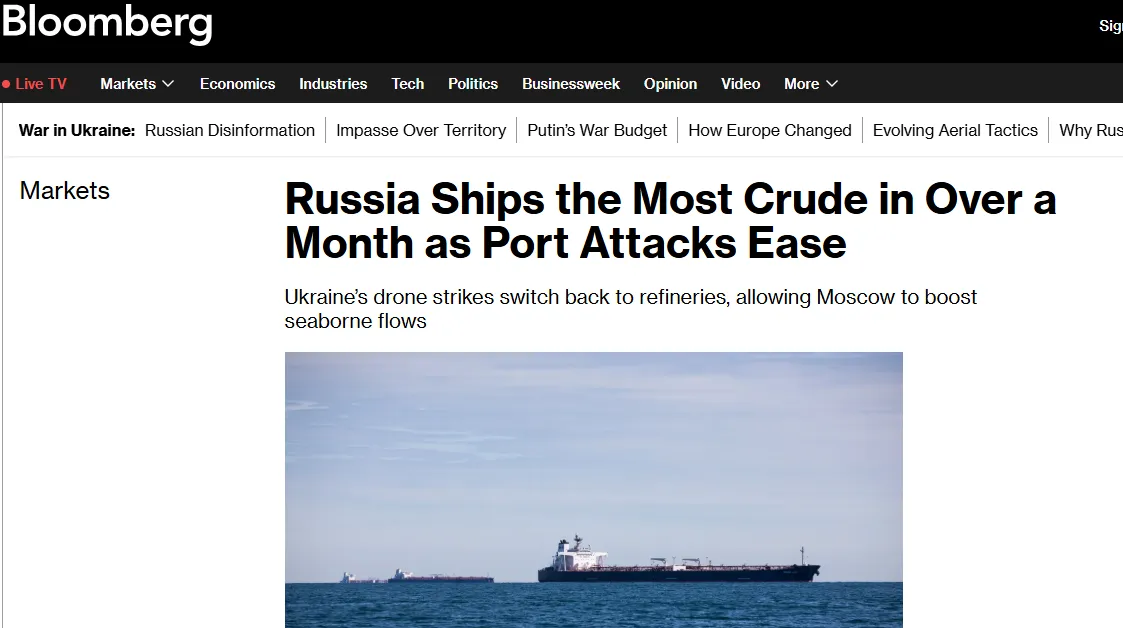
Russia has increased its seaborne oil shipments to their highest level in the past month. According to Bloomberg, this is due to the fact that the impact of previous strikes by Ukrainian drones on export infrastructure has gradually diminished.
Bloomberg reports this.
As noted, drone attacks on Russia’s energy infrastructure are contributing to the fact that the inability to process large volumes of oil at damaged refineries frees up more oil for export. Previously, drone attacks targeting export hubs in Primorsk and Ust-Luga on the Baltic Sea and in Novorossiysk on the Black Sea dealt a serious blow to cargo shipments and led to a sharp drop in supply volumes.
Currently, according to Bloomberg data based on tanker traffic information, in the four weeks leading up to April 26, oil shipments from Russian ports rose to 3.52 million barrels per day, the highest level in just over a month. At the same time, supply volumes over the past week rose to 3.79 million barrels per day, a new high since March 22.
This surge in shipments has increased the amount of Russian oil at sea; most of this oil is now in transit rather than on idle vessels. In particular, much of Russia’s oil has increasingly been heading to India in recent weeks: at least 10 shipments of ESPO crude loaded in the Pacific region in April are bound for India, three more than in February, before the war in Iran began. These voyages take an average of about three weeks, compared to four days to China.
As a result, the volume of Russian oil at sea rose to about 114 million barrels on Sunday, compared with about 100 million barrels two weeks earlier, but the volume on vessels that have been stationary for more than a week fell below 5 million barrels.
Additionally, pipeline flows of Russian oil to Hungary via Ukraine resumed last week after a Russian drone strike on a pumping station in western Ukraine halted them in late January. This could reduce the volume of oil available for maritime export by approximately 150,000–200,000 barrels per day, based on previous shipments.
For the first time in eight weeks, prices for Russia’s key Urals crude fell amid expectations that the conflict in the Middle East would end. According to this indicator, the export price of Russian oil from the Baltic Sea fell by approximately $0.10 to $98.41 per barrel, while the price of this oil from Black Sea ports stood at $96.67. The price of ESPO crude from the Pacific region fell by $0.90 to an average of $91.97 per barrel. Prices for delivery to India also fell by $0.50 to $129.47 per barrel.
Oil prices have surged amid geopolitical tensions.
As a reminder, U.S. President Donald Trump confirmed that the Strait of Hormuz will remain blocked to Iranian exports until a comprehensive peace agreement is reached.
Ukraine is ready to deploy at least two mine-sweeping ships to the international operation to clear the Strait of Hormuz of mines.
The Times reported that Ukraine could send all four of its mine-sweeping ships, which are based in Britain, to the Strait of Hormuz.
