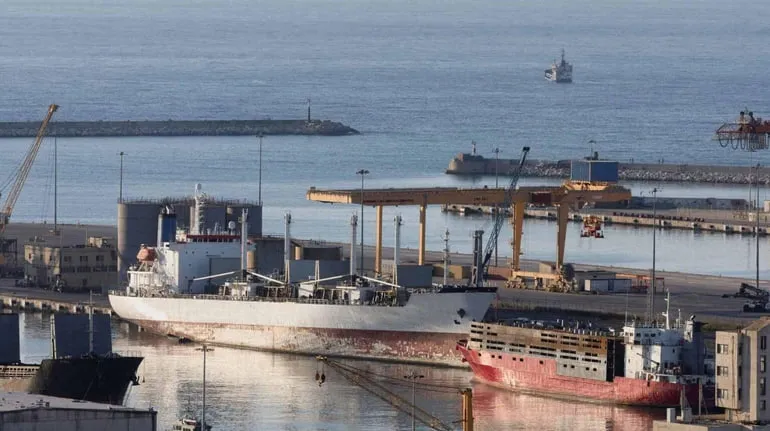
Russia is establishing a commercial logistics center in the Syrian port of Tartus in an effort to strengthen its economic influence in the region. According to available information, the new hub is planned to be used not only to develop trade routes but also to transship grain exported from the temporarily occupied territories of Ukraine.
In this way, the Kremlin seeks to expand its presence in Syria through economic means and establish new logistics chains for exporting goods. Specifically, this involves grain of Ukrainian origin, which Russia is illegally exporting from the occupied territories.
Moscow expects to launch a trade hub in the Syrian port of Tartus as early as mid-July. It will be located at one of the two piers of the naval base that Russia leases in Tartus, while the Russian military presence will remain fully intact at the other pier.
Grain and other goods will be transshipped there, with cargo turnover amounting to about 250,000 metric tons per month.
This economic project has become a central element of Moscow’s strategy to maintain its positions in the region following the 2024 ouster of former President Bashar al-Assad, whose downfall cost Russia its most loyal ally in the Middle East, according to the Middle-east-online website.
Moscow had supported Syria for decades and, in 2015, directly intervened in the conflict to save the Assad regime during the 14-year civil war.
His downfall immediately called into question the future of the lease agreements under which Russia operates a naval base in Tartus and an airbase in Hmeimim, located southeast of Latakia.
Syria’s new government in Damascus is now seeking closer ties with Western countries and Gulf states, but continues to cooperate with Moscow on food and energy imports, as well as in the military sphere. The parties are currently negotiating the future of Russian military facilities, according to Middle-east-online.
In 2025, Syria’s new authorities terminated a 49-year-old contract that granted the Russian company Stroytransgaz the right to develop commercial projects in Tartus. In its place, DP World, a company from the United Arab Emirates, signed a 30-year concession agreement worth $800 million to reconstruct and operate the port.
The Russian Federation’s new project at the port of Tartus is being implemented by the logistics company Rus Line; the project’s organizers have already reached an agreement with the Syrian Sovereign Fund on the joint management of the center.
“This trade hub is intended to further strengthen Moscow’s economic leverage. According to customs documents, about 85 percent of all wheat imported into Syria—2.9 million metric tons in the 2025–2026 season—comes from Russia and occupied Crimea,” writes Guild Hall.
Syria’s dependence on Russian oil has also risen sharply since Assad’s fall: in 2025, the country purchased 16.8 million barrels, and in the first months of 2026, it imported about 60,000 barrels per day, the media outlet adds.