
Trump has made personnel changes within the Republican Party — Reuters
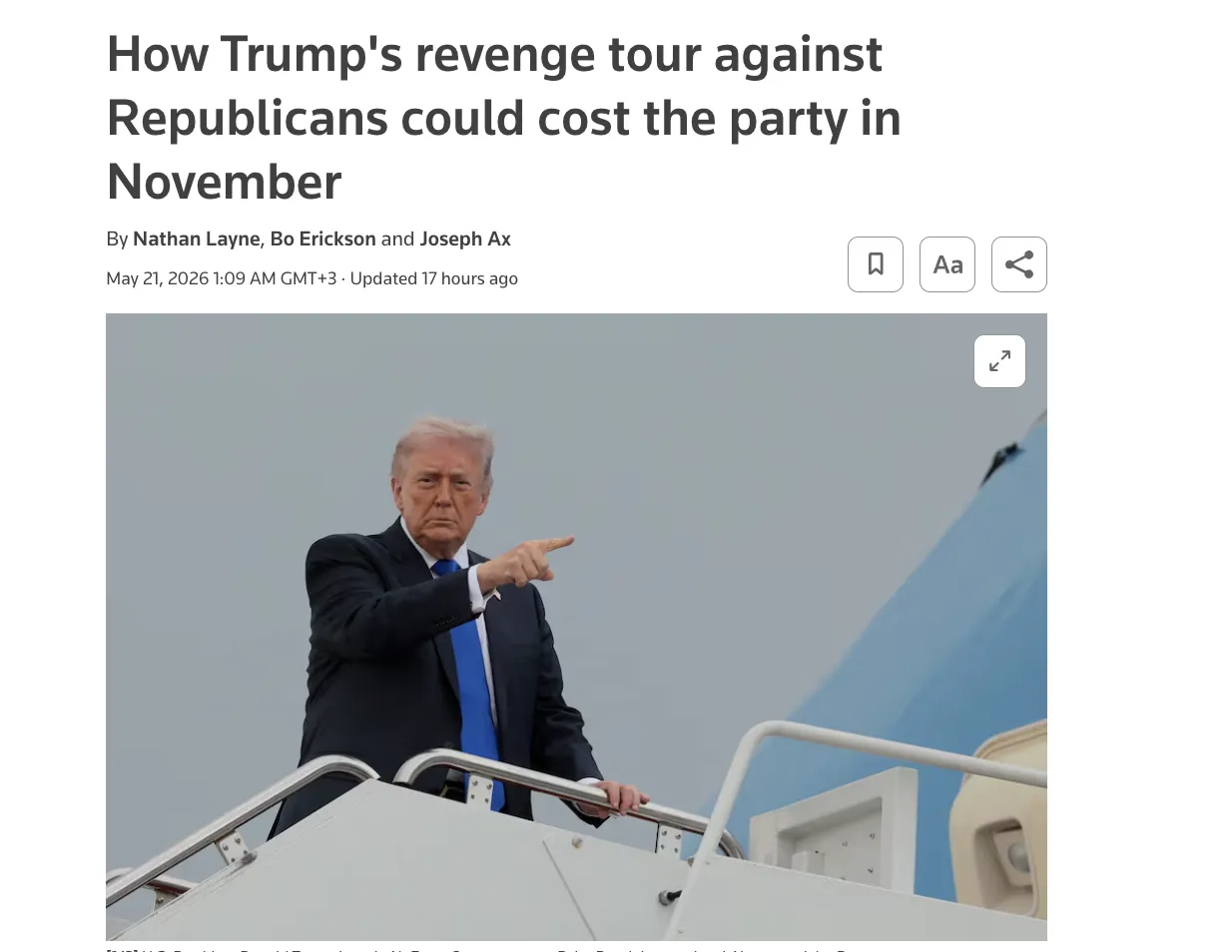
Over the past two weeks, U.S. President Donald Trump has ousted a number of Republicans who, according to Reuters, had not shown sufficient loyalty. Analysts suggest that such actions may strengthen the party’s internal cohesion around the president, but at the same time could undermine its position in the upcoming midterm elections and affect its chances of retaining control of Congress.
On May 19, a staunch Trump supporter, personally handpicked by the president, defeated Representative Thomas Massie—who had frequently criticized the president—in the Kentucky primary. Prior to this, Republican Senator Bill Cassidy, who voted to convict Trump during the 2021 impeachment trial, trailed significantly behind the candidate backed by the U.S. president. And on May 5, five Indiana state senators who opposed Trump’s demand to redraw the state’s electoral district boundaries lost to candidates backed by the president.
According to Reuters, Trump has reached a peak of unpopularity among the American electorate, but his influence over his core MAGA voter base remains unchanged. Against the backdrop of the war in Iran, which has led to rising energy prices, Trump’s approval rating has dropped to 35%, according to a recent Reuters/Ipsos poll.
According to some Republican strategists, Trump’s purge of dissenters within the Republican Party could undermine the party’s chances of retaining control of Congress after the midterm elections.
“Trump’s actions are most likely aimed at mobilizing his most loyal supporters, rather than attracting independent or moderate Republican voters, who are likely to play a decisive role in the outcome of this extremely tense election. And Republican candidates in this election may feel pressure to align even more closely with Trump to avoid another outburst of his anger—even if it costs them votes from voters outside the MAGA movement’s base,” the agency notes.
As Reuters reports, Trump’s refusal to tolerate any disloyalty could make it harder for Republicans holding vulnerable seats in Congress to oppose him on politically contentious issues. Rachel Bloom, a political science professor at the University of Oklahoma, explained that the ruling party has traditionally allowed members of Congress to diverge from its views ahead of midterm elections, especially when the president is unpopular. However, Republicans do not have that freedom now.
At the same time, a person familiar with the Republicans’ strategy told Reuters that Trump mostly attacks Republicans in safe districts, while some party members in competitive districts are allowed to demonstrate bipartisanship or even disagree with the president on certain issues.
On Friday, May 22, Trump will hold a campaign rally alongside Representative Mike Lawler, whose district in New York is considered one of the Democrats’ most promising opportunities for victory. Lawler has at times disagreed with Trump, notably supporting Democrats on a bill protecting Haitian immigrants from deportation.
However, the president has also shown a willingness to attack Republicans in more competitive districts. For example, he publicly criticized Representative Brian Fitzpatrick, a Republican from Pennsylvania whom Democrats have targeted in the midterm elections and who is one of three Republicans in the House who voted to end the war with Iran. Trump told reporters that he doesn’t know “what’s wrong with him.”
As a reminder, Cuba has restored its power grid following a massive blackout.
Trump also confirmed the U.S. intention to intervene in Cuba.


