$ 44.49 € 50.84 zł 11.83
+19° Kyiv +18° Warsaw +27° Washington

A rare copy of the U.S. Declaration of Independence has been found in Britain

UA.NEWS 07 July 2026 17:52
A rare copy of the U.S. Declaration of Independence has been found in Britain

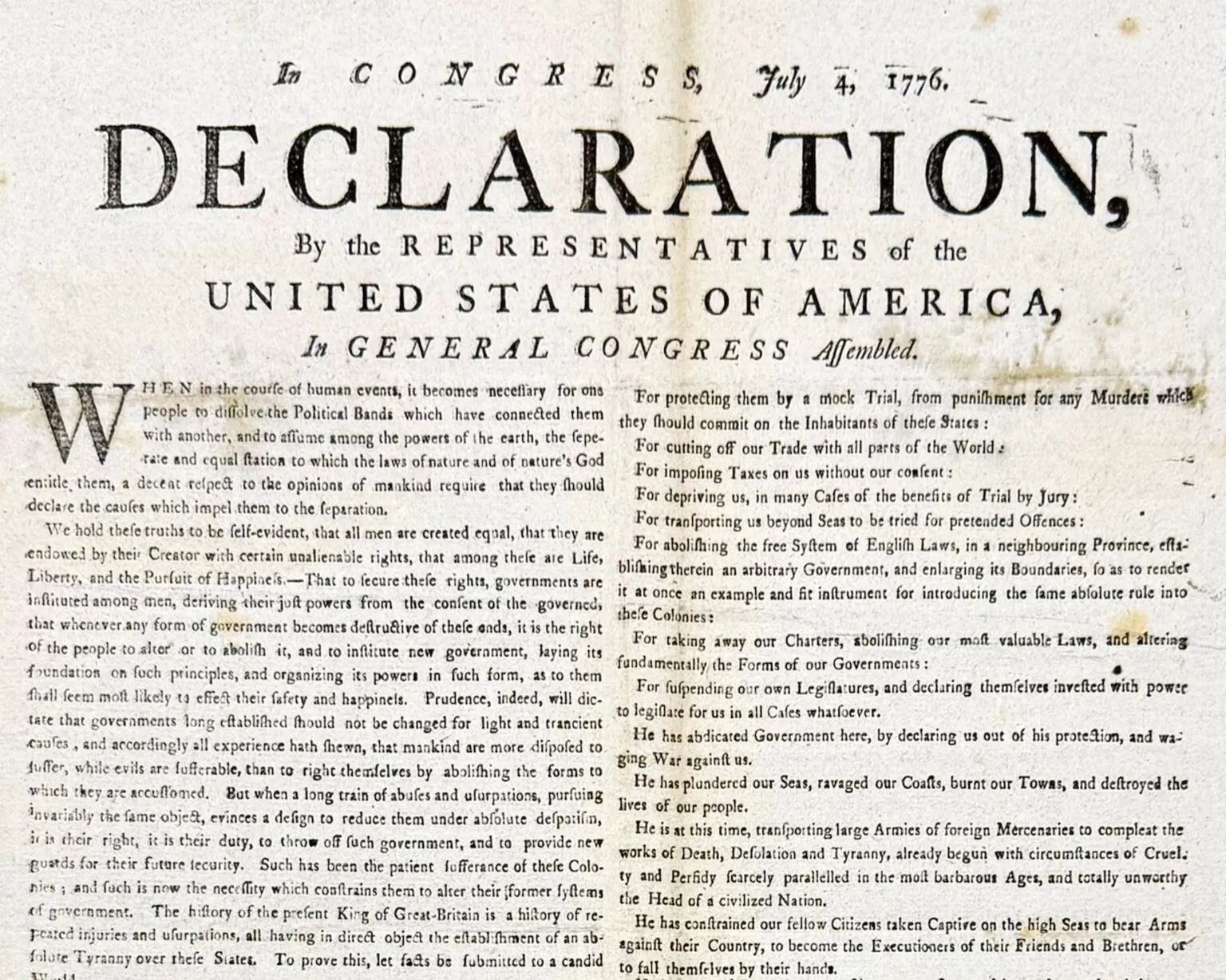
One of the 11 known copies of an early print of the U.S. Declaration of Independence was discovered by chance in the National Archives of the United Kingdom. The document had been sitting among the Royal Navy’s archives for over two centuries, and no one had paid any attention to it.


The unique discovery was made in late May while working through archival documents that had not previously been cataloged in detail. Michael Scarr, an employee of the National Archives of the United Kingdom, was reviewing a volume of 18th-century Royal Navy correspondence when he came across some familiar words.

The first page of the document read: “In Congress. July 4, 1776. Declaration of the Representatives of the United States of America…” The historian immediately realized he was looking at something special and called over a colleague. “I think you should come take a look at this,” he told his supervisor.

After a detailed examination, it became clear that this was a so-called Exeter print of the U.S. Declaration of Independence. Only 11 such copies have survived to this day. The discovered document is the only known copy currently located outside the United States.

Graham Moore, a specialist at the National Archives, noted that the value of the find lies not only in the document itself but also in its remarkable history. According to him, this copy helps us better understand how news of the U.S. Declaration of Independence spread around the world in the summer of 1776. The document was found among the papers of the American privateer Dalton, which a British warship captured off the coast of Spain in December 1776.

After the capture, some of the important documents were handed over to the Admiralty Court. Among them was a privateer’s license signed by John Hancock, President of the Continental Congress. It was this document that authorized the crew to attack British ships on behalf of the newly formed United States. However, a copy of the Declaration of Independence never made it to the court. It was merely briefly mentioned in the inventory as “another document,” after which it remained in the naval archives for more than 200 years.

Historians have determined that this sheet was printed in Exeter, New Hampshire, between July 16 and 19, 1776—just a few days after the Declaration of Independence was adopted in Philadelphia. Graham Moore explains that such printed copies were produced as quickly as possible so that people would learn about the historic event as soon as possible. “They were printed as quickly as possible, distributed promptly, and intended to be read by as many people as possible in the shortest amount of time. This was the news of 1776,” he said.

Researchers believe that the captain of the Dalton, Eliezer Johnson, purchased this copy in Portsmouth, where the ship had stopped briefly to recruit crew members. Johnson himself openly supported U.S. independence.

After the British seized the ship, the captain declared in a Plymouth court that he was a citizen of the United States of America. At that time, British authorities regarded such a statement as treason. Historians have also been able to partially reconstruct the fate of the crew thanks to other archival documents and the diary of one of the sailors—Charles Herbert. There were 120 sailors of various nationalities aboard the Dalton—English, Scottish, Irish, French, Danish, and American. Among them was Daniel Kottle, a free Black sailor.

After capturing the ship, the British transferred Kottle and other crew members to a guard ship and later transported them to England. There, they were imprisoned in Plymouth. According to historians, this chance discovery not only added to the list of the most valuable historical documents of the 18th century but will also help us better understand how news of the birth of a new nation spread and how one of the most important documents in American history ended up in a British archive, where it lay unnoticed for over two centuries. This was reported by The Guardian.

The British government is launching one of the most ambitious defense reforms in recent decades, drawing on Ukraine’s military experience

The British Ministry of Defense has decided to phase out the AH1 Wildcat multi-role helicopters. Their decommissioning from the Army Aviation is scheduled to begin in 2027, after approximately 12 years of service.


Read us on Telegram and Sends

Download our app