
The EU has identified the timeline for a potential Russian strike against NATO — Politico
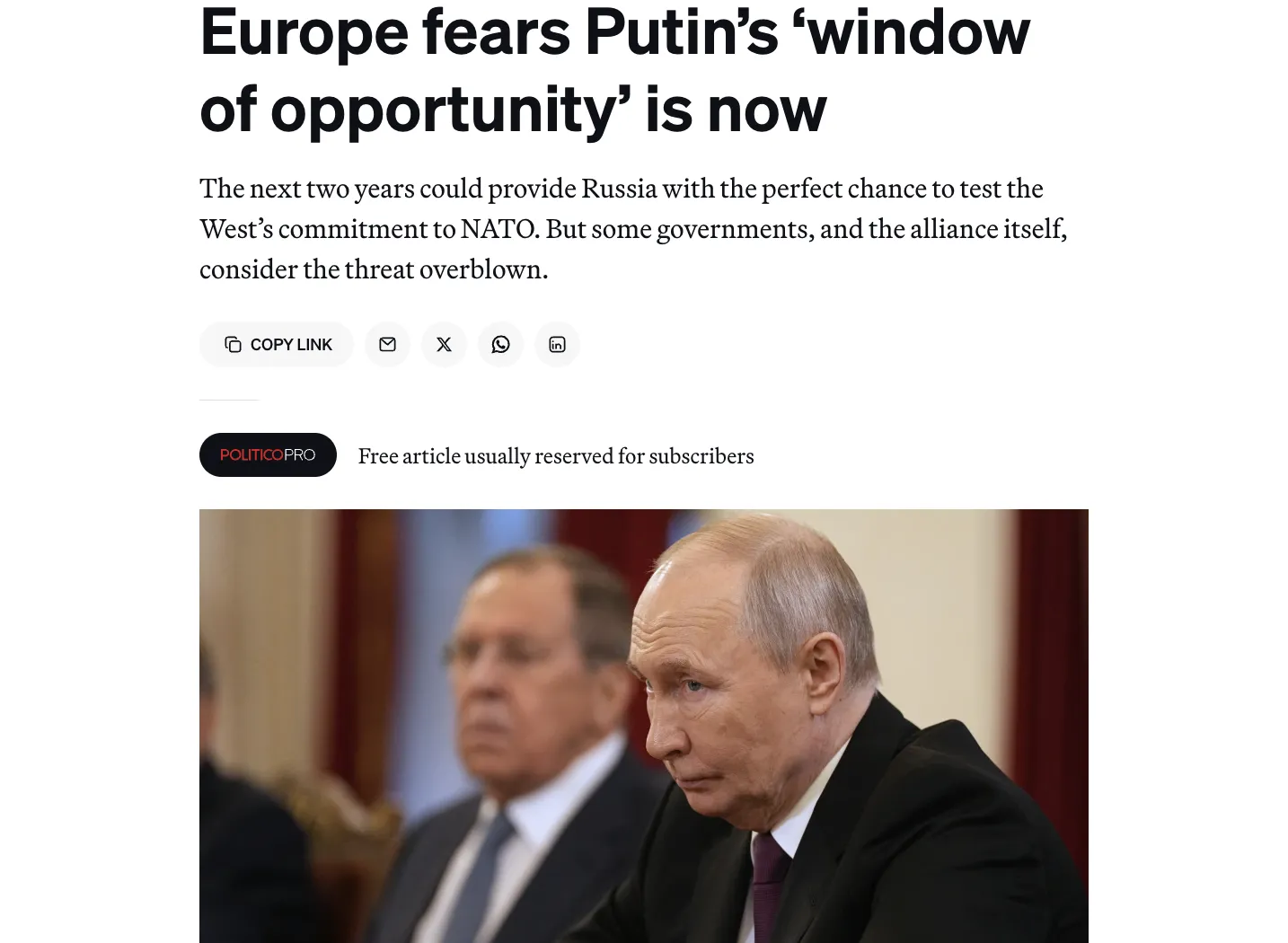
European officials are expressing concern that Russia could use the coming years to launch a potential attack on NATO countries, given the insufficient readiness of EU defense structures.
Politico reported this today, May 4.
The U.S. is withdrawing from Europe, transatlantic relations are strained, and the EU is not yet ready to defend itself on its own. It is precisely this moment, according to European officials, that the Kremlin leader could use to test the alliance’s strength.
“Something could happen very soon—Russia has a window of opportunity,” said Finnish MEP Mika Aaltola.
Officials consider a full-scale ground offensive against a NATO country unlikely—Russia is exhausted by the war in Ukraine. Instead, they are talking about something more targeted: operations that will create ambiguity and sow discord within the alliance.
“It could be a drone operation; it could be an operation in the Baltic Sea. It could be something in the Arctic, targeting small islands. They have a shadow fleet that is already partially militarized,” Aaltola said.
The goal is to pressure Ukraine’s allies and avoid a direct response from the U.S. If there is no border crossing, Washington may declare it “not strategically important” and advise negotiations with Russia—which is exactly what the Kremlin is counting on.
Former Lithuanian Foreign Minister Gabrielius Landsbergis warned: Putin may “escalate horizontally against another neighbor, trying to avoid humiliating negotiations with Ukraine.”
There is no consensus on the threat assessment in Europe. Finland and Lithuania are sounding the alarm, while Estonia and NATO are urging people not to panic—because panic itself is a tool of the Kremlin.
“Russia is very busy in Ukraine. I don’t think it has enough capacity to try to start a war in the Baltic states as well,” said Estonian President Alar Karis.
“You never know. And no one expected a war in Ukraine,” he added.
Aaltola warns: a false sense of security is the worst thing that can happen. If society does not perceive a threat, resources are not allocated to defense.
“The escalation of the conflict to other theaters of war could give Russia a strategic advantage… war is draining their resources, so they are looking for a way out,” said MP Aaltola. “And that way out is not peace talks, but the expansion of the conflict.”
Read also: NATO remains confident despite U.S. troop reductions.
As a reminder, the Pentagon has decided to withdraw approximately 5,000 U.S. troops from Germany. The process is planned to be carried out over the next six to twelve months. This is part of a review of U.S. force deployments in Europe.
Berlin acknowledges that the continent will have to strengthen its own defense more quickly and more seriously to compensate for the gradual reduction of the American presence.


