
A Russian tanker armed with machine guns was spotted in the Gulf of Finland
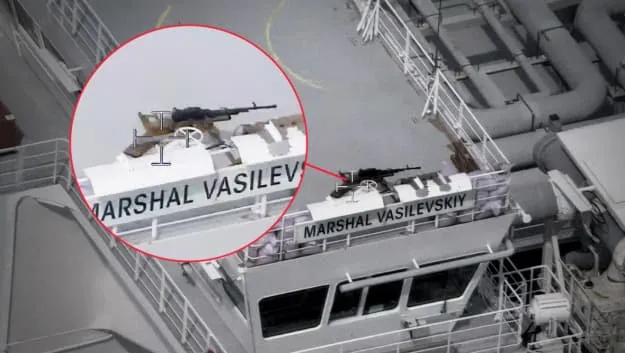
In May of this year, the Estonian Police and Border Guard Board detected the first instance of military weapons being placed on board a Russian civilian vessel in the international waters of the Gulf of Finland, in violation of international maritime law.
Estonian journalists released exclusive aerial photographs taken by the crew of an Estonian Border Guard reconnaissance aircraft. The images clearly show a large-caliber machine gun mounted on the deck of the Russian vessel “Marshal Vasilevsky.” This is a specialized floating regasification terminal and LNG tanker owned by Gazprom that regularly transports liquefied natural gas from ports in the Leningrad Oblast to the Kaliningrad exclave.
Military analysts and intelligence officers are considering several main theories regarding the appearance of machine guns aboard the gas tanker:
Protection against long-range Ukrainian UAVs—the Russian command is seriously concerned about successful airstrikes on maritime logistics in the Baltic Sea and directly in the vicinity of the major ports of St. Petersburg, Ust-Luga, and Vyborg.
Countering a potential detention—the firing positions may have been installed in case of attempts by NATO countries’ border services to forcibly stop or inspect the vessel, as Russia is increasingly using its civilian fleet to carry out covert military and geopolitical missions in the Baltic region.
The footage is the first confirmed and documented evidence of the militarization of Russian civilian commercial vessels sailing in close proximity to the borders of the European Union.
This was reported by the Estonian publication Eesti Ekspress and the Finnish newspaper Helsingin Sanomat.
France detained the Tagor, a tanker belonging to Russia’s shadow fleet, in the Atlantic.
The European Union is considering adding about 20 additional tankers from the Russian shadow fleet to future restrictive measures aimed at reducing Moscow’s oil revenues. The new sanctions are also planned to be extended to ships transporting liquefied natural gas (LNG) to prevent the Kremlin from creating a similar shadow fleet for LNG.


