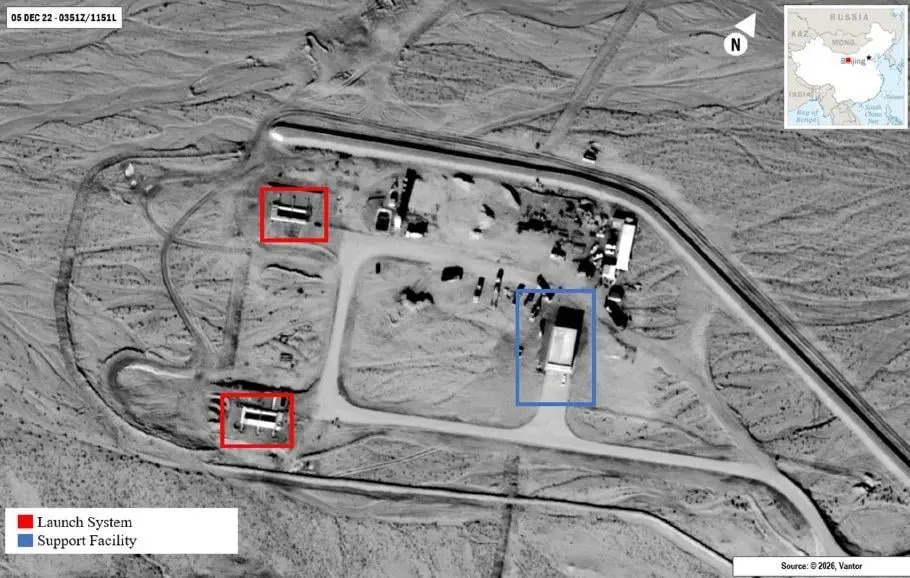
Satellite images have revealed two unusual fortified structures with large sliding roofs at the large Chinese Jilantai missile test site in Inner Mongolia. U.S. analysts speculate that these may be components of a new generation of fixed missile launchers designed for the rapid launch of various types of missiles.
The author of the study, analyst Eli Turk, notes that construction of the facilities began in late 2022, and by the end of 2023, they were nearly complete.
According to satellite images, each structure is equipped with a sliding rectangular roof approximately 20 meters long and over 6.5 meters wide, which opens by sliding to the side along special guides.
Experts noted that the new structures are significantly smaller and shallower than the classic silos for DF-31 or DF-41 intercontinental ballistic missiles, which China has been actively building in recent years.
According to analysts’ estimates, their depth ranges from 6 to 12 meters, which is more consistent with the deployment of:
DF-21 medium-range ballistic missiles;
DF-17 hypersonic missiles;
cruise missiles.
Presumably, the new complexes can serve as vertical launchers capable of launching several types of missiles simultaneously.
According to the report’s author, this architecture will enable the People’s Liberation Army of China to rapidly carry out massive missile strikes using various types of munitions from a single system.
In addition, such a system makes it more difficult to detect launch preparations, reduces response time, and increases the combat effectiveness of missile units.
At the same time, it remains unclear how the missiles will be loaded—special transport vehicles or cranes may be used for this purpose.
The report notes that such systems could become part of China’s “conventional rapid strike” concept.
In the event of a military crisis, they are potentially capable of launching rapid attacks on:
military facilities in Taiwan;
U.S. military bases in the region;
U.S. ships within the first island chain.
The analyst suggests that the emergence of such systems could bolster the confidence of China’s military leadership in its ability to rapidly transition from a blockade of Taiwan to a large-scale missile campaign.
Despite the researchers’ conclusions, the exact purpose of the new structures remains unknown for now. The author of the report emphasizes that they could be used not only as combat launchers but also as test sites for new types of weapons, missile defense systems, or other advanced military technologies.
At the same time, the expert points out that stationary complexes have a significant drawback—their location is easy to pinpoint, so after the first launch, they could become a priority target for a retaliatory strike.
This is stated in a report by the China Academy of Aerospace Research (CASI).
As a reminder, the United States, Poland, Germany, the Netherlands, and Swedenhave signed an official agreement to establish a European maintenance center for PAC-3 missiles used in Patriot air defense systems.
As a reminder, the U.S. and its NATO allies plan to establish a Patriot missile maintenance center in Europe.
The American company Lockheed Martin and the German defense contractor Rheinmetallhave agreed to establish joint production of ATACMS tactical missiles in Europe.