
Dinosaur tracks found in China show the animal moved at a snail's pace — IE
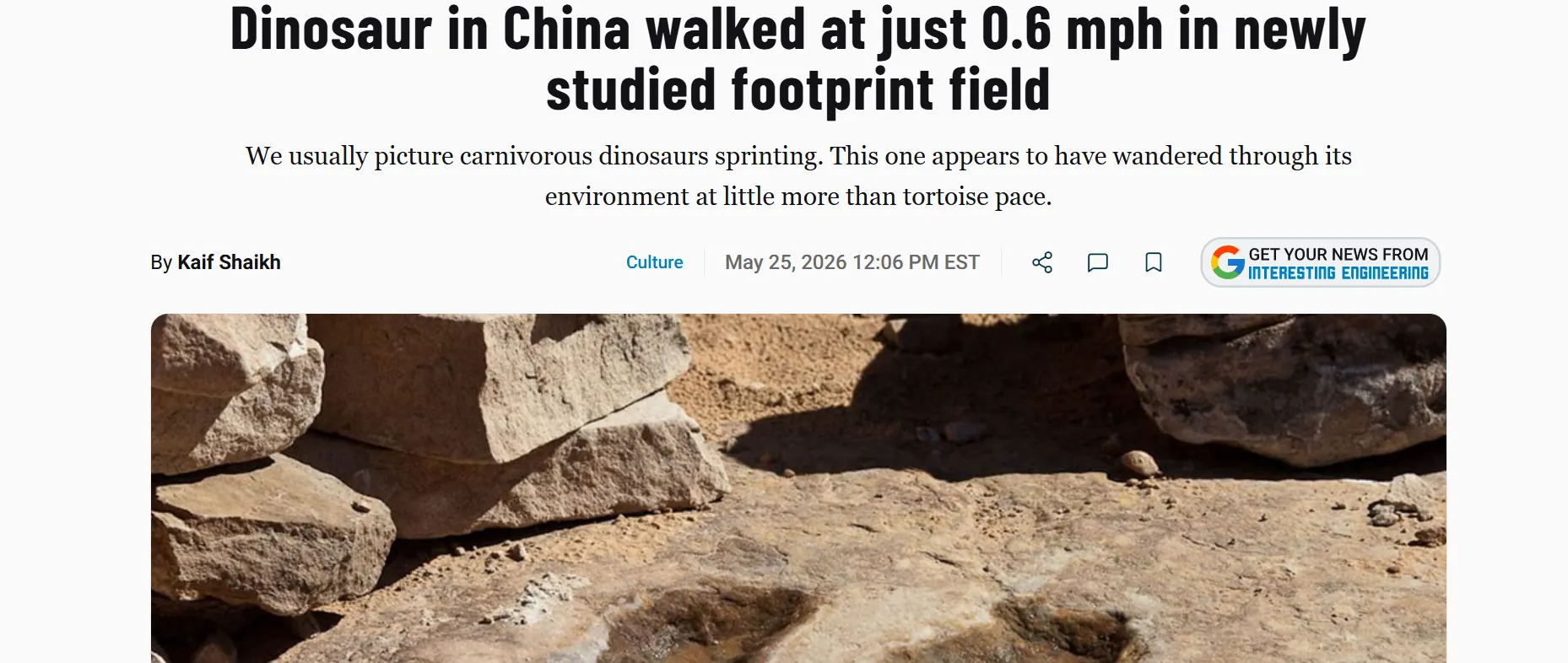
An international team of researchers has discovered unique footprints in China’s Hebei Province belonging to a small predatory dinosaur that moved at a speed of just 1 km/h.
This was reported by the popular science publication "Interesting Engineering."
This discovery officially confirmed one of the slowest movement speeds of theropods known to modern science.
In northern China, researchers have officially confirmed the existence of one of the country’s largest fields of ancient reptile tracks. It was found in the Xuanhua area of Zhangjiakou City, located in Hebei Province.
The total area of the site under study is approximately 30,000 square meters, where over 5,000 unique tracks have been perfectly preserved over millions of years.
Among this vast number of tracks, scientists have identified trails left by a small predatory dinosaur—a theropod. This prehistoric predator moved very slowly—at a speed of about 1 km/h.
This unhurried pace roughly corresponds to the walking speed of an ordinary turtle.
This important discovery challenges the common perception of predatory dinosaurs as constantly fast and aggressive hunters.
Researchers believe that the discovered tracks reveal their typical daily behavior in their natural habitat over 100 million years ago.
According to local geological strata, clear footprints of both giant sauropods and smaller theropods have been preserved in the area.
Later, scientists discovered two additional areas with similar tracks 1.5 and 2.25 kilometers from the original discovery site.
An international team of researchers from China, Brazil, and Australia studied in detail 27 well-preserved three-toed tracks ranging in length from 10.1 to 26.7 centimeters.
Paleontologists note that they belong to the so-called “grallator tracks”—distinctive footprints typically left by small predatory theropods.
The rock formations in which these unique tracks have been permanently preserved belong to the well-known Tuchengzi geological formation. Experts estimate their exact age to be between 154 and 134 million years.
A new species of giant dinosaur has been discovered in Thailand
Remains of a giant dinosaur have been discovered in Argentina.
Dinosaursweren’t exactly like lizards: scientists have revealed what their skin was like.
As a reminder, the oldest wooden tools were found in Greece.
Archaeologists also found artifacts from the Kievan Rus’ era during excavations.


