
In Germany, pro-Palestinian activists blocked the entrance to an air show ahead of Merz's speech — The Straits Times
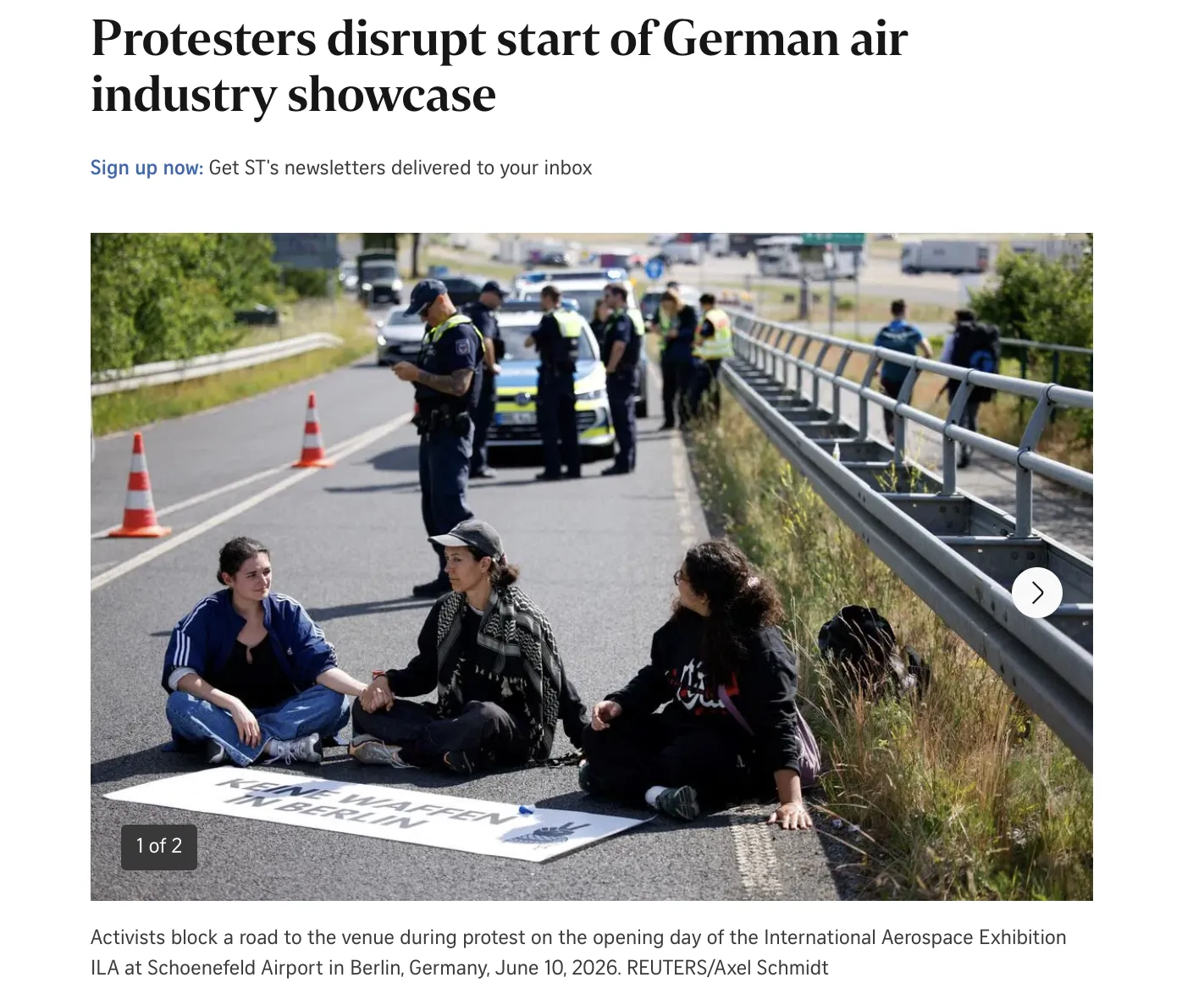
On Wednesday, pro-Palestinian activists blocked the entrance to the ILA Berlin Air Show—one of the largest aviation conferences in Germany. The incident occurred a few hours before German Chancellor Friedrich Merz was scheduled to speak. Details of the protest and the organizers’ response are being clarified.
Activists from a pro-Palestinian group called “Peacefully Against Genocide” blocked access to the conference venue by staging a sit-in protest on the grounds of the former Berlin International Airport.
The International Aerospace Exhibition (ILA), held every two years, opens here on Wednesday; about 750 companies from 37 countries are expected to participate.
The exhibition showcases new products and innovations in the aviation, aerospace, and defense sectors. Drones and the recent failure of the Franco-German fighter jet project are expected to be the main topics of discussion at this year’s event.
In a statement on Instagram, a pro-Palestinian group said it opposes cooperation between companies participating in the exhibition and Israel.
“The main focus of criticism is on the presence of Rheinmetall and the Israeli arms manufacturer Elbit Systems,” the activists’ statement reads.
Both companies, which are believed to be linked to Israel’s actions against civilians in the Gaza Strip, will present combat drones and air defense systems in Berlin on Wednesday.
The German and Israeli governments have consistently rejected claims that Israel committed genocide in Gaza.
Organizers advised ILA visitors to walk to the venue from the nearest train station to avoid protesters, The Straits Times reported.
As a reminder, Germany has recorded a record number of political crimes.
Following the de facto cancellation of the joint European FCAS sixth-generation fighter jet project, Germany is exploring new options for developing its combat aviation, including purchasing additional F-35s, joining another international program, or launching its own project.
Germany has decided to allocate an additional 300 million euros to the Czech initiative to purchase ammunition for Ukraine, which will allow for the acquisition of tens of thousands of long-range shells for the Ukrainian Armed Forces. Berlin states that it will continue to support this mechanism as one of the key aid instruments.
Germany and France are considering the possibility of suspending or effectively winding down their joint defense project to develop the next-generation FCAS fighter jet. The initiative, which had been in the works for several years and involved multi-billion-dollar funding, has encountered serious difficulties during implementation. Due to disagreements between the parties, the project—which was intended to be a key element of future European defense aviation—is now at risk of collapse.


