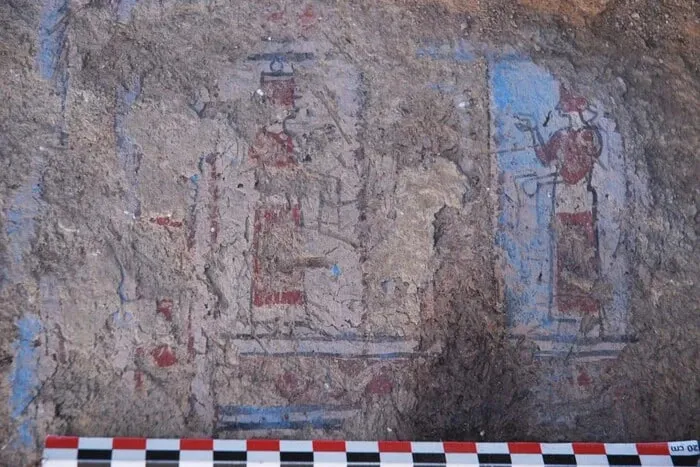
A French-Armenian archaeological expedition has uncovered an ancient fresco preserved at the Erebuni Fortress within the boundaries of modern-day Yerevan. The find has already been called an unprecedented discovery, as it dates back more than 2,500 years.
The Erebuni Fortress is one of Armenia’s most important archaeological sites, linked to the history of the ancient kingdom of Urartu. The discovered fresco may help researchers learn more about the culture and art of that period.
What makes the fresco unique is its condition and the images depicted on it. They may help scientists study the materials and techniques used by artisans of that time. There are currently no details or interpretations of the images themselves. However, this discovery may reveal many secrets of the art of that era.
The rare fresco found in an Armenian fortress dates back to the second half of the seventh century BCE or the beginning of the sixth century BCE. Thus, the find may be over 2,500 years old and date to the period of the Urartu Kingdom.
Specifically, the fresco was created during the final decades of the kingdom’s existence. At that time, the Assyrian Empire was in decline in the Ancient Near East, and new states were emerging in its place. Meanwhile, Urartu eventually disappeared from historical records.
The fortress where the fresco was discovered was founded in 782 BCE by King Argishti I. It is located on Arin-Berd Hill, within the territory of modern-day Yerevan. At this site, archaeologists found 23 stone inscriptions confirming the existence of several generations of Urartian kings.
Erebuni was not merely a fortification. Within its walls were residential quarters, temples, warehouses, and other structures. The fresco fragments found in the fortress indicate that it once featured vibrant murals, which have since faded over time.
It should be noted that during excavations at the Kartal site near the village of Orlivka in the Odesa region, archaeologists discovered several Roman-era burials, including a grave showing signs that the leg bones had been removed after death and a burial containing a unique set of ceremonial horse harness.
Armenia has prepared a response to the Russian trade war.
Armenian Prime Minister Nikol Pashinyan stated that Russian restrictions on imports of Armenian products could lead to the de facto collapseof theEurasian Economic Union (EAEU).
As a reminder, Russia banned the import of dairy products from Armenia starting July 27. The Federal Service for Veterinary and Phytosanitary Surveillance of the Russian Federation (Rosselkhoznadzor) attributed this to alleged violations discovered during inspections of Armenian dairy processing plants.