
Hungary Engaged in Espionage Against EU Officials — Politico
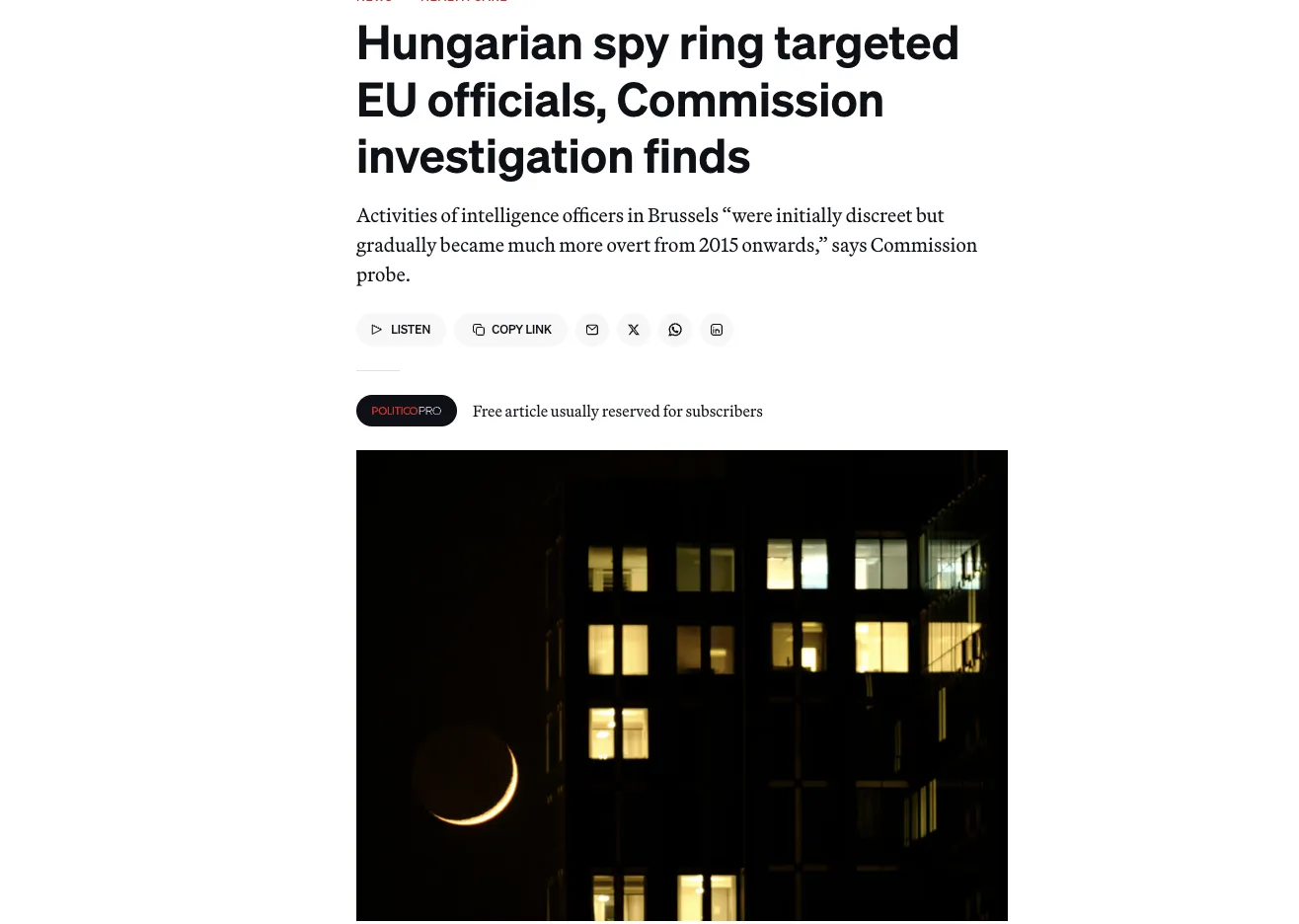
Hungarian intelligence services used the country’s permanent mission in Brussels as a base for espionage activities against European Union officials. According to Politico, this operation reached its peak in 2015.
The document contains the findings of an investigation conducted by Piotr Serafin, the European Commissioner for Anti-Fraud. He was tasked with verifying reports that Hungarian intelligence officers at the diplomatic mission had attempted to recruit employees of European institutions in the mid-2010s.
According to the report, between 2013 and 2016, Hungarian intelligence services placed several of their officers at the embassy in Brussels. Initially, they operated covertly, but beginning in 2015, they shifted to more overt tactics. As a result, word of the spies spread among Hungarian officials within EU structures, which reduced the effectiveness of the intelligence operations. According to available data, these activities ceased in 2016.
In 2015, Oliver Várhegyi, who currently serves as the European Commissioner for Health, took over as head of the delegation. He had been working at the institution since 2011. After the first media reports emerged, Várhegyi assured European Commission President Ursula von der Leyen that he knew nothing about these efforts by Budapest. In January of this year, during a hearing before the European Parliament, he again denied any contact with intelligence services and stated that no one had asked him to pass on classified information. Várhegyi ignored a recent request from journalists for comment.
Serafin’s investigation was unable to identify specific perpetrators due to the European Commission’s limited tools; therefore, only the operatives themselves are considered responsible. At the same time, the report officially confirms for the first time the existence of this group and its activities targeting European officials. The intelligence operatives abused their diplomatic status to gather information on behalf of the Hungarian government, focusing on European officials with Hungarian citizenship.
Hungary’s Permanent Representation declined to comment on the situation. In response to journalists’ inquiries, the European Commission referred to an April statement by spokesperson Balázs Újvári regarding the closure of the case due to a lack of evidence of serious security breaches, Politico reports.
Hungary has restored access to a number of Ukrainian news sites that had been blocked in response to reciprocal restrictions imposed by Kyiv. The decision marked a step toward partially unblocking the flow of information between the two countries following a media conflict.
Hungary pushed to remove language regarding Ukraine’s accelerated accession to the EU from the final declaration of the European Union summit.


