
Ukraine has spoken out against the new UN map
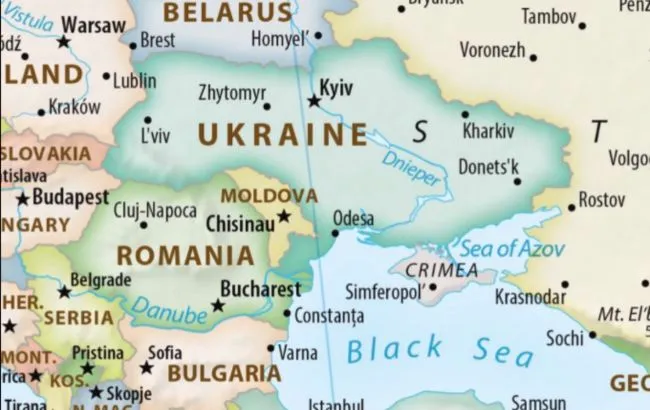
Ukraine did not support the UN resolution on a new cartographic projection of the world because the proposed map inaccurately depicts the temporarily occupied Ukrainian territories. Specifically, the map shows Crimea as separate from Ukraine. The Ukrainian delegation stated that it does not object to the idea of a new map itself, but cannot agree to a version that calls into question the country’s territorial integrity.
Ukraine refused to support a UN General Assembly resolution concerning a new cartographic projection of the world. The reason was a map on which Ukrainian territories temporarily occupied by Russia are depicted in a manner unacceptable to Kyiv.
People’s Deputy Kira Rudyk also drew attention to the issue. The projection in question is called “Flat Earth.” Its authors propose using it to more accurately depict the true sizes of the continents.
Why Ukraine Disliked the Map
The Ukrainian delegation emphasized that the idea behind the resolution itself is not objectionable. In particular, Ukraine supports the goal of more accurately depicting the sizes of continents. This is especially important for Africa and other regions of the Global South, which often appear smaller on conventional maps than they actually are. The problem arose because of the specific version of the map proposed in the resolution.
On this map, the parts of Ukraine occupied by Russia are depicted in a way that could create a misleading impression of their status. Crimea drew the most attention—on the map, it appears separated from the mainland of Ukraine. For Kyiv, this is unacceptable, as Crimea is an integral part of Ukraine, despite its temporary occupation by Russia.
The Ukrainian delegation stated that such a depiction contradicts the principles of state sovereignty and territorial integrity. Kyiv also pointed to numerous UN General Assembly resolutions that reaffirm Ukraine’s territorial integrity and do not recognize Russia’s attempt to annex Ukrainian territories. In other words, for Ukraine, the issue goes beyond the map’s design. It is about how an international organization visually depicts state borders and the status of occupied territories.
Ukraine Tried to Reach an Agreement
According to the Ukrainian delegation, Kyiv did not simply oppose the document but tried to find a compromise. The Ukrainian side held negotiations with the authors of the resolution and proposed changing the wording so that the new cartographic projection would not create problems regarding Ukraine’s territorial integrity.
However, it was not possible to agree on the necessary changes. As a result, Ukraine was unable to support the resolution in its proposed form. The Ukrainian delegation separately emphasized that efforts to correct long-standing issues with the representation of the continents’ sizes should not create new disputes over state borders.
Kyiv fears a dangerous precedent
The Ukrainian delegation also warned of the possible consequences of such an approach. In Kyiv’s view, vague or ambiguous wording in international documents could set a dangerous precedent. If an international organization’s maps depict a state’s territory in a manner that does not correspond to its internationally recognized borders, this could lead to further attempts to politically distort the world map.
The Ukrainian side effectively called for not conflating two distinct issues—the accuracy of the geographical representation of continents and the internationally recognized borders of states.Officials in Kyiv emphasized that changing the cartographic projection should not affect the political status of territories. The Ukrainian delegation urged other countries to give this issue careful consideration during the vote.
What Kira Rudyk Said
People’s Deputy Kira Rudyk also reacted sharply to the situation. She stated that Ukraine could not support the resolution precisely because of how Crimea is depicted on the proposed map. “Ukraine could not support the UN resolution on the new world map because it depicts occupied Crimea in a way that separates it from Ukraine. In 2026, the UN should not need to be reminded: Crimea is Ukraine,” Rudyk wrote.
Thus, the Ukrainian side is not opposed to the very idea of creating a more accurate world map. Kyiv objects to this specific version, which, in the opinion of the Ukrainian delegation, inaccurately depicts the occupied territories.
Why Maps Matter
At first glance, a cartographic projection may seem like a purely technical matter. In reality, maps can also have political significance, especially when it comes to national borders and disputed territories. Depicting a territory on a map does not, in and of itself, change its status under international law. However, an incorrect or ambiguous depiction can create a false impression of who it belongs to.
According to the Ukrainian side, this is precisely what Kyiv has been trying to prevent. It is of fundamental importance to Ukraine that any maps used in UN documents do not contradict international law or decisions already adopted by the General Assembly. Therefore, the Ukrainian delegation opposed the resolution in its proposed form.
At the same time, Kyiv continues to support the very idea of more accurately depicting the world on maps. The Ukrainian side believes this can be done without creating new problems regarding borders and the status of occupied territories.
Ultimately, the dispute over the new UN map turned out to be more than just a matter of geography. For Ukraine, it concerns a matter of principle—how an international organization depicts the territories of a state that has been resisting Russian occupation for over a decade. This was reported by the Ukrainian delegation to the UN.
Vladimir Putin still hopes to fully seize the Donbas and, according to a Reuters source close to the Kremlin, believes this is possible by the end of 2026. Western military analysts view such a scenario with skepticism due to the slow pace of the Russian army’s advance.


