
Meloni's government is preparing for Italy's return to nuclear power – AP
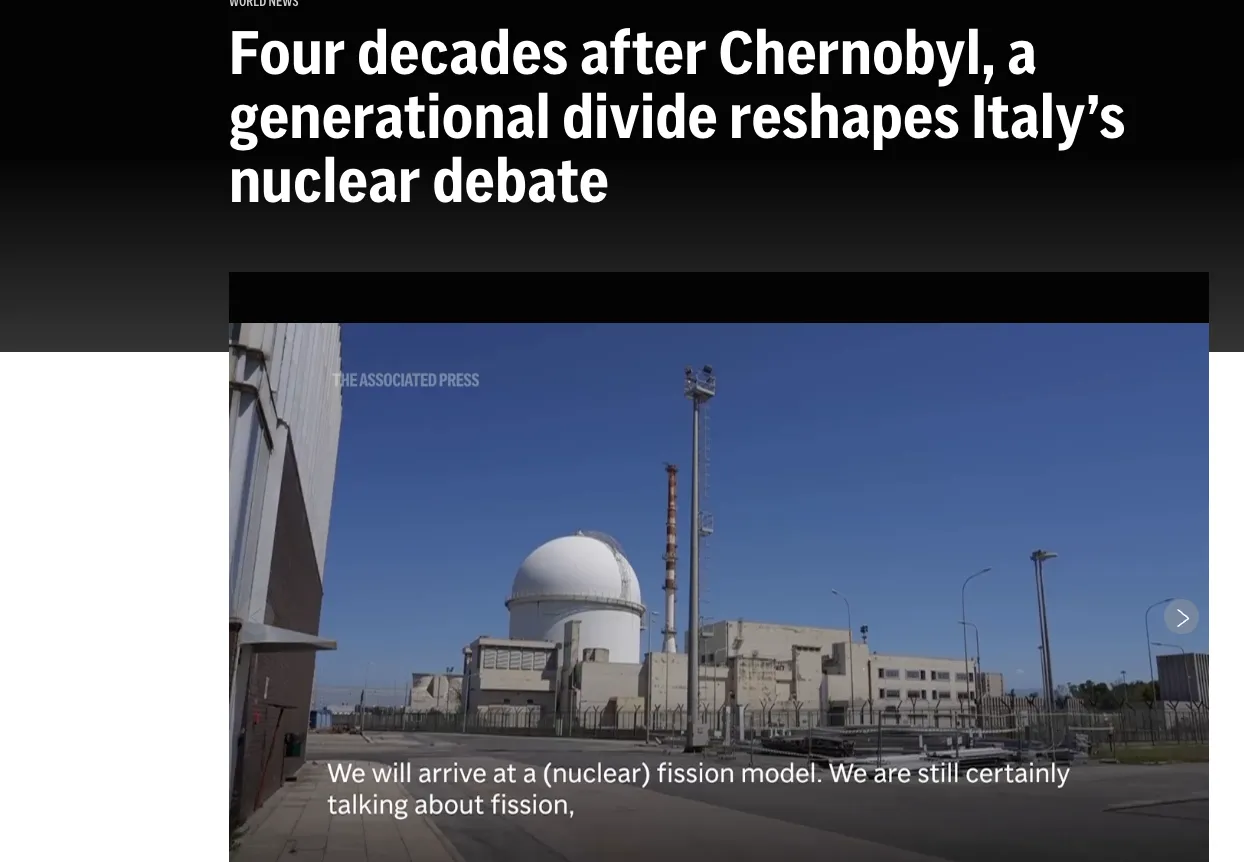
The Italian government, led by Prime Minister Giorgia Meloni, is working to create the conditions for the revival of nuclear energy in the country. Italy phased out nuclear power plants after the 1986 Chernobyl disaster, but the government is now considering a return to nuclear energy due to the need for energy security and diversification of electricity sources.
The government is counting on a new generation of Italians who view nuclear power as a low-carbon source of electricity, a tool in the fight against climate change, and a way to strengthen the stability of energy supplies amid the upheavals caused by the wars in Ukraine and Iran.
Experts note that the government is banking on the fact that such support willwill improve the stance of Italians, who—since the events of 1986—have continued to view nuclear energy through the lens of risk and disaster and have twice rejected a return to nuclear power in nationwide referendums.
Next week, parliament is expected to approve a government-sponsored bill establishing the legal framework for next-generation nuclear technologies.
After that, the government will have 12 months to draft implementing regulations governing reactor licensing, safety standards, waste management, and site selection.
“The government’s task at this point is to create the conditions so that those who will ultimately make decisions regarding the construction of facilities can do so,” said Gilberto Picchetto Fratin, Minister of the Environment and Energy Security, in an interview with the Associated Press.
Italy was once among the European pioneers of nuclear energy. Four reactors were in operation until the 1987 referendum, which effectively put an end to the country’s nuclear program following the Chernobyl nuclear disaster.
Another attempt to revive nuclear power failed after the 2011 disaster at the Fukushima nuclear power plant in Japan, when about 94% of voters opposed plans to build new reactors.
As a result, Italy’s change of course will mark one of the most ambitious energy pivots in Europe.
The Meloni government argues that rising demand for electricity, climate goals, and energy security concerns arising from Russia’s invasion of Ukraine justify the return of nuclear power to Italy’s energy mix.
Instead of reviving the large nuclear power plants of the past, the government is focusing on small modular reactors (SMRs) and other advanced technologies that may be safer, more flexible, and faster to build.
“We’re talking about third-generation nuclear power, which is much better suited to current needs, much safer thanks to its compact size, and can be built in a very short time,” said Picchetto Fratin.
The biggest political obstacle may be finding sites for reactor construction and waste storage.
Italy still lacks a national repository for existing nuclear waste, much of which is stored at temporary facilities throughout the country. Any future reactor or waste storage site is likely to face strong opposition from local communities.
Even if parliament passes the legislation, opponents—particularly environmental organizations and left-wing parties—may push for a new referendum as soon as specific reactor sites and waste storage plans are announced.
Polls show that support for nuclear power drops sharply when people are asked whether they would agree to the construction of a reactor near where they live. Polls cited by experts show that about six out of ten Italians oppose the placement of a reactor in their province.
Source: AP
As a reminder, debates continue in Italy over electoral reform and access to abortion.


