
Two powerful earthquakes have rocked Venezuela; there may be tens of thousands of victims
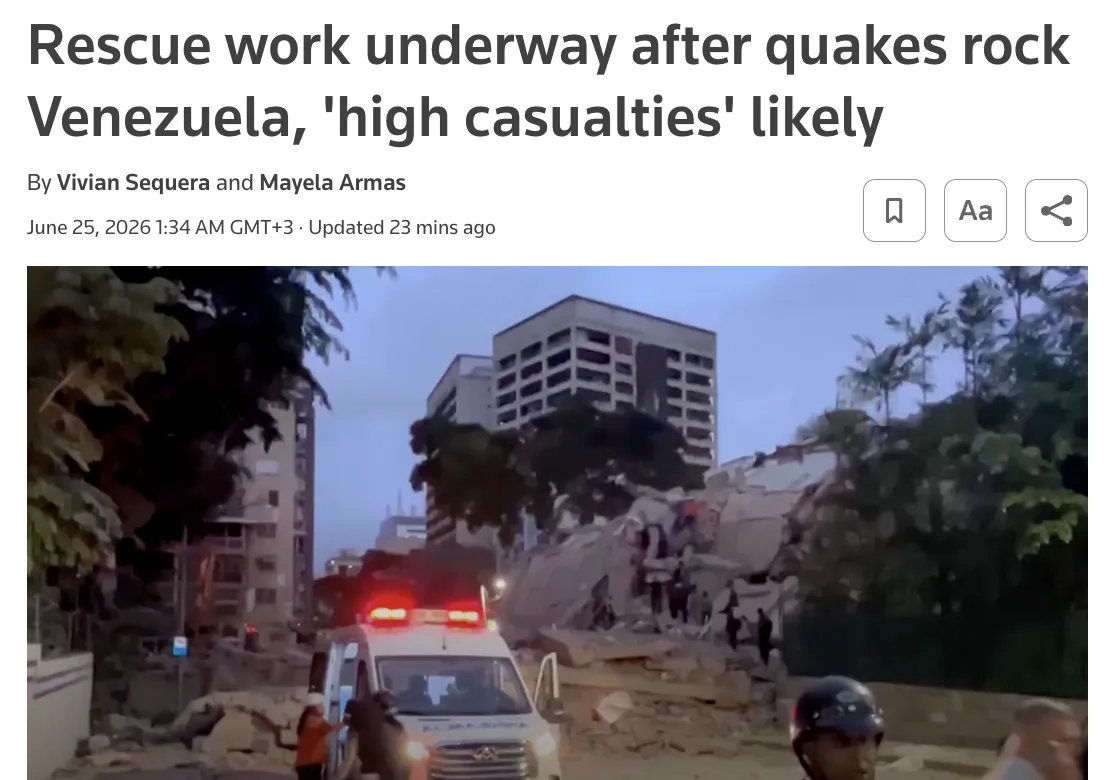
On the evening of June 24, Venezuela was struck by two powerful earthquakes, measuring 7.2 and 7.5 on the Richter scale, which occurred less than a minute apart. In the capital, Caracas, damage to buildings was reported, and the U.S. Geological Survey warned of the risk of a large number of casualties and significant economic losses.
The first quake, with a magnitude of 7.2, struck at 22:04 GMT near the city of San Felipe—approximately 284 kilometers west of Caracas, at a depth of 22 kilometers. Less than a minute later, a second, stronger tremor with a magnitude of 7.5 struck—its epicenter was located 16 kilometers southwest of Morón, at a depth of 10 kilometers. According to the U.S. Geological Survey, these were among the most powerful earthquakes to hit Venezuela in over a century.
Residents of the capital evacuated en masse from unstable buildings and remained on the streets even after sunset—many watched in shock as entire walls collapsed and furniture was visible through the open windows of apartments. Pillars of dust rose in two districts of the city. People sat right on the ground, holding their pets close.
“At first, it was a slight tremor, then it got stronger and stronger—and eventually we all ran out of our homes into the street,” said Caracas resident Hector Ricci.
“The building was swaying from side to side. It was unbelievable. The force was just insane,” said another resident, Roberto Gamas. “We were thrown around the street. Everything in the apartment fell over. Thank God we managed to get out.”
Venezuelan Interior Minister Diosdado Cabello reported that the tremors were felt in several states. “Alarming situations” were reported in the Altamira district of Caracas, where residential buildings and other structures collapsed. The minister urged drivers to clear the way for emergency vehicles and residents to stay outdoors, as aftershocks could cause further damage to weakened structures.
“We understand that some people may be in distress, but we are following protocols to provide assistance to those who need it most,” Cabello said on national television.
The U.S. Geological Survey has issued the highest—red—alert level regarding human casualties and economic losses. “Significant casualties and extensive destruction are likely, and the disaster is most likely to be large-scale,” the agency said in a statement.
According to preliminary estimates, the death toll could range from 10,000 to 100,000 people. Geologists estimate economic losses at between $10 billion and $100 billion—representing 2 to 20% of Venezuela’s GDP. The authorities have not yet released exact figures on the number of victims.
Meanwhile, in the coastal city of La Guaira in northern Venezuela, fires broke out amid the ruins of buildings destroyed by the nighttime earthquakes. The tremors damaged gas pipelines, causing gas leaks and fires in several areas of the city.
The U.S. Tsunami Warning Center issued a tsunami warning for the U.S. Virgin Islands and the Dominican Republic. The warning for Puerto Rico was lifted within an hour. The islands of Aruba, Curaçao, and Bonaire were also at risk of dangerous waves.
Venezuela is located at the boundary between the Caribbean and South American tectonic plates. Strong earthquakes are rare here—the last time Caracas was seriously affected by seismic activity was in 1967. Unlike Mexico or Chile, which lie along the “Pacific Ring of Fire”—responsible for 90% of the world’s earthquakes—Venezuela is considered a relatively quiet region.
This was reported by AP, Reuters, and Al Jazeera.
Earlier, a 5.9-magnitude earthquake struck Amami Island in Japan.
A powerful earthquake also struck China, prompting the evacuation of thousands of people.
Prior to that, an earthquake was recorded in Ukraine.


