
Agrochemical residues found in rivers of South Africa’s Western Cape province
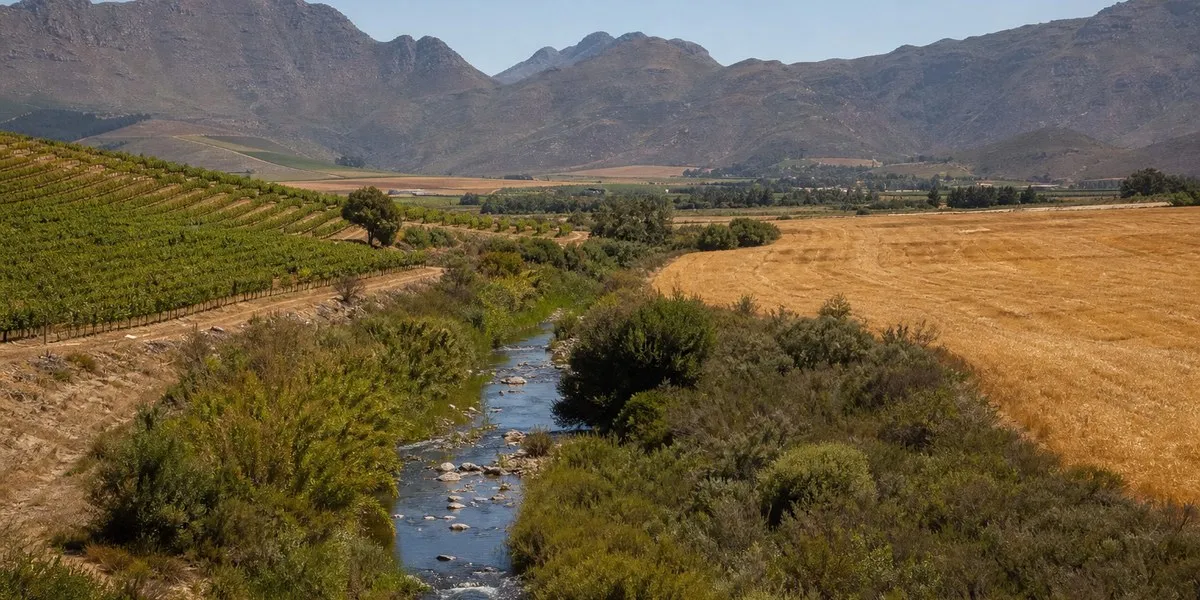
Research in South Africa’s Western Cape province has found dozens of agricultural chemicals and their breakdown products in rivers in farming areas. Some substances exceeded threshold values that scientists use to assess potential risks to aquatic organisms, Daily Maverick reports.
River monitoring results
During the severe drought of 2017–2018, a team led by Lou Kurchod of the Swiss Tropical and Public Health Institute studied three agricultural areas of the province. The scientists collected spraying data from 38 farms and placed devices in the Krom, Berg and Hex rivers for two weeks to collect traces of substances.
The team found 53 different chemicals and their breakdown products. Most concentrations did not exceed the warning levels established by the researchers. However, the insecticides imidacloprid, thiacloprid, chlorpyrifos and acetamiprid, as well as the herbicide terbuthylazine, exceeded these levels at least once.
The researchers noted that this does not mean the water is toxic to humans. However, exceeding the thresholds signals a possible risk to insects and other small organisms on which the viability of river ecosystems depends. The study did not track fish or insect deaths.
More current news is available on the UA.News Telegram channel Telegram.
Possible contamination pathways
A further study conducted in 2022–2023 in the Grabouw, Piketberg and Hex River areas again recorded exceedances of protective levels for imidacloprid, chlorpyrifos, terbuthylazine and the fungicide spiroxamine. Imidacloprid was the most persistent concern in all three areas.
The scientists suggested that some substances may have entered rivers not only through runoff from recently treated fields. Some compounds were detected during periods when farmers were not expected to use them, which may indicate leaching into groundwater and subsequent entry into rivers. In Piketberg, traces of pharmaceuticals also pointed to wastewater treatment plants as a possible source of contamination.
Reducing wheat treatments
A separate experiment at the Langgewens research farm compared conventional and reduced wheat protection schemes. The reduced programme retained two herbicides — glyphosate and pyroxasulfone — abandoned synthetic insecticides and fungicides, and used a beneficial fungus and algae-based biostimulants.
According to the study, the reduced scheme did not worsen yields, wheat quality or soil biological indicators. Less intensive ploughing also increased the activity of several natural compounds in the soil that help process carbon, nitrogen and phosphorus.


