
On June 1–2, the Earth will experience weak geomagnetic fluctuations
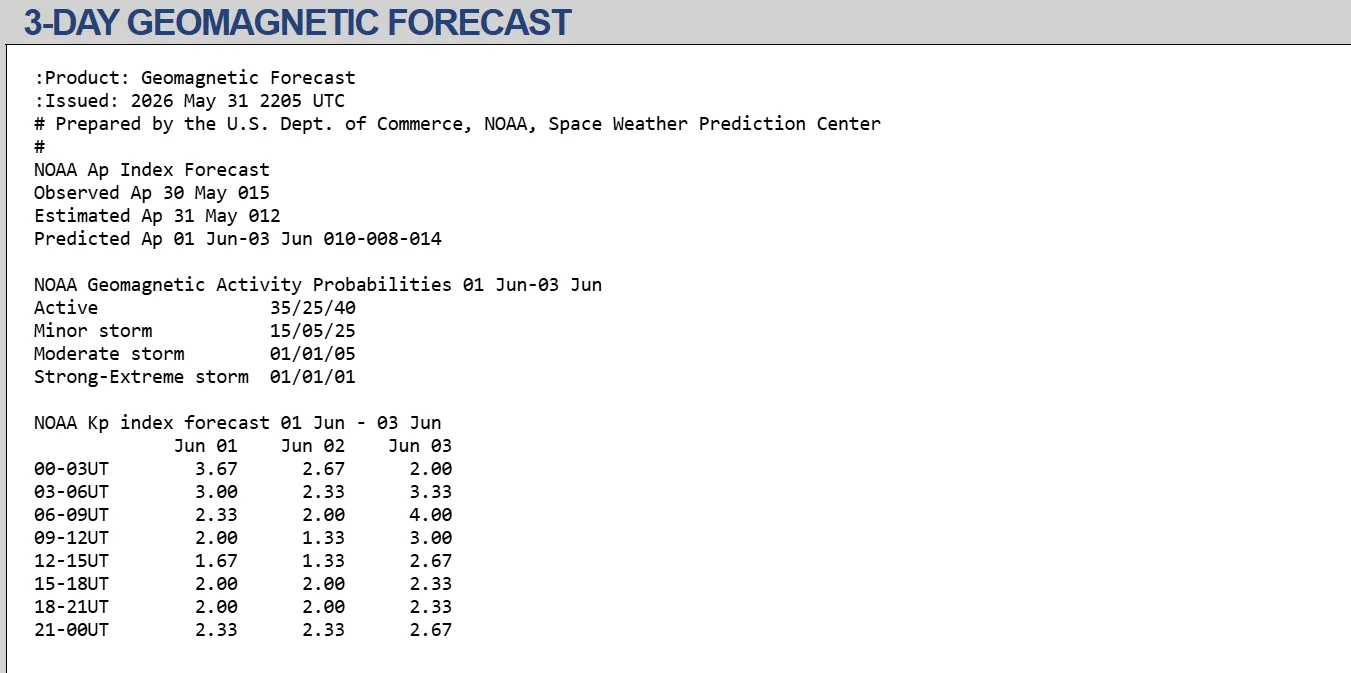
NOAA's Space Weather Prediction Center (SWPC) has released a forecast of solar activity for the next two days, according to which weak green-level magnetic storms are expected on Earth.
This is reported by space monitoring data.
On Monday, June 1, scientists forecast solar activity with a K-index of 3.7. The very next day, Tuesday, June 2, the intensity of fluctuations will decrease slightly—geomagnetic activity will be recorded at a K-index of 2.7.
Both indicators correspond to a low level and do not pose a serious threat to technological systems.
A magnetic storm is a phenomenon caused by regular flares and eruptions on the Sun, which release a significant amount of solar energy.
It consists of charged particles moving rapidly in various directions, including toward Earth. When these protons and electrons reach our planet’s magnetosphere, a disturbance occurs that is classified as a solar storm.
To determine the intensity of geomagnetic disturbances, experts use the planetary K-index, which is measured on a scale from 0 to 9. Disturbances ranging from 1 to 4 are considered minor and usually go unnoticed by humans.
If the index reaches 5 or higher, it is a strong red-level magnetic storm. Such phenomena can cause disruptions in the operation of satellites, cellular communications, radio frequencies, and GPRS, and at indices of 7 or 8, they trigger auroras.
Magnetic storms affect atmospheric pressure, which is why some people may experience headaches, fatigue, and stress.
There are no specific medications to counter this natural phenomenon, but doctors recommend minimizing symptoms by adjusting your daily diet and routine.
Researchers note that forecasts may change, as data is updated every three hours.
In June 2026, several periods of solar activity are expected, which may affect the well-being of weather-sensitive people and the operation of electronic devices.
June 2026 marks the main turning point of the summer.


