
“The Next Billion Players Won’t Come from the U.S.”: An Exclusive Interview with Alona Shevtsova Following Her Presentation at the Global Blockchain Show in Riyadh
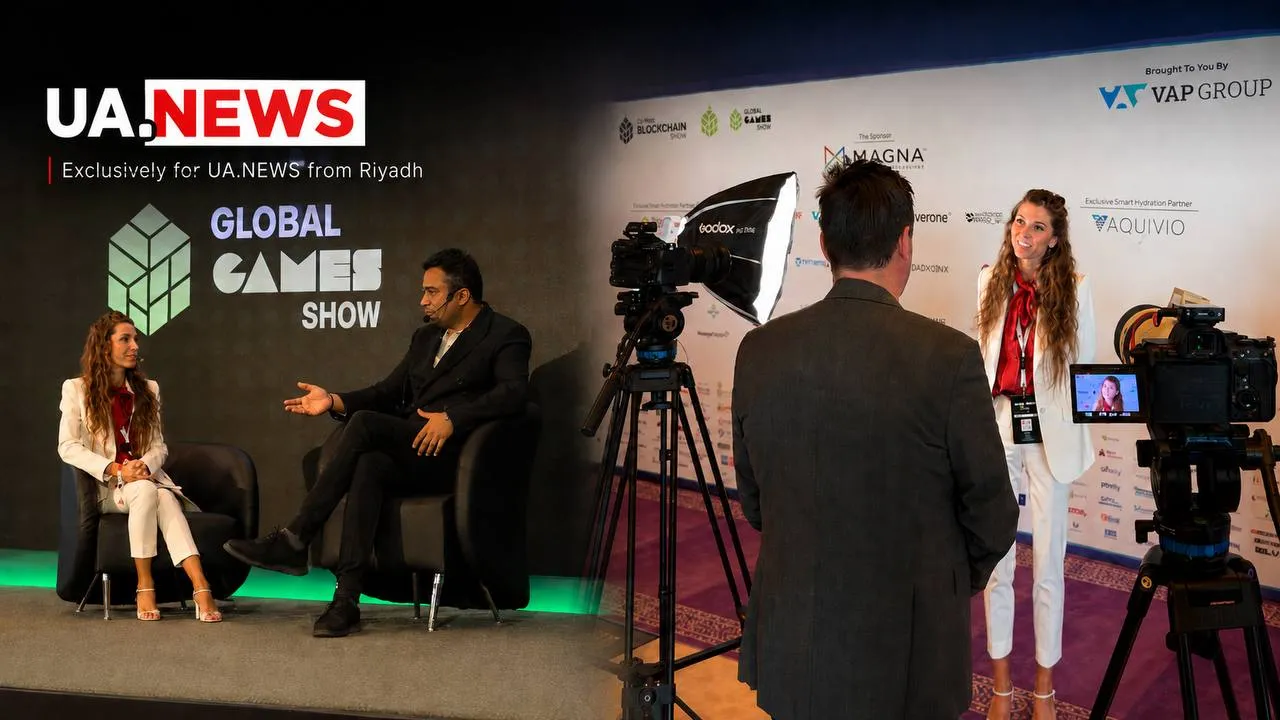
RIYADH — exclusively for UA.NEWS
The global gaming industry is undergoing one of its most significant transformations in recent decades. While North America, Western Europe, Japan, and South Korea remained the key markets just ten years ago, today the Middle East, Southeast Asia, Africa, and Latin America are attracting increasing attention from international publishers, investors, and technology companies.
This was the topic of the panel discussion “Global Gaming Expansion: Lessons from Untapped Markets,” which took place as part of the Global Blockchain Show in the capital of Saudi Arabia. The discussion was moderated by Alona Shevtsova, CEO of the international fintech company Sends.
After the panel concluded, a journalist from UA.NEWS spoke with Alona Shevtsova about why MENA countries are becoming new hubs of the digital economy today, what challenges await international companies, and why the future of global gaming will be shaped in a place quite different from where most investors tend to look.
“The next billion users are already taking shape”
— Ms. Shevtsova, today you moderated a discussion on expansion into new markets. What was your main takeaway?
— The most important thing is to realize one simple fact: the next billion players won’t come from the U.S. or Western Europe. They’re emerging in countries that, just a few years ago, international businesses considered secondary.
We see enormous potential in Saudi Arabia, the United Arab Emirates, Southeast Asia, India, and certain regions of Africa. Smartphone penetration, digital services, and online payments are growing rapidly there, and an entirely new generation of digital users is emerging.
That is why today, global companies are increasingly looking not only at the size of the existing market but also at the pace of its future growth.
Saudi Arabia Is Changing the Rules of the Game
Over the past few years, Saudi Arabia has become one of the most ambitious investors in the digital technology sector.
As part of its Vision 2030 program, the country’s government is investing tens of billions of dollars in the development of gaming, esports, artificial intelligence, and digital infrastructure.
According to Alona Shevtsova, this is no longer just a government initiative.
“Saudi Arabia is demonstrating today how a national strategy can serve as a catalyst for the development of an entire digital industry. These are no longer just individual investments—they are shaping a new economy.”
She notes that during the conference, virtually all panelists discussed the long-term prospects for the region’s development.
“It’s not just about building data centers or creating new studios. An ecosystem is taking shape here that combines education, investment, innovation, and government support.”
Localization Is More Important Than Marketing
Many international companies mistakenly believe that it’s enough to simply translate a product into the local language.
However, as Alona Shevtsova points out, modern expansion works quite differently.
“Today, it’s not the companies that simply enter a new market that succeed. The winners are those who know how to adapt their products to the local culture, regulatory environment, and user expectations.”
That is why international brands have to thoroughly study local habits, payment methods, audience behavior, and even the cultural characteristics of individual countries.
In her view, there are no longer any one-size-fits-all solutions.
“Every market has its own unique characteristics. What works perfectly in London might not work at all in Riyadh or Jakarta.”
Money is no longer the main advantage
The panel devoted special attention to investments.
Just a few years ago, attracting large amounts of capital was considered the key to success.
Today, the situation is changing.
According to Alona Shevtsova, investors are increasingly valuing companies’ ability to build long-term ecosystems.
“A fund can finance product development. But no fund can build trust between a company and its users.”
That is why partnerships with local companies, educational projects, and engagement with professional communities are becoming increasingly important.
Blockchain is no longer a standalone technology
Although the conference is dedicated to blockchain, this technology is increasingly no longer viewed in isolation.
It is becoming part of a larger digital infrastructure.
“Blockchain, AI, and modern payment solutions are no longer separate fields. They are gradually becoming a single ecosystem of the digital economy.”
According to the expert, it is precisely this integration that will enable the creation of new business models for international gaming, digital assets, and global e-commerce.
Riyadh as a Place Where the Future Is Shaped
Summing up her participation in the Global Blockchain Show, Alona Shevtsova notes that the main value of such events lies not only in the speakers’ presentations.
What matters most is the opportunity for business, government, investors, and technology companies to come together.
It is precisely these platforms that are shaping the direction of the global digital economy today.
“Conferences of this scale are no longer just a venue for presentations. This is where partnerships are forged that can shape the industry’s development for years to come.”
A Look into the Future
According to Alona Shevtsova, the next five years will be pivotal for the global gaming industry.
The winners will not be the largest companies, but those who can adapt more quickly to new markets, work alongside local partners, and build user trust.
And while the center of the digital economy was traditionally associated with Silicon Valley or London, today more and more experts are looking toward Riyadh, Dubai, Singapore, and other cities that are already shaping the new landscape of global technology.


