
In Poland, most traffic fines for drivers from Ukraine are not enforced
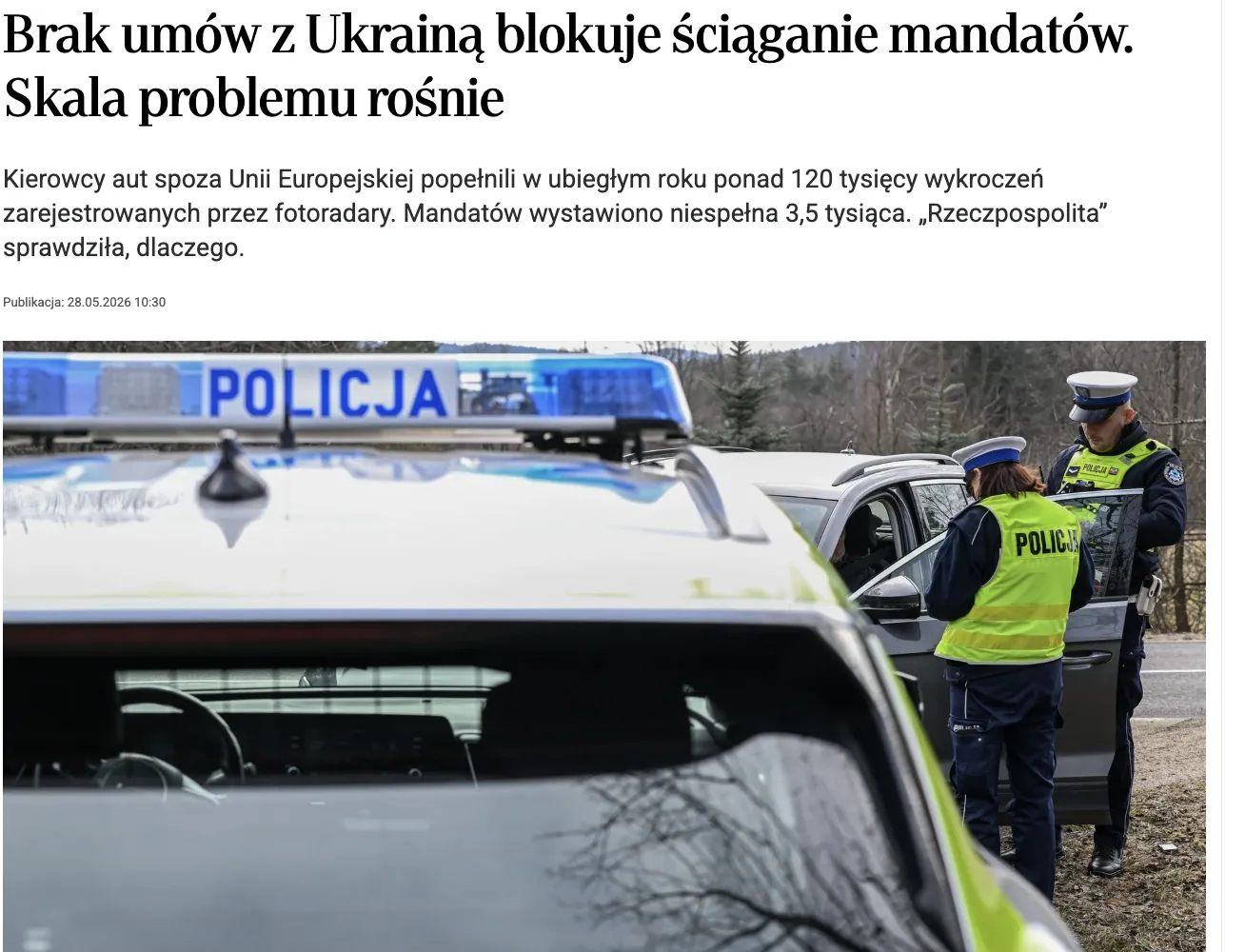
Speed violations caught on camera in Poland often do not result in penalties for foreign drivers. More than 96% of Ukrainian drivers who break the rules on Polish roads avoid fines due to the difficulties involved in collecting them from citizens of non-EU countries.
This is reported by Rzeczpospolita.
As the publication notes, the Polish police manage to actually fine just over 3% of such offenders. According to official data from the General Inspectorate of Road Transport of Poland (GITD), in 2025, drivers of vehicles with non-EU license plates committed over 120,000 traffic violations, which were clearly recorded by automatic cameras. However, only 3,500 people actually received the “notices” and payment invoices.
Cars with Ukrainian registration hold the absolute record for the highest number of traffic violations. Moreover, this figure is growing rapidly and dynamically every year:
- 2023: 52,000 recorded violations;
- 2024: 62,400 cases;
- 2025: a record 77,200 violations.
For comparison: Belarusian citizens racked up just over 7,000 speed camera flashes last year, while Russian citizens had only 218.
In contrast, the actual statistics on enforcement appear negligible. Over the past year, Polish authorities fined only 2,500 Ukrainians and 42 Belarusians. As for drivers with Russian license plates, the system’s effectiveness is effectively zero—not a single fine was issued.
The General Inspectorate of Poland openly admits: the catastrophically low level of enforcement is linked to the complete absence of relevant international agreements between Warsaw and the governments of non-EU neighboring countries. Because of this, Polish databases do not have automatic access to the vehicle owner registries of Ukraine or Belarus.
Today, identifying a driver based on a photograph of a license plate is too complex, expensive, and labor-intensive a process for Polish border guards and police. Individual officers have to manually cross-reference images with archived data from the Border Guard Service or regional provincial offices, which prevents them from efficiently processing thousands of daily violations. As a result, drivers can only be held accountable if patrol officers catch them red-handed during a physical roadside check.
Due to millions of unpaid tickets, Poland’s state budget suffers colossal losses every year, which experts estimate at hundreds of millions of zlotys.
Polish industry experts are demanding immediate and decisive action from the government. In particular, Łukasz Zboralski, head of the leading Polish transport portal brd24.pl, proposed the simplest and most technically feasible solution: to integrate border control cameras at checkpoints with Ukraine and Belarus into a single automated CANARD system.
“The camera should automatically photograph every single foreign vehicle entering Poland or attempting to leave it. The system will instantly check the database for any outstanding fines associated with that license plate number. If the driver has a debt on record, they will simply be physically unable to cross the border until they pay every last zloty,” explains Zboralski.
In parallel with this, Poland’s Ministry of Infrastructure announced a major amendment to the relevant law last year. The new regulation will require drivers from Ukraine and Belarus to fully re-register their vehicles with Polish license plates and enter the data into local systems after one year of continuous residence in the country. So far, this bill has been stalled in the offices due to the lengthy review of public comments, but journalists have learned that the ministry is simultaneously preparing the so-called “speed camera law,” which is intended to finally eliminate all existing loopholes for foreigners.
It is noteworthy that drivers from EU countries, whose data can be easily verified through the pan-European system, violate the rules much less frequently. However, in 2025, even among Europeans, an abnormal spike was recorded—a record 111,000 violations in Poland (nearly five times more than in previous years), which brought the Polish police over 33,000 successfully collected fines.
Previously, Ukrzaliznytsia had promised to launch a train to Berlin in 2019. Meanwhile, Ukrzaliznytsia announced an extension of the “Four Capitals Train” route. The Estonian state-owned company Eesti Raudtee plans to launch the “Four Capitals Train” to Tallinn as early as summer 2019. Ukrzaliznytsia has also agreed to a simplified registration process for passengers on the Kyiv Boryspil Express.


