
Weekly Event Highlights at the National Philharmonic of Ukraine

The National Philharmonic of Ukraine has released its schedule of events for the coming week.
Column Hall
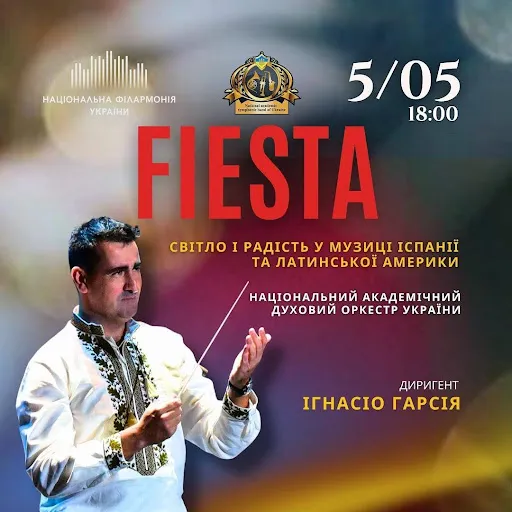
May 5: FIESTA. Light and Joy in the Music of Spain and Latin America!
If one were to look for a common thread in the sound of Spanish and Latin American music, it would undoubtedly be the overall tone: festive, joyful, and inspired.
Habanera, pasodoble, seguidilla, tango—the dance-like energy instantly captivates the listener and fills them with energy and passion. Arabic, American, European, and Sephardic; ritual and secular; naive and refined—the interplay of different traditions always gives rise to unique and unusual sounds that are fascinating to discover.
The concert will also feature unexpected musical surprises!
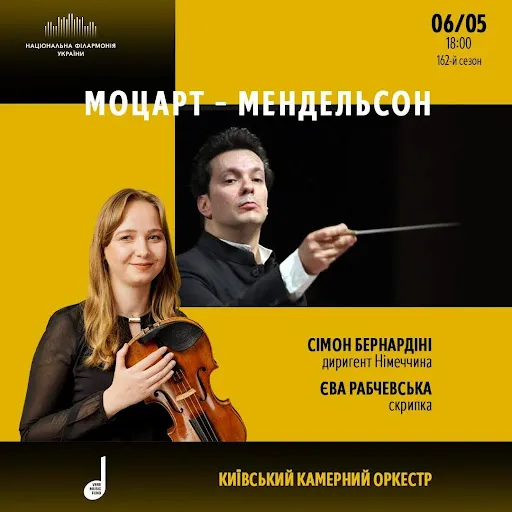
May 6: MOZART – MENDELSOHN. The concert program combines an early work by Felix Mendelssohn, full of inner tension, with the bright, refined music of Wolfgang Amadeus Mozart.
Mendelssohn’s Symphony No. 10 for string orchestra is a single-movement work in which restrained melancholy blends with deep psychological depth and an almost confessional tone. This is music of deep inner concentration, in whose harmonies one can already sense the breath of Romanticism—more personal, sensual, and psychologically rich. As noted by the composer’s scholar R. Larry Todd, this symphony is one of the most enigmatic among Mendelssohn’s early works.
The music of the immortal Mozart invites us to immerse ourselves in another world—clear and full of vital energy. Violin Concerto No. 4 captivates with a combination of brilliant virtuosity and a melodious, almost operatic expressiveness, where the soloist engages in a refined and witty dialogue with the orchestra. In Symphony No. 29, with its light, pulsating energy and refined thematic material, there is no outward pomp; instead, one senses a subtle interplay of light and shadow, the elegance and depth characteristic of Mozart’s mature style. This is music of harmony and balance, in which his unique voice already rings out clearly—light, transparent, and truly perfect.
Felix Mendelssohn and Wolfgang Amadeus Mozart. Two dimensions of musical beauty—deeply personal and impeccably harmonious.
Supported by VERE MUSIC FUND.
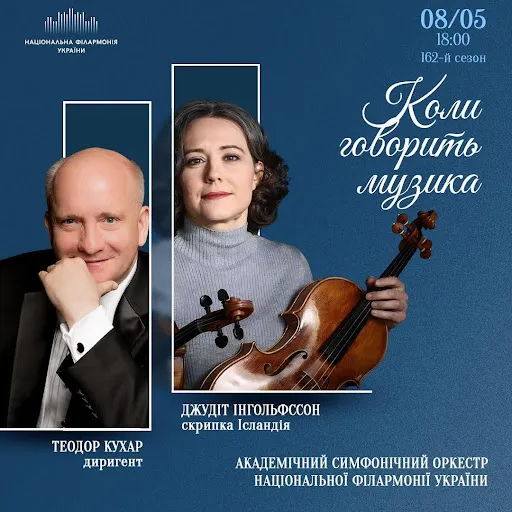
May 8: WHEN MUSIC SPEAKS. May 8—Day of Remembrance and Victory over Nazism in World War II (1939–1945), and the concert “When Music Speaks,” performed by the Academic Symphony Orchestra of the National Philharmonic of Ukraine under the baton of Theodor Kuchar, featuring violinist Judith Ingolfsson (Iceland), takes on special significance as an opportunity to reflect on human experience, memory, and the value of life. The program offers the listener the immediacy of musical expression, in which sound becomes the vehicle for meaning, emotion, and thought, and the historical dimension—a space for their reinterpretation.
In the first part, Johannes Brahms’ Tragic Overture emerges as a concentrated reflection on the nature of tragedy—without a specific plot, but with deep inner conflict and intense psychological drama. Alongside it, Ludwig van Beethoven’s Violin Concerto reveals another dimension of musical language—restrained, balanced, and at the same time deeply expressive, where the soloist and orchestra interact as equal partners, forming a cohesive sonic fabric.
In the second part, Anton Bruckner’s Symphony No. 3, dedicated to Richard Wagner, embodies a grand symphonic vision in which the music unfolds as a complex system of interconnected themes and images. Its dramatic structure is built through a combination of contrasting states—from tense solemnity to meditative concentration, from rhythmic energy to monumental climaxes.
Everyone knows the saying: “When guns speak, the muses are silent,” yet it is music that speaks where words are powerless: of memory, human dignity, and the value of life, leading the listener to reflect on the experience of tragedy and the personal and collective experience of hope.
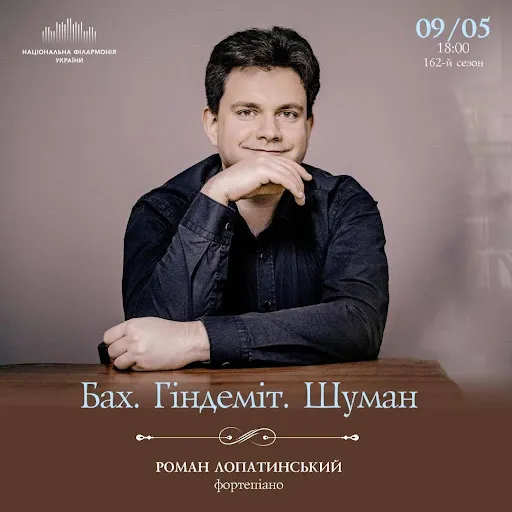
May 9: BACH. HINDEMITH. SCHUMANN. At the heart of this program is the piano as a space of expressiveness, where intellectual clarity, rhythmic energy, and the depth of emotion come together in Roman Lopatynsky’s performance.
Johann Sebastian Bach’s Partita No. 6 emerges as a complex and exquisite architecture of the Baroque form. It embodies a balance between strict polyphony and the inner freedom of expression. The dance movements gain depth and focus, while the Toccata and Gigue stand out for their energy and grandeur, revealing the intellectual and emotional richness of Bach’s music.
Paul Hindemith’s Suite “1922” brings a different tone—sharp, urban, and imbued with the rhythm of modernity. Echoes of jazz, cabaret, and dance halls resonate here, yet a clear structure and ironic detachment shine through. Each movement has its own character—sharp and contrasting, where movement and rhythm become the driving force of musical expression.
In the second movement, Robert Schumann’s “Symphonic Etudes” unfold a grand artistic canvas in which the variation form takes on a symphonic dimension. The piano sounds polyphonic and rich, combining intimate lyricism with inner tension and drama. Each episode is a distinct emotional state, woven into a cohesive, deeply personal concept.
This program explores various dimensions of musical thought—refined Baroque logic, acute modernity, and romantic inner expression—revealing the richness of sound and artistic meaning in the art of the piano.
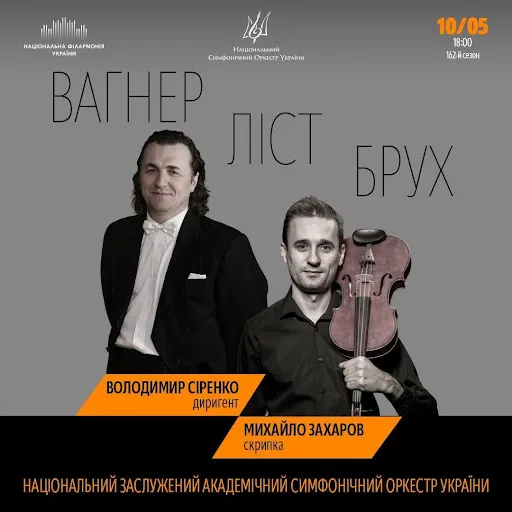
May 10: WAGNER. LISZT. BRUCH. Performed by the National Honored Academic Symphony Orchestra of Ukraine under the baton of Volodymyr Sirenko, featuring violinist Mykhailo Zakharov, the program will present a selection of iconic works of European Romanticism.
The first movement features the Prelude to Richard Wagner’s opera “Lohengrin,” centered on the image of the Holy Grail, which seems to descend from heaven to earth. The sound emerges from an almost weightless, radiant harmony, gradually enriching itself with new timbres and unfolding into a majestic orchestral crescendo. Upon reaching its climax, the music dissolves once more into a transparent, ethereal light. This continuous process—from silence to radiance and back—creates a sense of mystical revelation and timeless beauty.
Max Bruch’s Violin Concerto No. 1 in G minor is among the most famous works in the violin repertoire. At its heart lies the poignant Adagio—one of the most expressive examples of Romantic cantilena, one of the most beautiful slow movements in violin literature. The combination of melodic richness and orchestral depth has made this concerto a true classic of the violin repertoire.
The second section is dedicated to Franz Liszt’s “Faust Symphony” (first version), based on Goethe’s famous drama. The work paints a musical and psychological portrait of the three central characters—Faust, Gretchen, and Mephistopheles—revealed through contrasting thematic and orchestral characteristics. In the first version, the symphony concludes without a choral episode, retaining a purely orchestral finale and emphasizing the philosophical openness of the concept.
In this combination, the works of Wagner, Bruch, and Liszt emerge as different facets of a Romantic worldview—ranging from intense spiritual concentration to sweeping philosophical generalization—forming a cohesive artistic image of the era.
Music Salon
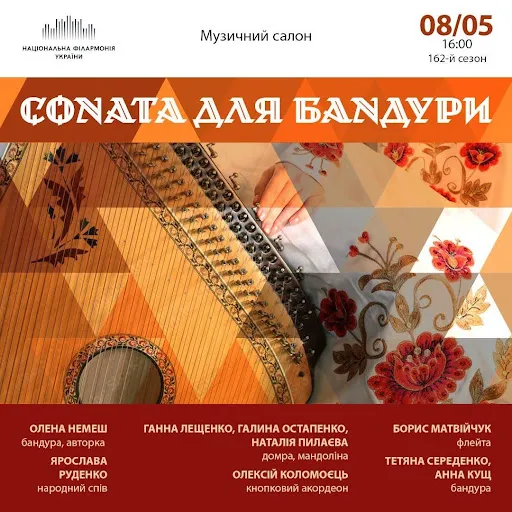
May 8: SONATA FOR BANDURA. A concert of original works by Olena Nemesh—this is music born here and now: from chamber solos and duets to large-scale ensemble pieces. The bandura will be heard solo, in dialogue with the flute, in a trio of bandura players, and in combination with an ensemble of folk instruments. And in the climactic piece “People – Birds,” live voices will join the instruments.
Here you’ll find an academic sonata, free improvisation, an ancient song brought to life anew, and a vibrant cycle of children’s pieces that brings light and smiles. This evening celebrates the power of the bandura, its contemporary spirit, and how Ukrainian music can sound bold, sincere, and always relevant.
May 9–10: Barrier-Free Weekend at the Philharmonic “Overcoming Stereotypes.” The National Philharmonic of Ukraine continues its series of cultural and educational events, “Barrier-Free Weekend: Overcoming Stereotypes.” This event will be dedicated to the theme “The Philosophy of Hearing”—an attempt to rethink what it means to hear, to listen, and to be heard.
This weekend is about the diversity of perception. It explores how people interact with sound in different ways: hearing it differently or not hearing it at all, yet simultaneously feeling, comprehending, and creating. The events will bring together art, education, and inclusive practices, opening a space for dialogue among people with diverse experiences.
Special attention will be given to the culture of deaf communities, the role of sign language in art, as well as the phenomenon of music and artistic expression beyond sound.
All events will be accompanied by translation into Ukrainian Sign Language.
Admission to all events taking place in the Music Salon and Music Foyer is free with prior registration.
Information resources of the National Philharmonic of Ukraine
https://www.facebook.com/philukr
https://www.instagram.com/kyivphilharmonic/
https://www.youtube.com/@philukr
https://www.tiktok.com/@go.to.phil
https://www.threads.com/@kyivphilharmonic
