
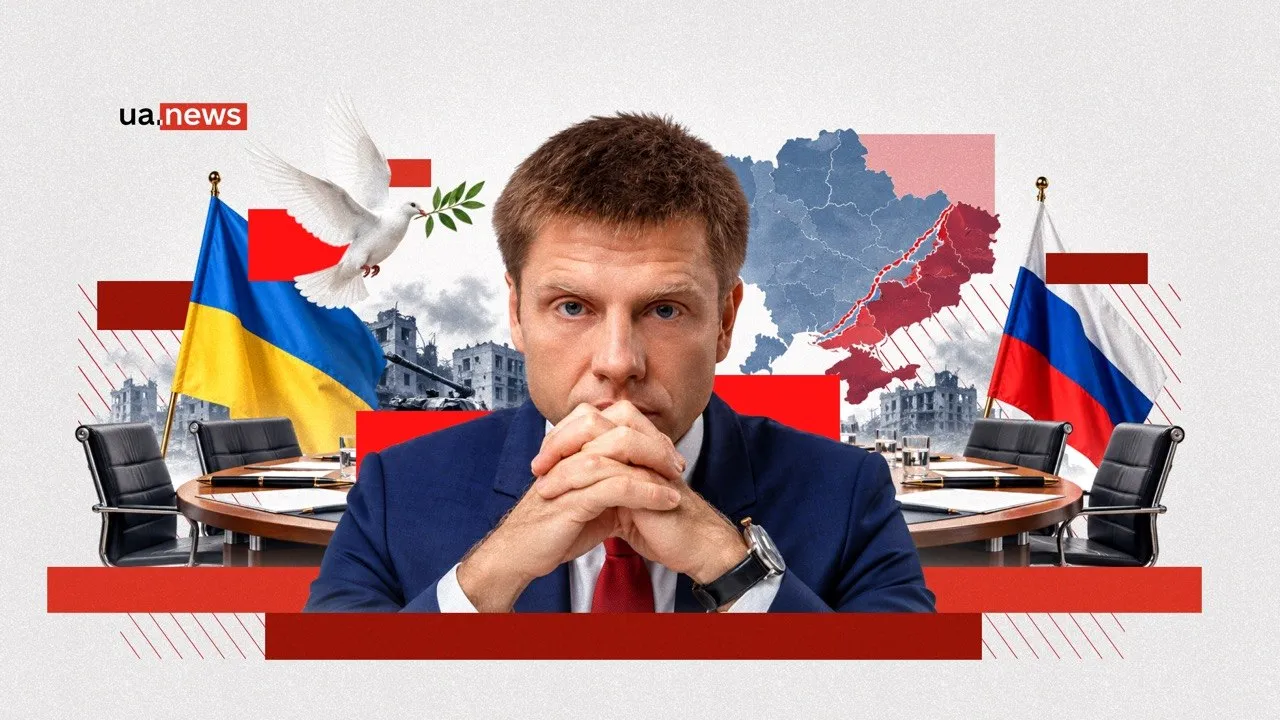
Don’t try to agree on everything at once; instead, start with areas where the parties can find common ground. Peace with Russia does not necessarily mean surrender, and negotiations do not mean that Putin should be taken at his word. This is the view of MP Oleksiy Honcharenko, who proposed his own plan to end the war. But instead of a nationwide discussion on how to stop the fighting and under what conditions Ukraine could negotiate with the aggressor, the politician faced a major scandal.
He was expelled from the “European Solidarity” faction and later added to the “Myrotvorets” database. His former party colleagues saw his proposals as dangerous concessions to Russia, while Goncharenko himself insists: he is not proposing surrender, but is trying to find a way to stop the deaths of Ukrainians and preserve the state. The MP’s political past has also become a point of contention. His former ties to the Party of Regions and past statements about the Russian language have taken on new significance in light of his current proposals for negotiations with the Kremlin. Goncharenko himself makes no secret of his political past, but emphasizes that his current goal is to preserve an independent Ukraine, a strong army, and the Ukrainian people.
Why does the lawmaker consider a war of attrition disadvantageous for Ukraine, what concessions is he willing to make, and where does he draw the line between compromise and capitulation? UA.NEWS journalists spoke with MP Oleksiy Goncharenko about these issues, as well as his split with Petro Poroshenko’s team, language policy, and the work of the parliamentary temporary investigative commission.
Ukraine’s Victory: Concrete Results That Will Lead to the End of the War
Let’s be realistic. For nearly five years, we have been waging a full-scale war against a massive state that possesses far greater human and financial resources. And during this time, Russia has failed to break us. This is primarily thanks to our military and the entire Ukrainian people. But we must honestly admit: today, a certain balance of power has emerged on the battlefield. We cannot defeat Russia militarily, but neither can Russia defeat us. At the same time, in a protracted war of attrition, we find ourselves in a much more difficult position.
Therefore, victory means putting an end to the deaths of Ukrainians, stopping the attacks on our cities, ensuring safe navigation in the Black Sea, rebuilding the economy, bringing back prisoners of war and deported children, and preserving a strong Ukrainian army.
New Agreements: How to Compel the Kremlin to Honor Its Commitments
I am absolutely not suggesting that we trust Putin. Moreover, I am convinced that there will be no trust between Ukraine and Russia for many generations to come. But international politics does not operate solely on trust. It operates on interests. And this is precisely what my peace plan is built on.
Instead of a single grand peace treaty—which is practically impossible to conclude today—I propose creating dozens of smaller agreements. Each would have its own subject matter, its own terms, and its own guarantor. Take the Black Sea, for example. Ukraine is interested in the safety of shipping and exports. Russia is also interested in the safety of its shipping. And Turkey is interested in the operation of its ports, the transit of energy resources, and stability in the region. At the same time, Ankara has real leverage over Moscow: the straits, energy transit, and the Middle East.
In other words, if Russia violates such an agreement, it creates a problem not only for Ukraine but also for Turkey, with which it has much broader relations. Similarly, China, Saudi Arabia, Egypt, the United States, and European countries can be engaged in other areas of negotiation.
There is also a specific economic mechanism. I propose a phased lifting of sanctions on Russian energy resources in exchange for concrete steps by Russia: ceasing long-range strikes, unblocking the Black Sea, and limiting military operations. The principle is very simple: first, Russia fulfills the agreement, and only then does it receive a corresponding easing of sanctions. If it resumes strikes, the sanctions are automatically reinstated.
On Donbas and a Ceasefire
My proposal is to move from simple agreements to more complex ones. First, we agree to cease strikes on specific targets: schools, hospitals, bridges, railways, and residential buildings. Next, we agree to a complete halt to attacks on infrastructure. The next stage is the gradual narrowing of the geographical scope of hostilities so that they are ultimately confined to Donbas. And only after that do we move on to the most complex issue—the final formula for resolving the situation in Donbas.
Why is this the case? Because all previous attempts at a peaceful settlement actually began with the most difficult issue—territory. And it was precisely on this point that the negotiations reached an impasse. I propose a different approach.
As for the territories, various options are possible: a ceasefire along a defined line, the creation of a neutral zone, mutual withdrawal of troops, or international administration of a specific territory under the auspices of the UN. But the fundamental issue is this: establishing the de facto line of control does not imply legal recognition of the occupation.
We have historical examples. The Baltic states were part of the USSR for decades, but the U.S. and many other Western countries did not recognize the legality of their annexation. Germany also remained divided for a long time but eventually reunified.
Of course, I am not suggesting that we legally relinquish Ukrainian territories. I am suggesting that we find a way to stop the loss of life, preserve the state, and leave the door open for a future political settlement.
Ukraine’s Neutrality and Who Will Guarantee Our Security
Let’s start with reality. Today, Ukraine is not being admitted into NATO. And no NATO country has provided us with guarantees that its military will fight for Ukraine in the event of a new Russian invasion. I believe we must prepare to discuss various models for Ukraine’s future security, the foundation of which must remain a strong Ukrainian army. We must continue to modernize our military, cooperate with NATO, and develop our own defense industry.
I also propose that funding for the Ukrainian army be provided, in particular, through a joint European budget. After all, our army defends not only Ukraine but also the security of all of Europe. The discussion on security guarantees must involve the states that have a direct interest in Ukraine’s security: Poland, Germany, the United Kingdom, Denmark, Sweden, Finland, Norway, and the Baltic states.
The Limits of Compromise with Russia
Russia’s first concession must be concrete actions that save the lives of Ukrainians. For example, ceasing attacks on energy infrastructure, schools, hospitals, and residential buildings. Or a genuine agreement on Black Sea security.
We can even start with a very narrow agreement. To put it simply: we won’t attack Novorossiysk, and Russia will stop its attacks on Odesa. If such an exchange doesn’t work, we’ll look for another one. But we must constantly seek opportunities to reach an agreement. It’s important to understand that a compromise is not a surrender. Surrender is when one side gives in and accepts all the other side’s terms. An agreement, on the other hand, involves mutual concessions.
The 2022–2023 Peace Agreement: How Close We Were to Signing It
I publicly confirmed the information about this peace plan published by the Financial Times. I want to emphasize that it contained some very interesting proposals that few people mention today.
What did this plan entail? First and foremost, Russia was to withdraw its troops from most of the four Ukrainian regions that it had itself declared annexed. The line of demarcation was to return, roughly, to the one that existed prior to February 24, 2022.
In addition, Russia was prepared to return the Zaporizhzhia Nuclear Power Plant to Ukraine. And $300 billion in frozen Russian assets were to be directed toward Ukraine’s reconstruction, including the occupied territories.
As for Crimea, there is a fundamental point here that is often misinterpreted. Ukraine was not required to legally recognize Crimea as Russian territory. The issue was the recognition of Russia’s de facto control over the peninsula—that is, acknowledging the situation as it exists in practice. At the same time, Ukraine was to pass a law that would prohibit the return of Crimea by military means.
There were also discussions about creating a land corridor to Crimea—a highway and a railroad—which Russia was to build at its own expense. This raised complex security issues. In particular, the Russians were prepared to cede Tokmak but refused to hand over Melitopol, as they feared Ukraine could cut off this corridor with artillery fire.
Importantly, NATO countries were to guarantee the ceasefire and would also provide protection for Ukraine. At the same time, Russia was to begin negotiations with the United States regarding its own security guarantees.
Why Zelenskyy Rejected the Proposal
I do not wish to attribute motives to the president that he himself has not publicly discussed. However, I believe that the public has a right to an explanation of exactly which proposals were discussed and why they were rejected.
Possible Concessions and Ukraine’s Negotiating Position
I believe that the lack of a clear strategy significantly weakens our negotiating position. When we spend years talking only about what we don’t want, but fail to propose a realistic path to ending the war, this also has consequences.
And let’s not confuse two things: public discussion of possible scenarios and specific concessions in negotiations. I am not suggesting that we lay all our red lines on the table for the Kremlin or agree to its demands in advance. I propose that we formulate a Ukrainian initiative.
Kremlin Propaganda and the Limits of Compromise
Russian propaganda uses absolutely everything that serves its interests. It can take any statement by a Ukrainian politician out of context. But that doesn’t mean we should stop discussing the future of our country. I want to reiterate one fundamental point: Russia’s goal is to destroy Ukraine as an independent state. My goal is to preserve Ukraine, its independence, its army, and its people.
If Russia rejects the agreements
This isn’t about the Ukrainian army having lost the war. On the contrary, our army has demonstrated incredible resilience. I’m talking about the fact that in a protracted war of attrition, Ukraine is at a disadvantage.
Let’s look at resources. Russia has a much larger population. It has greater capacity for mobilization. It continues to finance the war with its own resources.
Ukraine, on the other hand, depends heavily on international financial and military aid. And any political changes in partner countries can directly affect our ability to continue the war.
But there is another cost that is often overlooked in political discussions. It is human lives, demographics, destroyed infrastructure, businesses, and people who are leaving and may never return. Every month of the war weakens our economic and human potential.
My plan does not propose halting our defense and waiting for the Kremlin’s goodwill. Only a strong Ukrainian army remains the main guarantor of our security.
And if we cannot agree on ending the war entirely, we must try to reach agreements on specific issues: maritime access, energy, prisoner exchanges, and the protection of civilian infrastructure. We already have examples of prisoner exchanges taking place even during a full-scale war.
Therefore, I do not believe that negotiations should be halted after a certain number of failed attempts. We need to change the format, seek new guarantors, and identify other shared interests.
The Point of No Return in Relations with “European Solidarity”
I have always spoken my mind on any issue. We could have debated these issues within the faction. The same goes for peace. But on this issue, some positions were more contentious. That’s why things turned out the way they did. I don’t plan to form my own political party just yet. Right now, the most important thing for me is peace, not political projects or elections.
Position on the Russian Language
I want to state clearly: the Ukrainian language is and must remain the sole official language of Ukraine. It is the language of our state, education, science, culture, and public life.
But at the same time, we must understand that Ukraine is a European country that aspires to membership in the European Union. And the EU has set specific requirements for us regarding the protection of the rights of national minorities and bringing language legislation into line with European standards. This does not mean granting the Russian language the status of a second official language.
On the Results of the Temporary Investigative Commission’s Work
I believe that trust must be earned through concrete action. That is precisely why our Temporary Investigative Commission is addressing issues that directly concern the rights of military personnel, those who have been mobilized, and ordinary citizens. We are raising issues regarding violations during mobilization, the unlawful use of force, a lack of transparency in the work of the Territorial Recruitment Centers, the need to use body cameras, and ensuring proper oversight of officials’ actions.
We are hearing testimony from representatives of the Ministry of Defense, the National Police, the State Bureau of Investigation, the Territorial Recruitment Centers, and other agencies. And I am convinced that parliamentary oversight in these matters is extremely important.
My task is to use the tools provided by Parliament to bring about concrete changes. Specifically, greater transparency in the work of the Territorial Recruitment Centers, proper video recording of their actions, accountability for violations, and the protection of people’s rights during mobilization.
What to Say to Service Members and Their Families
First and foremost, I want to say that I have the utmost respect for our military personnel, veterans, and the families of those who gave their lives for Ukraine. It is thanks to our military that Ukraine has stood its ground. They were the ones who prevented Russia from carrying out its plans in 2022. And it is thanks to them that we are even able to discuss any negotiations today.
But I want to ask a very simple question: shouldn’t saving the lives of Ukrainian soldiers be one of the state’s top priorities? Shouldn’t we do everything possible to ensure that the people fighting today can return to their families?
My peace plan does not call for Ukraine’s surrender. It does not call for renouncing our independence, disbanding our army, or legally recognizing the occupied territories as Russian. On the contrary, I want Ukraine to remain a strong state, capable of defending itself. But I also want people to remain in this country. Because we must think not only about how to continue the war, but also about how to secure the country’s future after it ends.




