
Europe and China have launched a satellite to study space weather
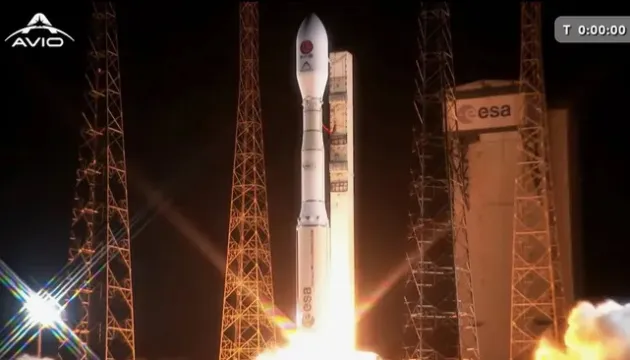
As part of a joint European-Chinese scientific mission, the Solar Wind Magnetosphere Ionosphere Link Explorer spacecraft was successfully launched.
This was reported by the specialized publication Space.com. The European Vega C launch vehicle lifted off from the Kourou spaceport in French Guiana and, approximately fifty-six minutes later, placed the satellite into an initial circular orbit at an altitude of over seven hundred kilometers.
The spacecraft’s primary mission is to study the effects of the solar wind on Earth’s magnetosphere and ionosphere. Using four specialized instruments, scientists aim to gain a deeper understanding of the nature of solar and geomagnetic storms. Scientists from the European Space Agency and the Chinese Academy of Sciences, which is also responsible for the direct control of the satellite, participated in the development of the equipment.
Over the next twenty-five days, the probe will perform a series of maneuvers to transition to a highly elliptical operational orbit. After the completion of the test period, which will last about three months, the mission team plans to obtain the first X-ray and ultraviolet images. The official duration of the scientific expedition in near-Earth space is estimated to be at least three years.
Space weather forecasters report that relatively stable solar activity is expected on May 19–20, with no significant geomagnetic disturbances.
You might be interested in: Magnetic storms in May 2026: dates and intensity.
Hubble Spots a "Space Slug" in the Trifid Nebula
Also, NASA has announced the date of the first human flight to the Moon in 50 years.
A NASA satellite will fall to Earth after 14 years in orbit.


