
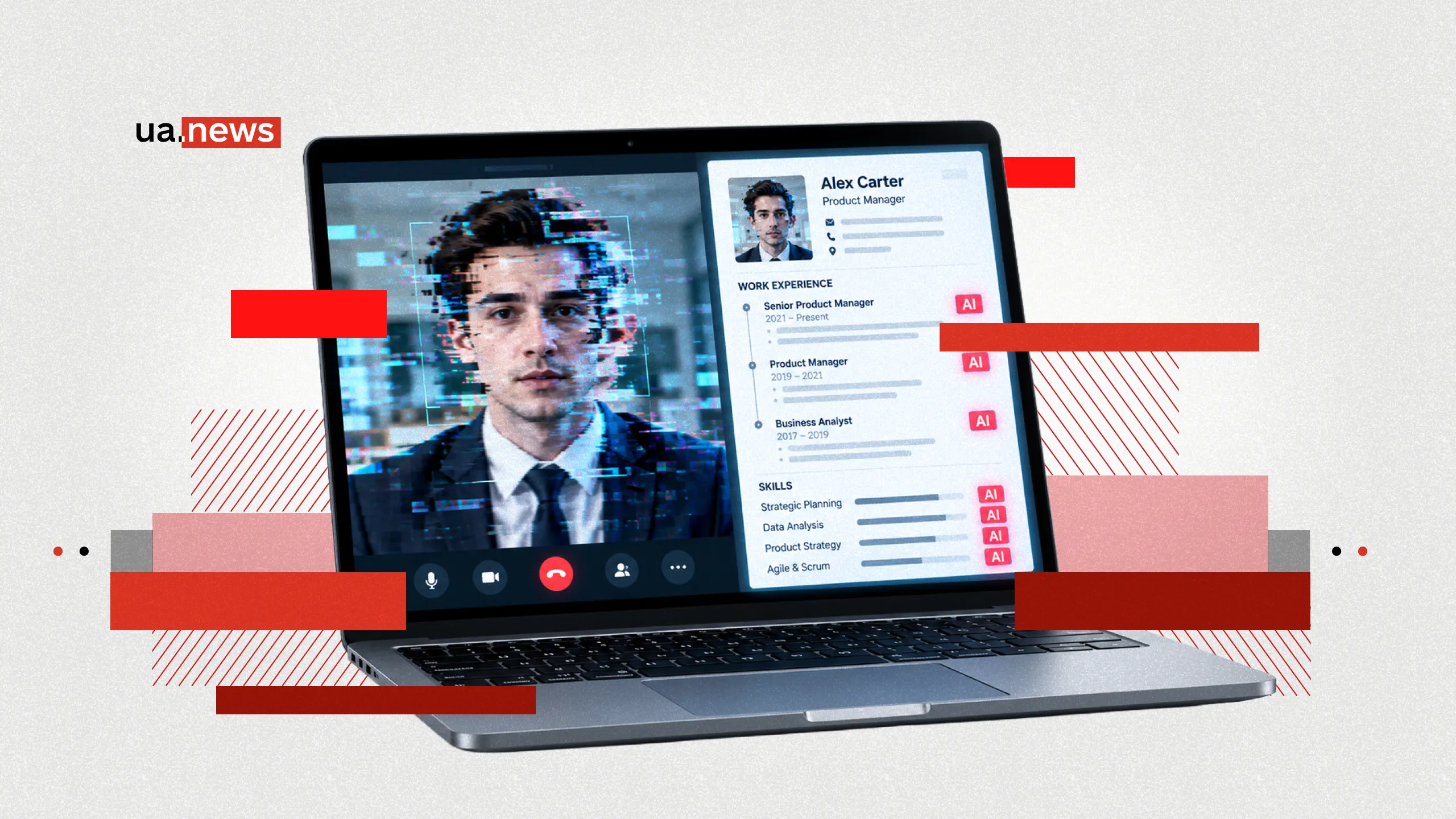
Fake Resumes and AI Avatars: How Candidates Deceive Employers During Job Interviews
26 October 2026 15:36Artificial intelligence is transforming the job market on both sides: companies are automating their recruitment processes, while candidates are using neural networks to apply for jobs more quickly, prepare for interviews, and showcase their experience. However, this has also led to a growing problem with the accuracy of information.
Employers are increasingly encountering resumes that do not match applicants’ actual skills, AI-generated prompts during technical interviews, and attempts to impersonate others using forged documents and digital avatars.
The problem isn’t limited to a candidate asking ChatGPT to edit a cover letter. It also includes situations where a person cannot explain what’s written in their own resume, reads generated answers from a screen, or uses someone else’s professional history.
UA.News explains how AI is changing the hiring process, why it’s becoming increasingly difficult for employers to vet candidates, what Ukrainian recruiters are noticing, and how companies are trying to distinguish real competencies from a convincing digital performance.
Why Employers Are Changing Their Hiring Rules

One reason for the stricter vetting is the increase in the number of applications, which are easy to create and adapt using generative AI. A neural network can, in a matter of minutes, tailor a resume to a specific job opening, draft a cover letter, and prepare answers to typical recruiter questions. For the candidate, this saves time; for the company, it means an additional flood of applications, making it harder to find people with the right experience.
The Financial Times points out that the proliferation of generative AI tools makes it harder to evaluate candidates: applications now look more polished, but they no longer guarantee on their own that a person actually possesses the skills described.
This trend is also illustrated by the results of a study commissioned by Deel among British HR managers. According to data released in February 2026, 75% of respondents reported an increase in the number of applications created using AI, and 74% consider resumes and cover letters less reliable than they were two years ago.
Companies are responding to this by making changes to their hiring processes. Some are increasing the number of interview rounds, while others are adding practical tasks, reference checks, or probationary periods. Questions that help determine how a person thinks, makes decisions, and applies knowledge in practice—rather than simply reciting a prepared text—are becoming increasingly important.
At the same time, employers themselves are actively using AI. Neural networks help analyze resumes, draft job descriptions, prepare messages for candidates, and organize notes after interviews. A kind of technological race is emerging: applicants are automating the preparation of applications, while companies are automating their processing. As a result, there is a growing risk that both sides will spend more and more time interacting with algorithms instead of having a meaningful conversation.
How Candidates Use AI in IT Interviews

This problem has become particularly noticeable in the IT sector, where some professional skills can be assessed through technical questions, coding exercises, and analysis of practical scenarios. AI is capable of quickly explaining algorithms, suggesting code snippets, and generating answers even to complex questions. If a candidate uses such prompts without the interviewer noticing, it becomes more difficult to assess their true skill level.
According to Stanislav Revko, Team Lead and Senior PHP Engineer, the use of AI during technical interviews has already become a significant problem for employers.
“Out of seven candidates, three, as I suspected, used AI during the interview,” Revko noted.
He explained that in one instance, ChatGPT began answering questions on the candidate’s behalf. Another candidate was reading prepared answers from a secondary monitor. Yet another candidate answered technical questions with such confidence that Revko decided to test his knowledge by asking about nonexistent technologies. Despite this, the candidate continued to provide convincing answers.
At the same time, Revko emphasizes the importance of verifying actual knowledge, not just outward appearances. The use of AI in and of itself does not necessarily indicate cheating: developers regularly consult documentation, search engines, and AI assistants in their daily work. The problem arises when a candidate conceals outside assistance during an assessment that is meant to demonstrate their own level of competence.
To test a candidate’s knowledge, Revko advises going beyond standard questions and canned answers: ask them to explain the logic behind their solution, change the conditions of the task, and clarify details. This helps determine whether a person truly understands the material and is capable of applying it in practice, rather than merely regurgitating a generated prompt.
Fake degrees and stolen professional profiles
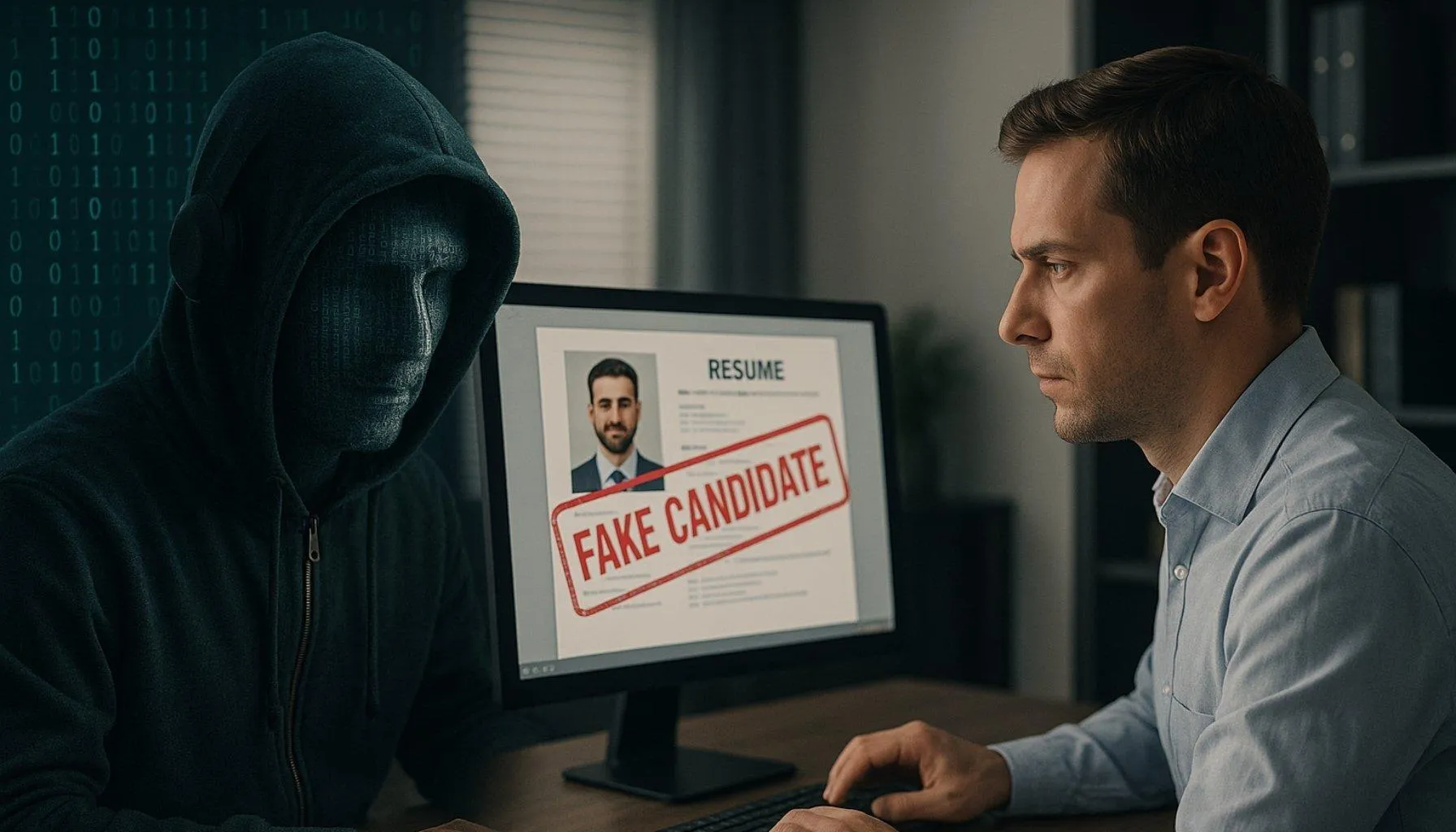
In addition to resumes with exaggerated experience, employers encounter cases where candidates conceal their true identities. To do this, they may use other people’s photos, forged documents, copied professional profiles, and deepfakes, which allow them to mimic another person’s appearance during a video interview.
Detecting such impersonation isn’t always easy. Sometimes during a video call, you might notice unnatural synchronization between lip movements and speech, delays, or inconsistencies in facial expressions. However, these signs are not definitive proof of deepfake use, and technological advances are gradually making it more difficult to detect fakes based on the image alone.
One of the problems is that it isn’t always necessary to fabricate professional experience from scratch to deceive. Fraudsters can use the data of a real professional, copy their resume and portfolio, and add links to genuine LinkedIn or GitHub profiles. As a result, the application looks convincing, even though the person being interviewed may have absolutely no connection to the listed achievements.
Therefore, vetting a candidate should include not only their qualifications and experience but also identity verification. Even if the projects and professional profiles are genuine, that doesn’t mean the employer is actually speaking with the person behind them during the interview. Without additional verification, the company risks hiring someone who has stolen another person’s professional history.
When a Fake Candidate Threatens Corporate Security
In some cases, the use of fake identities serves more than just career or financial goals. These include attempts to gain access to companies’ internal systems, customer data, source code, and corporate infrastructure. Employers who hire employees remotely and grant them access to internal resources immediately upon hiring may be particularly vulnerable.
In March 2026, The Guardian reported on the use of AI to mislead Western companies during the hiring process, linked to North Korean agents. Such schemes may involve fake identities, stolen data from real people, and other methods designed to conceal a candidate’s true background. The article also mentioned that Microsoft had blocked thousands of Outlook and Hotmail accounts linked to such activities.

In this case, the risk is not limited to a company hiring an employee who does not meet the job requirements. If a person gains access to internal tools, they can collect confidential information, study corporate processes, or use the provided login credentials for other purposes. For an employer, this is already a cybersecurity issue, not just a matter of recruitment efficiency.
It is important, however, not to equate every candidate who uses AI with a potential malicious actor. Automated resume generation, prompts during training, and identity spoofing are distinct phenomena with different motives and consequences. The threat arises when technologies are used for deliberate deception or to gain access under a false name.
Cybersecurity companies are also investigating the problem of fake candidates. HR Dive, citing materials from Palo Alto Networks, reported on an experiment in which experts were able to create a convincing fake candidate profile using deepfake technology. According to the experiment’s description, preparing and carrying out the scenario took approximately 70 minutes.
This example shows just how accessible tools have become that previously required specialized knowledge and significant resources. However, a successful demonstration of this technological capability does not mean that all fake candidates pass the screening process or that fraud occurs on the same scale across all industries. Rather, it explains why companies should verify not only professional skills but also the character of the person being hired.
How AI Is Used to Deceive Employers in Ukraine
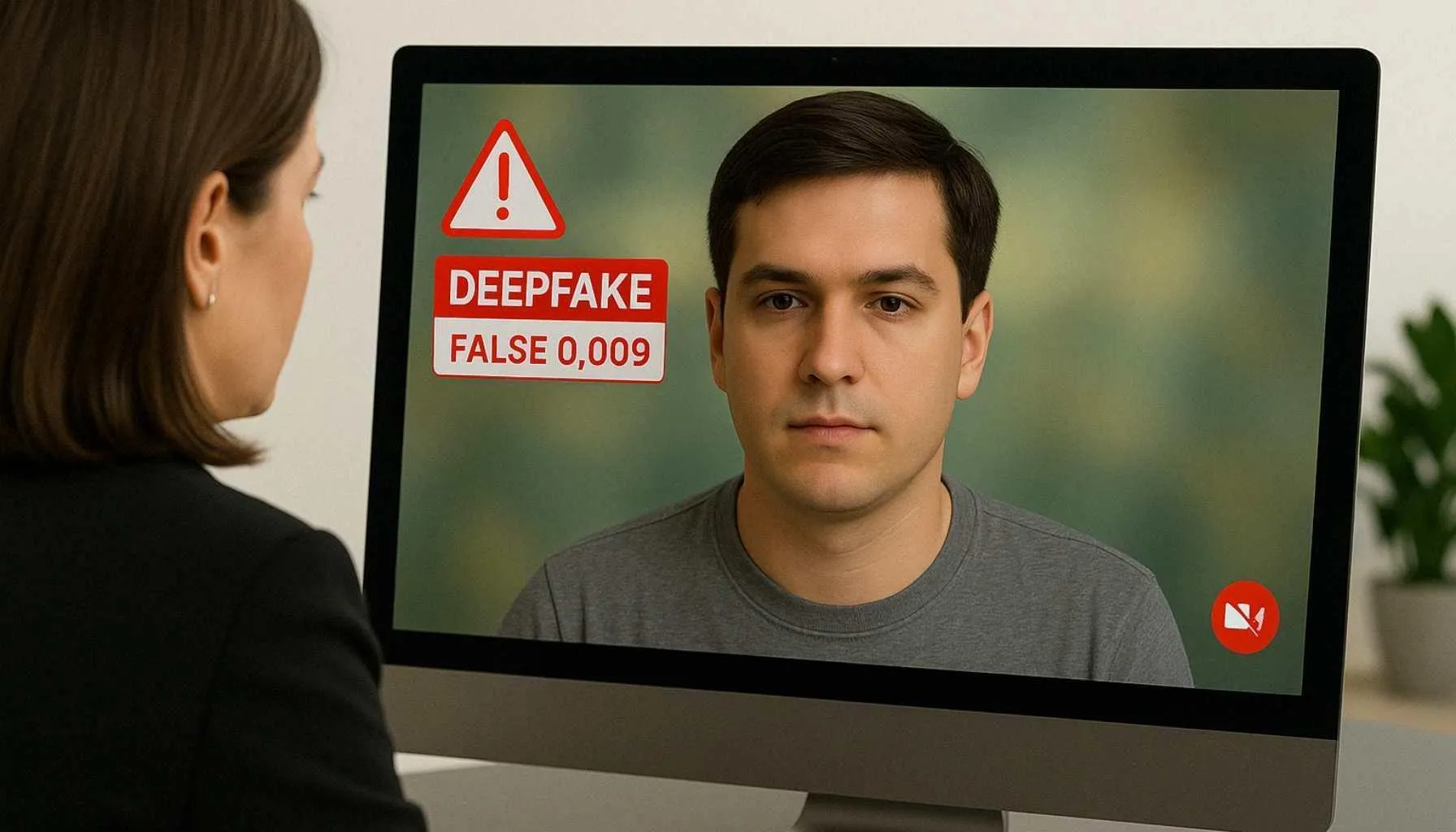
Cases of fraud during the hiring process have also been detected in the Ukrainian IT sector, including the use of others’ professional data and deepfake technology. Vladislav Muzhilivsky, an IT recruitment specialist and representative of the recruitment agency Itentio, spoke about the growing practice of candidates using AI to pass technical tests or altering their appearance during video interviews. Such cases complicate the vetting of applicants and create additional risks for employers.
Sofia Didukh, CEO of SODI, recounted an incident encountered by a recruiter on her team. Before the interview, the candidate refused to turn on his camera but instead sent a video on his own initiative, even though the recruiter hadn’t asked him to do so. It later turned out that the video had been created using artificial intelligence, with the face of another person superimposed on the candidate’s body. In the video, the candidate tried to convince the interviewer in English that he was a native Ukrainian.
HR business partner Yana Borovik shared her own experience with detecting such cases.
“This happens most often when we’re testing hard skills. To spot it, we sometimes ask slightly confusing questions or approach the same topic from a different angle. There was a case where a candidate gave two different answers to the exact same question, and it became clear that he wasn’t drawing on his own experience,” she said.
According to Borovik, there are also certain signs that may indicate a candidate is reading answers generated by artificial intelligence. In particular, a person may hesitate before starting their answer, use introductory phrases like “thank you for the question,” and then speak as if reading from a prepared text.
“The answer sounds too smooth: no pauses, no self-corrections, no natural ‘um’s’ or hesitations, and no imprecise words that are usually found in natural speech. Their eyes dart across the text, and this is clearly visible on camera. The answer is general and ‘correct,’ but lacks specifics drawn from their own experience,” the HRBP explained.
At the same time, the expert emphasizes that artificial intelligence doesn’t necessarily complicate a recruiter’s work. It can be used as a supportive tool that frees up time for direct communication with the candidate. For example, an AI note-taker can automatically capture the main points of a conversation, and analyzing resumes with such tools helps identify in advance the topics worth discussing in more detail.
However, candidates’ use of AI is forcing recruiters to change their approach to evaluating responses. According to the expert, it is no longer enough to focus solely on how confidently and coherently a person speaks. It is far more important to determine whether their statements are backed up by specific examples and real-world experience.
To reduce the risk of fraud during remote hiring, Borovyk advises structuring the interview as a live dialogue rather than a list of questions with predictable answers.
“The key is to structure the interview as a live conversation, not as a set of questions with prepared answers. I would recommend three things.
First—dig deeper. After each answer, ask follow-up questions: ‘How exactly did you do that?’, ‘What went wrong?’, ‘What role did you specifically play?’ AI is good at giving general, correct answers, but real experience is revealed in the details.
Second, revisit what’s been said. After 10–15 minutes, you can return to a topic from earlier in the conversation and ask the candidate to explore it from a different angle. If the experience is genuine, the story will remain coherent.
Third, engage in a dialogue rather than listening to a monologue. You can gently interrupt with clarifying questions in the middle of their response. “It’s very difficult to read text off a screen while simultaneously responding to the other person’s comments, so this becomes obvious very quickly,” the HRBP concluded.
How Companies Can Screen Candidates in the Age of AI
It’s hardly possible to completely ban the use of AI during the job search, and not every such ban would be justified. Neural networks can help people formulate thoughts, prepare for interviews, translate materials, and analyze complex topics. It is more important for companies to determine which uses of these tools are permitted and which violate the assessment guidelines.
The first step is to clearly explain the selection criteria. If AI cannot be used during a test task, this should be communicated in advance. If, on the other hand, the job involves the use of such tools, it’s worth assessing how well the candidate understands the results and whether they can independently evaluate their quality. In real-world work, the ability to apply AI correctly can be an advantage, but it does not replace responsibility for the decisions made.
The second step is to change the format of technical interviews. Instead of focusing solely on the correct answer, the interviewer can ask the candidate to explain the sequence of steps, suggest alternative approaches, identify an error, or adjust the solution under new conditions. This allows for an assessment not only of the final result but also of the candidate’s understanding of the process. Questions based on the experience listed on the resume are particularly useful: what exactly the candidate did, what challenges they faced, and why they chose a specific solution.
The third step is to verify experience through practical examples. If the resume mentions work on a complex project, the candidate should be prepared to explain their own contribution, the architecture of the solution, the trade-offs, and any mistakes. If necessary, you can ask them to demonstrate their workflow or walk through a portion of the project. It’s important that the assessment aligns with the job’s requirements and doesn’t turn into the candidate doing a significant amount of unpaid work for the employer.

Step four is to separate the assessment of skills from the verification of identity. For remote hiring, this may involve verifying documents in accordance with applicable legal procedures, cross-checking contact information, and confirming prior experience and references through independent channels. If there are doubts about who exactly is participating in the interview, the company should conduct additional verification rather than drawing conclusions based solely on video quality or behavioral cues.
Step Five: Do not rely on automated AI detectors as definitive proof. Tools that attempt to determine whether text was generated by a neural network can be inaccurate. It is particularly risky to draw conclusions based solely on the style of a resume, accent, pauses, or eye movements. Suspicious signs should prompt further clarification, not automatically lead to rejection.
Finally, companies should restrict new employees’ access to internal systems in accordance with their job responsibilities. Even after a successful hire, not every employee should immediately be granted access to all data and services. Background checks, access controls, multi-factor authentication, and gradual granting of permissions help mitigate risks regardless of whether a candidate used AI during the selection process.
Where Is the Line Between Assistance and Deception?
Artificial intelligence hasn’t made all candidates suspicious, but it has changed what employers may consider convincing proof of competence. A polished resume, a confident answer, and a professional profile no longer always indicate that a person actually possesses the skills they claim to have.
At the same time, attempts to identify AI use based on external signs can lead to false suspicions and weed out strong professionals.
Therefore, the main challenge for companies is not to combat the technology itself, but to verify actual abilities and the accuracy of the data. If a candidate uses AI but understands its responses, can verify the results, and takes responsibility for their own decisions, this can be a legitimate part of modern work. However, if they conceal outside assistance, pass off someone else’s experience as their own, or impersonate someone else, that constitutes fraud.
For employers, this means combining technical tasks, in-depth interviews, experience verification, and basic security procedures. For candidates, it’s important not only to learn how to use new tools but also to be prepared to explain their own work without a pre-prepared script.
As AI becomes more widespread, hiring will depend less and less on how well a person can present themselves on paper. What will remain decisive is a person’s ability to think, demonstrate experience, work with information, and take responsibility for results. It is precisely these qualities that distinguish a real professional from a convincingly crafted digital image.




