
Physicists propose a model of a discrete time liquid — ScienceAlert
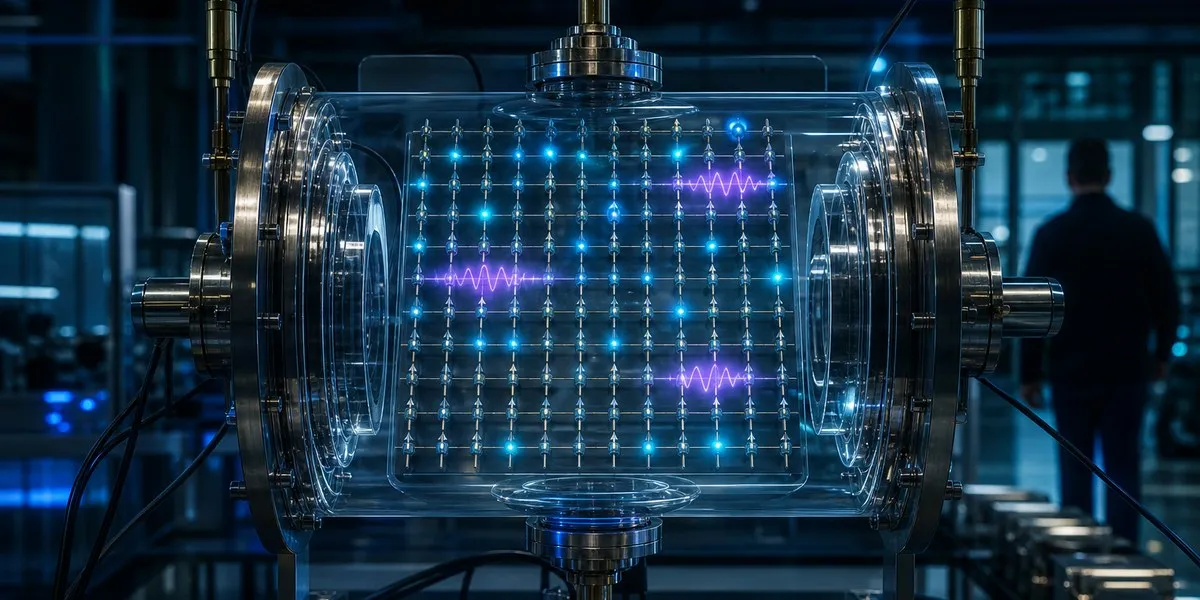
Physicists from the Max Planck Institute for the Physics of Complex Systems in Germany have proposed a theoretical model of a discrete time liquid. In such a system, local order in time is retained, although long-range coherence of oscillations is destroyed. The work of the team led by Zuo Wang and Marios H. Michael was published on the arXiv preprint server; it has not yet undergone peer review, ScienceAlert reports.
Time liquid model
The researchers relied on the principles of discrete time crystals. In an ordinary crystal, a structural pattern repeats in space, while in a time crystal a certain mode of behavior repeats in time. A discrete time crystal is driven by an external source, but its own rhythm may differ from the frequency of that source: for example, one crystal cycle may occur over two cycles of the external influence.
In the model, the physicists considered a two-dimensional lattice of interacting spins — conventional magnetic moments. It was coupled to an electromagnetic resonator in which thermal fluctuations cause oscillations of the electromagnetic field. The field affects the spins, prompting them to change orientation and interact with neighboring elements of the lattice.
More current news is available on the UA.News Telegram channel Telegram.
Order in the presence of fluctuations
Under certain simulation conditions, the spins began oscillating at a frequency twice as low as that of the resonator, despite the irregular fluctuations driving the system. At the same time, they occasionally switched between two equivalent variants of the repeating rhythm.
The authors called such disturbances time solitons. They disrupt long-range temporal coherence but do not destroy local temporal order. By analogy with water, which retains local structure after ice melts, the simulated system retained local temporal order after losing long-range order.
The simulations also showed an unusual role for temperature. At low temperatures, fluctuations were too weak for a repeating rhythm to emerge. At intermediate temperatures, order appeared, while at high temperatures excessive fluctuations destroyed it. The authors suggest that such a system may restore time-translation symmetry on average and could potentially exist in thermal equilibrium, where ordinary time crystals should not form. The time liquid has not yet been realized experimentally.




