
Scientists discover magma’s ability to store excess oxygen — ScienceDaily
A group of researchers has found that molten rock under high pressure can store additional oxygen beyond the amount predicted by its normal chemical composition. As ScienceDaily reports, this may indicate a previously underestimated link between Earth’s interior, volcanism, and the formation of an oxygen-rich atmosphere.
The study was led by Yanhao Lin and Ho-Kwang Mao of the Center for High Pressure Science and Technology Advanced Research, together with Haiyang Niu of Northwestern Polytechnical University and Wim van Westrenen of Vrije Universiteit Amsterdam. The results were published in the journal National Science Review.
High-pressure experiments
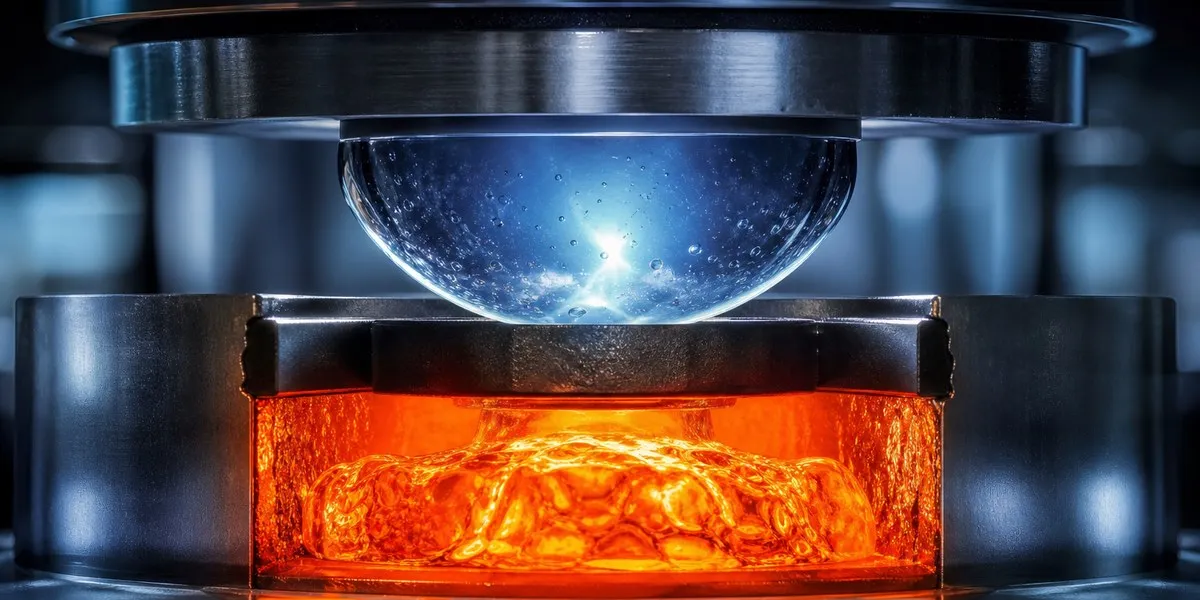
The scientists heated a synthetic analogue of mid-ocean ridge basalt at temperatures from 1200 to 1800 °C and pressures of up to 7 gigapascals — approximately 69,000 times higher than atmospheric pressure. Platinum oxide was added to the samples to create an oxygen-rich environment.
After rapidly cooling the melt, the researchers analyzed the composition of the resulting glass, including its water and carbon dioxide content. They calculated the amount of oxygen needed to balance the other elements and determined the share of oxygen that remained unaccounted for. They called it excess oxygen.
More current news is available on the UA.News Telegram channel Telegram.
At normal atmospheric pressure, there was almost no excess oxygen in the glass. At a pressure of 7 gigapascals, its share exceeded 5% of the sample’s mass. In control experiments without added platinum oxide, this figure ranged from 0.2% to 0.5% of the mass.
A possible route for oxygen to reach the surface
Raman spectroscopy detected no signal of molecular oxygen in the glass, which, according to the authors, indicates that the excess oxygen was incorporated into the material’s structure rather than retained as gas bubbles. Computer modeling also showed that the melt’s ability to dissolve additional oxygen increases as pressure rises.
The researchers suggest that magma in oxidized parts of the mantle may have absorbed oxygen at great depth and released it as it rose toward the surface due to falling pressure. They emphasize that this does not prove that ancient volcanism contributed to the current amount of atmospheric oxygen. At the same time, a preliminary estimate showed that if magma released excess oxygen equal to 0.27% of its mass, it could theoretically be enough to account for the amount of oxygen currently present in Earth’s atmosphere.




