
JWST detects signs of an atmosphere on lava exoplanet TOI-561 b — Space.com
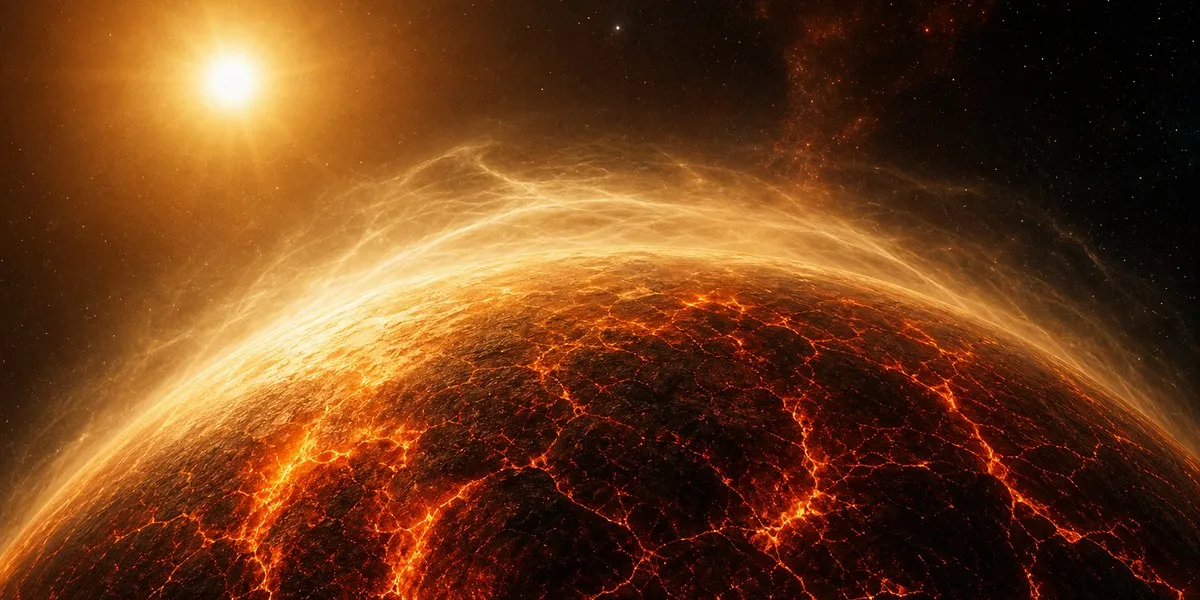
The James Webb Space Telescope (JWST) has detected signs of an atmosphere on the rocky lava exoplanet TOI-561 b, located about 280 light-years from Earth. As Space.com reports, the planet is covered by a reflective layer of clouds made of vaporized silicate minerals — compounds from the same group that includes quartz and sand.
A planet with an 11-hour year
TOI-561 b was discovered in 2020 using NASA's TESS satellite. It orbits so close to its star, TOI-561, that one complete orbit takes just 11 hours. Its surface temperature exceeds 1,800 degrees Celsius. Because of these conditions, astronomers had previously believed that the planet was unlikely to be able to retain an atmosphere.
Scientists analyzed changes in TOI-561 b's brightness and temperature throughout its orbit. For this purpose, JWST observed the exoplanet for 37 hours, covering nearly four complete orbits. The phase-curve method showed that the planet reflects a substantial portion of its star's light and that heat is distributed beyond the illuminated side.
More current news is available on the UA.News Telegram channel Telegram.
Clouds reflect most of the light
TOI-561 b is tidally locked: one of its hemispheres permanently faces the star, while the other faces space. Researchers observed the planet's night side for the first time and determined that it is not warm enough to explain the lack of heat on the day side.
According to the team's conclusion, the exoplanet reflects about three-quarters of the starlight that reaches it. This is comparable to Venus, which reflects about 75% of sunlight, while Earth reflects about 30%. This reflectivity is likely produced by clouds of silicon dioxide and magnesium silicate. The composition of TOI-561 b's atmosphere has not yet been established: it may resemble Venus's dense carbon dioxide atmosphere or contain sulfur dioxide, as on Io, Jupiter's volcanically active moon. The study's results were published in The Astronomical Journal.




