
Gravitational lensing may explain unusual black hole merger — Space.com
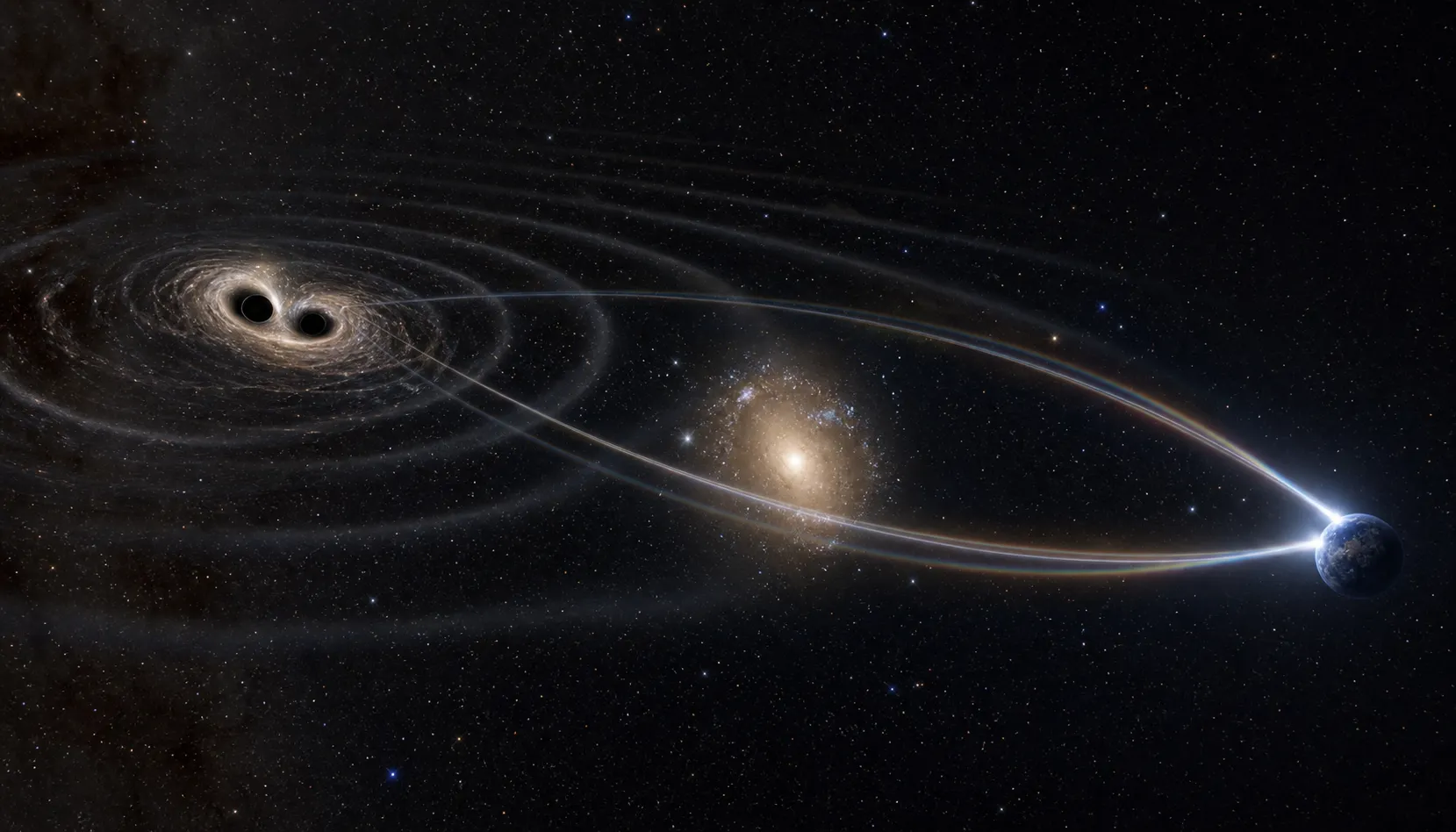
Researchers suggested that an unusually massive black hole merger recorded by the LIGO detector on November 23, 2023, may have appeared larger because of gravitational lensing. The GW231123 signal was initially interpreted as a collision of black holes with masses of about 140 and 100 solar masses, Space.com reports.
Why the merger was considered unusual
Standard models of stellar evolution struggle to explain the formation of such massive black holes. Researchers were also surprised by the initial interpretation that both objects may have been spinning rapidly. The new work offers another explanation: the black holes may have been smaller, while gravitational lensing amplified the gravitational-wave signal on its way to Earth and created the impression that the objects had greater masses.
Gravitational lensing occurs when a massive object warps spacetime and changes the path of radiation from a distant source. This effect is known for light, but according to Miguel Zumalacárregui, head of the Astrophysical and Cosmological Relativity Division at the Albert Einstein Institute, gravitational waves can also be deflected, amplified and split into several signals.
More current news is available on the UA.News Telegram channel Telegram.
Possible lensing object
The team created a mathematical model of gravitational lensing and software to analyze it. According to study participant Srashti Goyal, the observed high masses can be explained if the GW231123 signal was deflected and distorted by a compact object with a mass of 190 to 850 solar masses or by an extended structure such as a globular cluster. Such a scenario also does not require assuming extremely rapid black hole rotation.
According to modeling that accounts for lensing, the merger may have involved a system with a total mass of about 140 solar masses, rather than a 240-solar-mass system as initially assumed. At the same time, the nature of the object that could have caused the lensing remains uncertain. Scientists note that individual compact lenses with masses from 100 to 1,000 solar masses should be extremely rare, so it is necessary to determine whether this effect can be produced by a collection of lighter objects, including stars.
The study was published on August 25 in the journal Astrophysical Journal Letters. The authors cannot yet conclusively confirm whether GW231123 is the first detected case of gravitational lensing of gravitational waves. Increased sensitivity of detectors such as LIGO will be needed to search for similar signals.


