
Chinese-German team develops levitating magnetic sensor
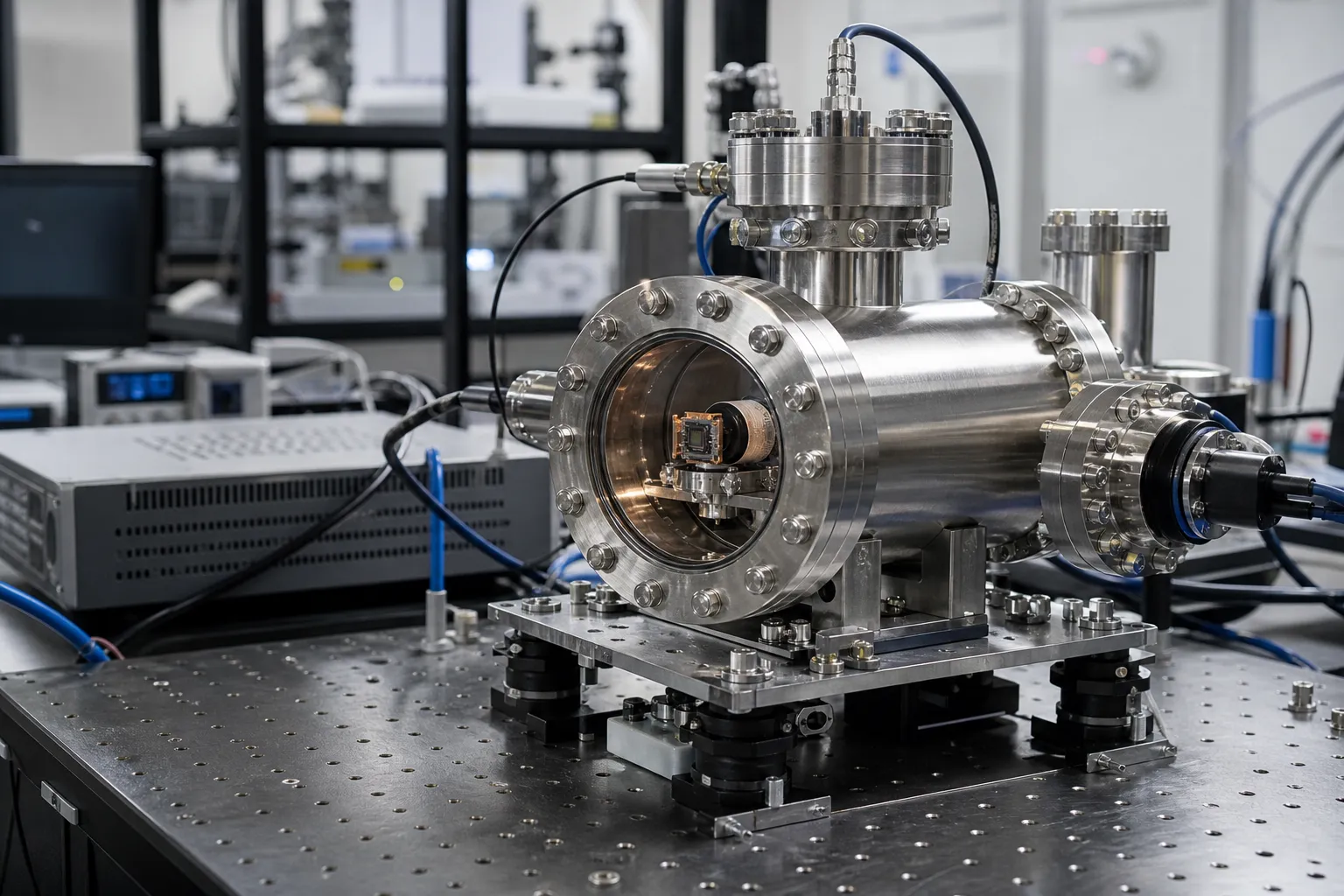
Researchers at Peking University in China and Johannes Gutenberg University Mainz in Germany have developed the ultra-precise Levitated Magnet Magnetometer, or LeMaMa. The device operates at room temperature and can detect magnetic signals at the femtotesla level — billions of times weaker than Earth’s magnetic field, South China Morning Post reports.
A magnet without an axis or suspension
At the core of LeMaMa is a miniature sensitive magnet 0.4 mm thick, held in the air without an axis or suspension thread. Another magnet creates a force that compensates for gravity, while specially designed diamagnetic materials below stabilize its position.
Under the influence of an external magnetic field, the sensor magnet deviates slightly. By measuring these movements, scientists can determine the strength and changes of the external field. The sensor is placed in a vacuum chamber, and the entire setup was installed on a vibration-isolation platform to reduce the impact of external noise.
More current news is available on the UA.News Telegram channel Telegram.
Operation without cryogenic cooling
As the publication notes, previous femtotesla-level measurements generally required either superconducting quantum interference devices operating at temperatures close to absolute zero, or atomic magnetometers using heated vapor and powerful magnetic shielding.
LeMaMa does not require liquid helium, heating, or a large shielded room. The entire system fits inside a vacuum chamber approximately the size of a lunchbox. In laboratory tests, the device detected ultraweak magnetic fluctuations against the background of Earth’s much stronger natural magnetic field.
The corresponding author of the study, Ji Wei, an associate professor at Peking University’s School of Physics, said that the combination of room-temperature operation, small components, and high sensitivity makes the device promising for fundamental physics experiments. According to him, the team has already managed to use LeMaMa to search for axion dark matter and improve sensitivity compared with previous results in a certain mass range. Other potential applications include the study of neural signals, magnetic imaging, and geophysical exploration.


