
Smile sends first images of aurora over sunlit Earth — Live Science
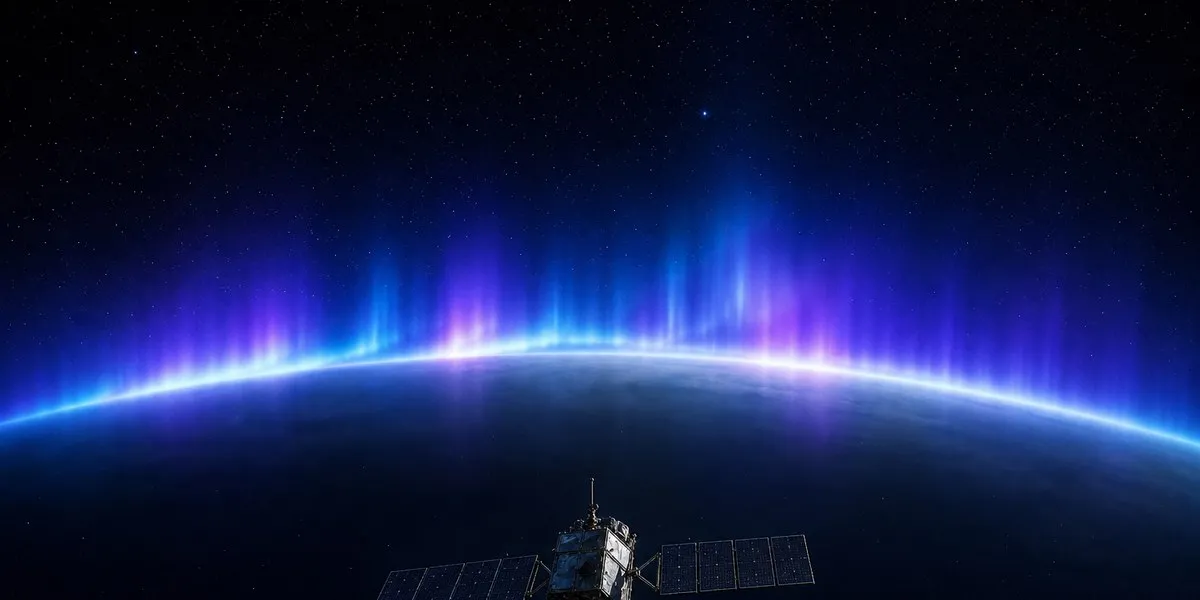
The European-Chinese Smile satellite has begun scientific observations and transmitted its first ultraviolet images of aurora over the sunlit side of Earth. In the image, the planet glows like a crescent moon, while a large ring of charged particles is visible above the North Pole.
Aurora in ultraviolet
The images were obtained in July 2026 using Smile's ultraviolet instrument for observing auroras. As Live Science reports, the aurora covers approximately one-third of Earth's visible part. The spacecraft captured it above the sunlit side of the planet in the ultraviolet range, whereas the human eye usually sees auroras at night and near the poles.
Auroras occur when charged particles from the Sun travel along Earth's magnetic field lines and interact with atmospheric molecules near the poles, causing them to emit light.
More current news is available on the UA.News Telegram channel Telegram.
Three years of observations
Smile was launched on May 19. Over the next three years, the spacecraft will operate in a highly elliptical orbit that takes it about 121,000 kilometers above the North Pole — roughly one-third of the distance to the Moon. From this trajectory, the satellite will be able to observe the North Pole for up to 45 hours at a time.
In addition to the ultraviolet instrument, Smile carries three more scientific instruments for detecting X-ray radiation, magnetic fields and light ions near Earth. The team also tested the soft X-ray imager by pointing it at the Cassiopeia A supernova remnant, located approximately 11,000 light-years from Earth. The instrument is working, but when pointed at Earth, the detector records slightly too much light and therefore requires additional calibration.




