
Physicists measure the W state of three quantum-entangled photons — ScienceAlert
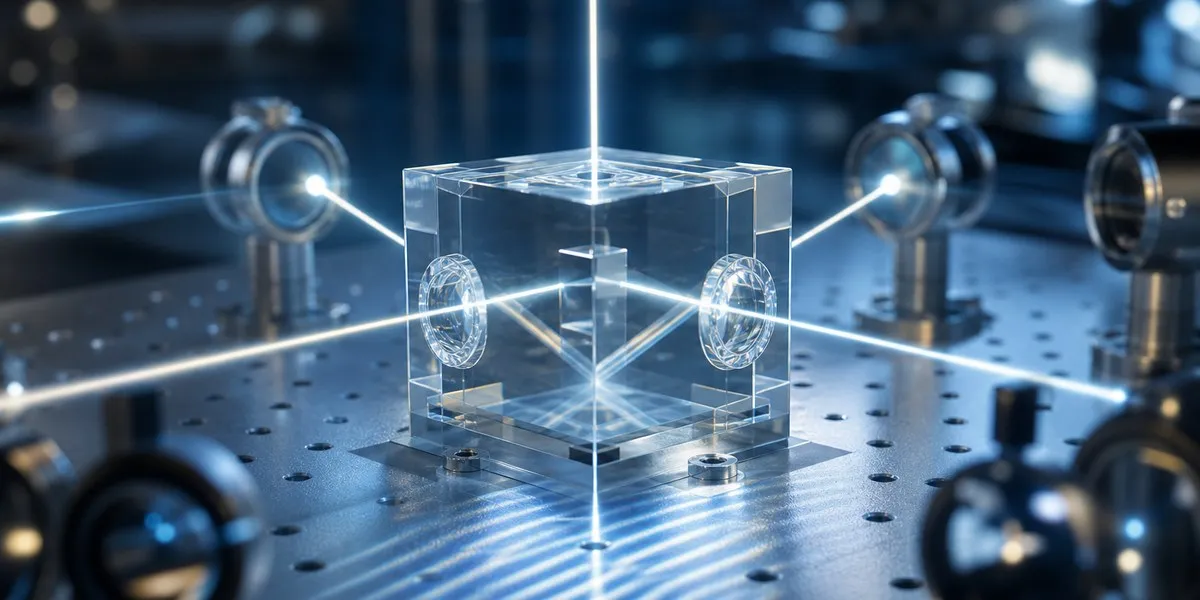
Researchers from Kyoto University and Hiroshima University demonstrated a one-step measurement of the W state of quantum entanglement in three photons. The method was described in an article published in the journal Science Advances in September 2025, ScienceAlert reports.
One-step measurement
The team used an optical device it developed based on a discrete Fourier transform, which operated as an interferometer. Three photons with known polarization were fed into it. The device directed them along different paths and then brought them together again to study the interference of their wave functions.
This approach made it possible to study the cyclic symmetry of the W state. With this property, the description of the system does not change when its individual photons are cyclically rearranged. Quantum information researcher Shigeki Takeuchi called the experiment a real demonstration of measuring W states of three photons.
More current news is available on the UA.News Telegram channel Telegram.
Accuracy and applications
The average accuracy of distinguishing the states was 0.871 ± 0.039. According to the source, the researchers correctly identified the W state in approximately 87% of cases. This exceeds the mathematical threshold of 66.7%, which the authors associate with demonstrating the measurement of an entangled state of three particles.
Quantum tomography is often used to determine the parameters of quantum-entangled systems. It requires numerous measurements and a large number of identical systems, since measurement takes the system out of the entangled state. In addition, the number of measurements needed to reconstruct a state grows exponentially as the number of particles increases.
The W state differs from Greenberger–Horne–Zeilinger states in that after the loss of one entangled particle, the others can retain a useful entangled state. The team attributed the deviation from 100% accuracy to imperfections in photon preparation and the measurement setup. The researchers plan to further develop photonic quantum circuits on a chip for such measurements.




