
The Webb Telescope has discovered an unusual planet with a soft atmosphere
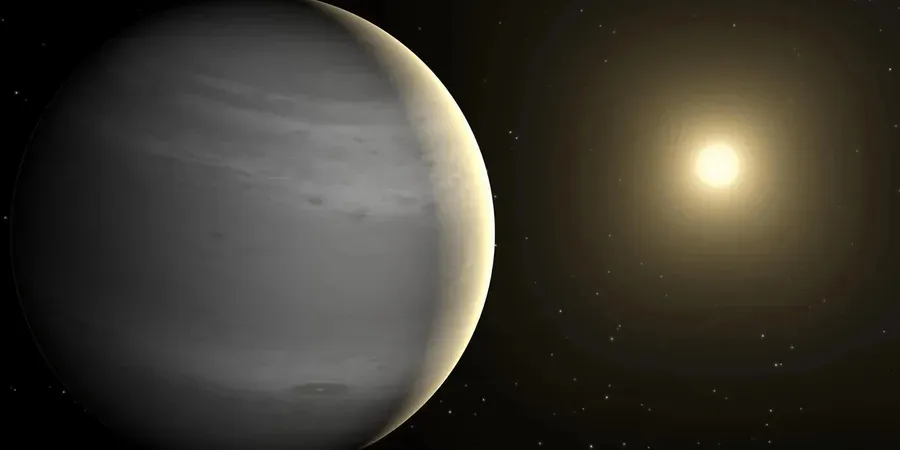
Using the James Webb Space Telescope, astronomers studied the distant planet TOI-199b, which surprised scientists with its relatively mild climate for a gas giant. The Saturn-sized world turned out to be much calmer than most similar exoplanets. The discovery could help us better understand how planets and atmospheres form, including our own Earth. The study’s findings were published in the scientific journal Astronomical Journal.
Scientists from the University of Pennsylvania and NASA used the James Webb Space Telescope to study in detail the atmosphere of the exoplanet TOI-199b, which is located more than 330 light-years from Earth and is similar in size to Saturn, but differs significantly in conditions from typical gas giants.
The planet completes one full orbit around its star in approximately 100 days, and its average temperature is estimated at around 79 °C, which is considered quite “moderate” on a cosmic scale, especially when compared to the scorching “hot Jupiters,” where temperatures reach extreme levels.
It is precisely this “moderation” that makes TOI-199b unique for study, since most known exoplanets are either too hot or too cold, while this object falls somewhere in the middle, allowing scientists to better study transitional atmospheric types. For their analysis, the researchers used the transit spectroscopy method: for about 20 hours, they observed the planet passing in front of its star, and as starlight passed through its gaseous envelope, the JWST recorded characteristic “fingerprints” of chemical elements.
The results showed that TOI-199b’s atmosphere contains methane, as well as traces of ammonia and carbon dioxide, suggesting more complex formation and evolutionary processes for this planet than previously expected.
A scientific paper published in the Astronomical Journal emphasizes that this is one of the first instances of such a detailed analysis of the atmosphere of a gas giant with moderate temperature conditions, and it is precisely this kind of data that helps refine models of planetary system formation.
As the study’s authors note, “the results obtained allow for a better understanding of how the atmospheres of different types of planets form and evolve,” and in the long term, this may help scientists more thoroughly explain the processes that once occurred in Earth’s early history.
NASA’s Psyche spacecraft successfully performed a critical gravity assist maneuver near Mars, using the Red Planet’s gravity as a “slingshot” for additional acceleration. Thanks to this, the probe increased its speed by 1,600 km/h and adjusted its flight path toward its primary target.


