
Dark matter could have distorted the plasma jet from a distant blazar
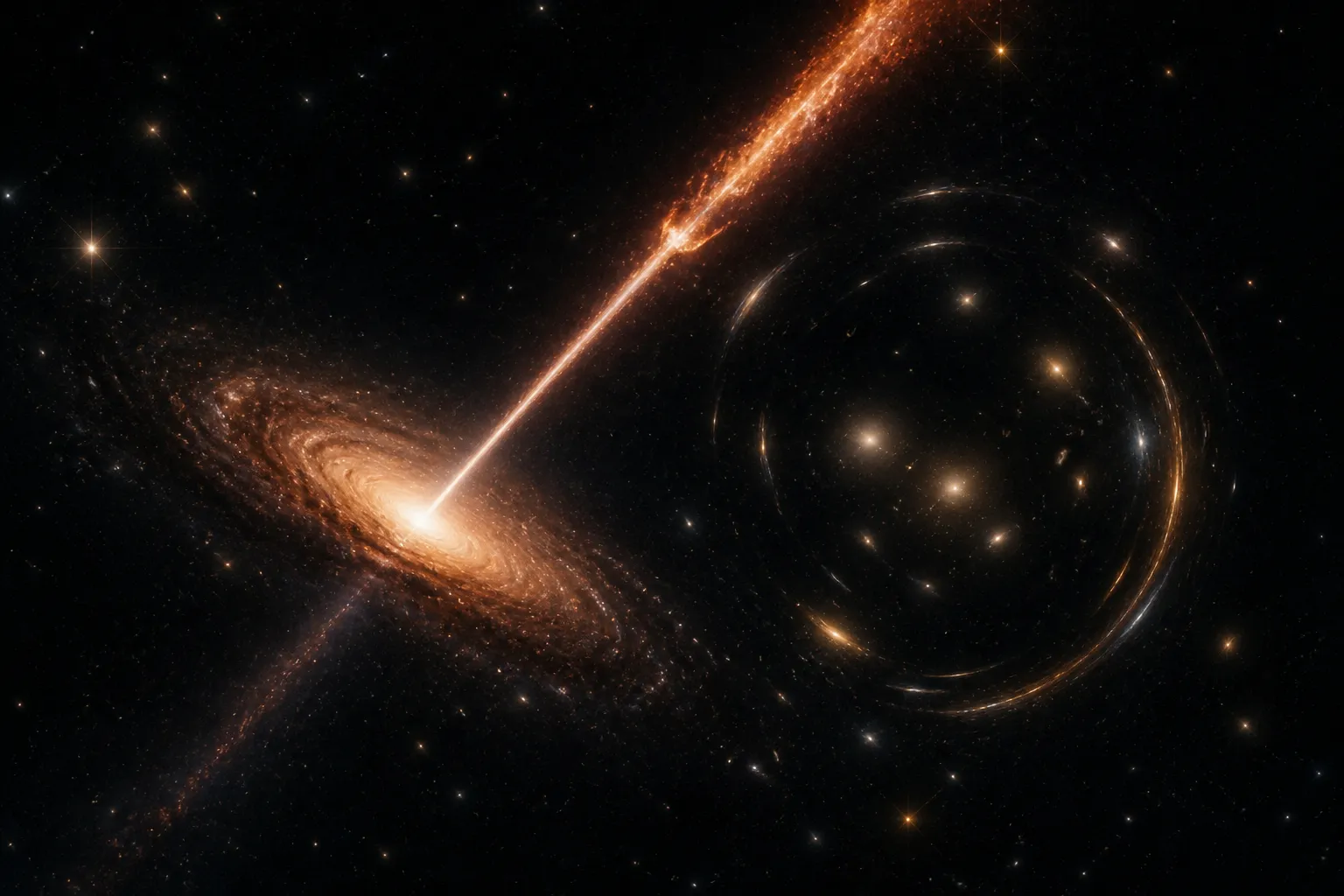
Astronomers have found evidence that a plasma jet from the distant blazar PKS 2233-148 has undergone gravitational lensing. Researchers believe a possible explanation for this phenomenon is an invisible cluster of dark matter, according to Space.com. The lensing could have altered the apparent direction of the jet, which is ejected at nearly the speed of light from a supermassive black hole.
PKS 2233-148 is a blazar—a type of quasar whose jets are directed toward Earth. The supermassive black holes in such objects are surrounded by vast amounts of matter that they consume. Some of the matter that does not fall into the black hole is directed toward its poles and ejected as plasma jets.
Silke Britzen and her colleagues reanalyzed data from the Very Long Baseline Array, the Fermi space telescope—which observed the blazar in the gamma-ray range—and the X-ray instrument on the Swift observatory. They tracked changes in the jet’s motion over time and detected a sudden deviation from its expected trajectory, as well as peculiarities in the gamma-ray curve.
For more breaking news, follow the UA.News Telegram channel.
Gravitational lensing occurs when a massive object warps space and alters the path of light from a source located behind it. In the case of PKS 2233-148, no large galaxy or galaxy cluster capable of acting as a lens was found in the expected position. Therefore, scientists are considering an invisible cluster of dark matter as a possible explanation.
Dark matter does not interact directly with light: it neither emits nor reflects it. At the same time, its mass, like that of ordinary matter, can warp space, affecting the path of light. This effect requires a precise alignment between the object, the jet, and the observer; therefore, it is temporary and difficult to detect.
Blazars are thought to be potential cosmic accelerators of neutrinos—electrically neutral particles with very low mass that are difficult to detect and link to a specific source. The researchers plan to search for other similar cases of gravitational lensing to further investigate the connection between blazars and the origin of neutrinos. The team’s work was published on July 31 in the journal *Monthly Notices of the Royal Astronomical Society*.




