
In China, the R6000 tiltrotor has completed full-scale flight tests
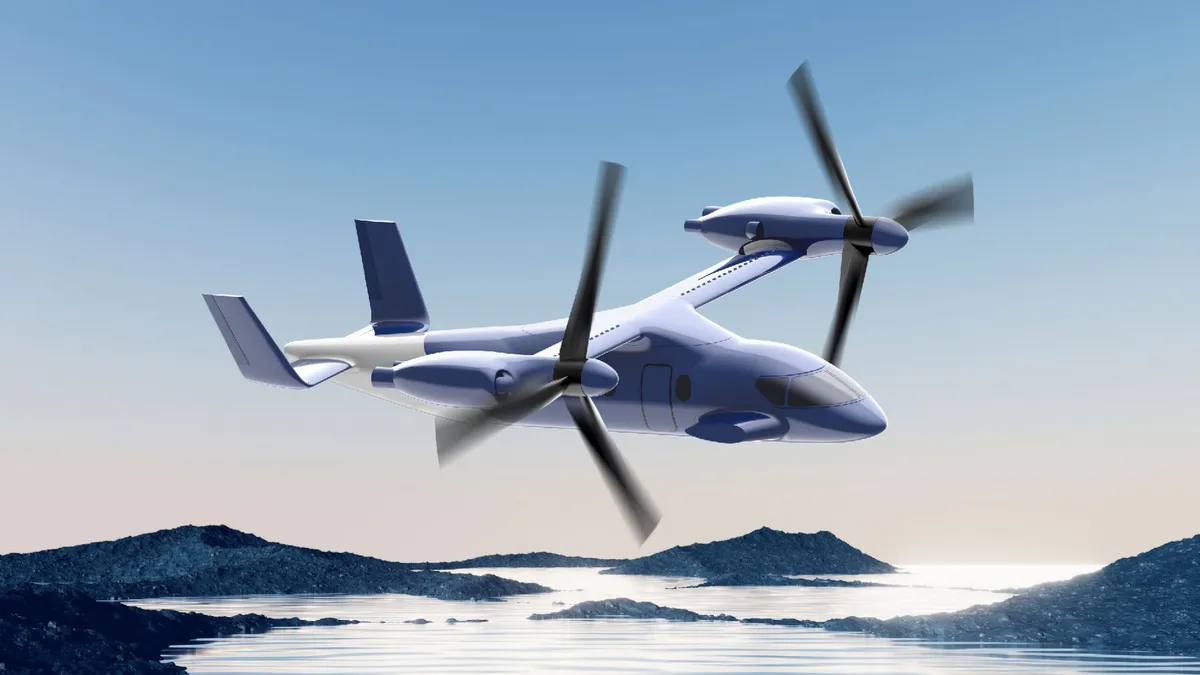
China’s large R6000 unmanned tiltrotor has successfully moved on to a new, significantly more complex phase of flight testing without the use of safety cables.
Videos that have appeared online confirm the aircraft’s ability to perform complex maneuvers in the air.
This latest drone is being developed for a wide range of civilian missions, but it has enormous potential for use by military units.
The aircraft’s design has attracted significant interest from experts due to its visual and technical similarities to the Bell MV-75A Cheyenne II—a second-generation American manned tiltrotor.
The new R6000 effectively combines vertical takeoff and landing (VTOL), like a conventional helicopter, with the high cruising speed typical of airplanes.
The released footage clearly shows the large drone in vertical flight, rotating around its vertical axis while hovering, as well as in steady straight flight with both rotors fully tilted.
Test flight of the world’s first 6-metric-ton tiltrotor drone pic.twitter.com/9oIZFq7taR
— DS北风 (@WenJian0922) June 15, 2026
Previous tests of this new Chinese drone were limited to evaluations using a special tether, which demonstrated only its basic hovering capabilities.
Now, with the start of full-scale flight tests, experts have been able to learn much more about the actual performance characteristics of this unique aircraft.
As in previous images, the aircraft’s engines are currently unprotected, and their fairings have been completely removed. Like its American counterpart, the MV-75, the Chinese R6000 has fixed engine nacelles with pivoting propellers.
This makes it fundamentally different from the first-generation tiltrotor design used on the V-22 Osprey, in which the entire nacelle rotates up and down as a single unit.
Although no official details regarding the exact scope of the current tests have been released yet, the ability to perform sustained unassisted flight is a key milestone for any tiltrotor program.
This is due to the extreme complexity of the aerodynamics and modern flight control systems of this type of aircraft.
The design of such tiltrotors is particularly complex, as evidenced by the mixed and dramatic operational history of the American V-22 Osprey over the years.
Developed by the well-known Chinese firm United Aircraft, the R6000 is one of the largest unmanned tiltrotor aircraft currently under active development worldwide.
Combining the vertical takeoff and landing capabilities of a helicopter with the speed and range advantages of a fixed-wing aircraft, it is officially intended for civilian use.
The manufacturer states that the unmanned aircraft will be used for logistics, disaster relief, offshore support, and other missions requiring rapid access to remote areas without prepared runways.
United Aircraft has previously unveiled both manned and unmanned versions of the R6000 project.
However, the R6000-class tiltrotor, with or without a crew, could effectively carry out various important military tasks for the People’s Liberation Army (PLA).
This aircraft will be particularly valuable for providing reliable support to the PLA’s extensive network of island bases in the South China Sea.
It would also be needed for isolated facilities in other parts of the Pacific Ocean and along China’s remote border regions, where conventional airfield infrastructure is severely limited.
This type of aircraft could actively support overseas troop deployments, including a potential large-scale operation against Taiwan.
The drone is capable of rapidly transporting personnel, supplies, and heavy equipment between dispersed locations without relying on prepared runways at all.
In particular, the R6000 would be well-suited for operations from the Type 076 amphibious assault ship and other large vessels of the Chinese Navy. This would significantly expand their overall operational range for logistics, reconnaissance, and many other missions.
This is discussed in an article by TWZ.
Ukraine Unveils the Sea Trident Underwater Drone
Banderole attacked Kyiv: what is known about the new Russian drone missile


