
Scientists have taught a tree to generate electricity even in near-total darkness
The scientific community is rethinking its approach to renewable energy, proposing to replace bulky silicon panels with modified organic materials.
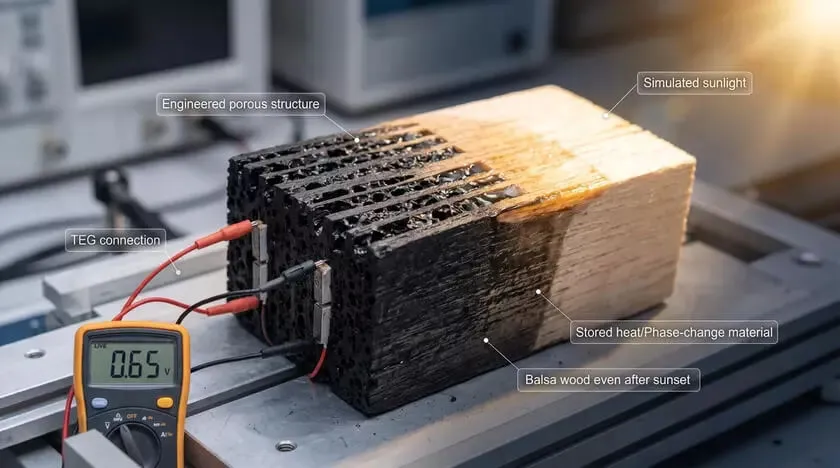
A new development based on balsa wood is capable not only of effectively absorbing sunlight but also of generating electricity after sunset thanks to stored heat.
The technology is based on the chemical modification of balsa wood—a material renowned for its lightness and porosity.
Scientists removed lignin from the material, creating a cellulose “skeleton,” which they subsequently filled with functional nanomaterials.
To absorb photons, the walls of the microchannels were coated with black phosphorene, protected by tannic acid and iron ions.
Thanks to the integration of silver nanoparticles, this material demonstrates an incredible ability to convert up to 91.27% of solar energy into heat.
“This device was supposed to detach from the main ship...” — engineering solutions of similar complexity are now being implemented in biomaterials, transforming ordinary wood into a high-tech device.
The main innovation is the system’s ability to operate during the “night shift.” To achieve this, stearic acid—a phase-change material that accumulates thermal energy during the day and releases it at night—was introduced into the wood structure.
This allows the thermoelectric generator to continue operating even in complete darkness, producing a voltage of up to 0.65 V.
According to research published in Wiley Advanced, the platform stores about 175 kJ/kg of energy.
Although this power is currently insufficient for household appliances, it is quite sufficient for the operation of autonomous sensors, low-power electronics, or components of “smart” home systems.
An important advantage of the development is its durability and practicality. After 100 cycles of operation, the material’s efficiency did not decrease, and the wood itself acquired fire resistance, hydrophobicity, and antibacterial properties.
Scientists Uncover the Secrets of the Sun’s “Hidden Life”
Scientists have identified new obstacles to life in space


