
The Psyche probe performed a gravity assist maneuver near Mars and captured a unique image
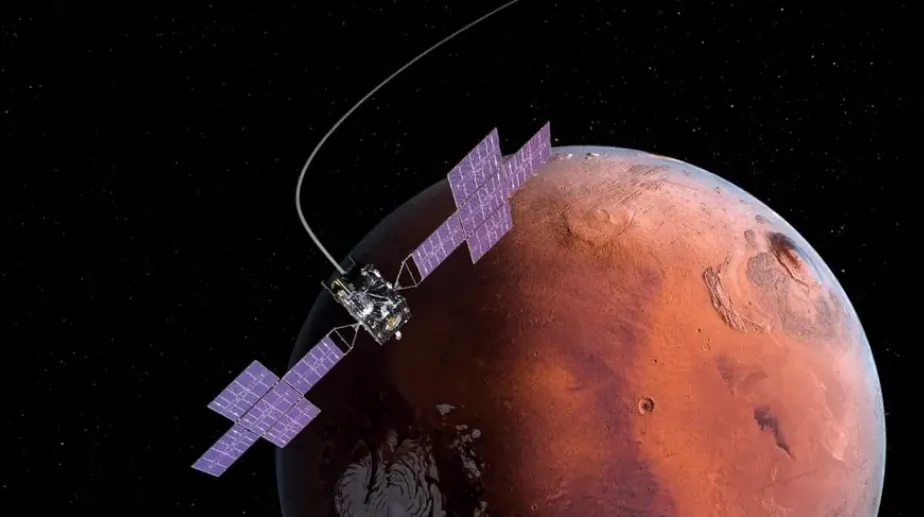
NASA’s Psyche spacecraft successfully performed a critical gravity assist maneuver near Mars, using the Red Planet’s gravity as a “slingshot” to gain additional speed. As a result, the probe increased its speed by 1,600 km/h and adjusted its flight path toward its primary target.
This was reported by Ars Technica. During the flyby, the spacecraft approached the planet from the side opposite the Sun, allowing the onboard cameras to capture Mars as a thin, bright crescent—a view that is physically impossible to see from Earth’s surface.

The unique image of the Martian crescent was taken on May 15, 2026. The probe’s multispectral camera captured thousands of wide-angle photographs clearly showing the southern polar ice cap and the massive canyon system of the Mariner Valley. Jim Bell, the leader of the imaging team, noted that these images will help scientists perfectly calibrate the sensors. In addition to the cameras, engineers tested two other instruments under “real-world conditions”: a magnetometer, which recorded the interaction of the solar wind with Mars’ atmosphere, and gamma-ray and neutron spectrometers, which measured the chemical composition of Martian soil.
The Psyche spacecraft was launched in October 2023 aboard a SpaceX Falcon Heavy heavy-lift rocket. The probe is equipped with advanced ion (plasma) engines that operate continuously to build momentum along a route totaling 3.6 billion kilometers. A successful flyby of Mars has brought the spacecraft into the home stretch of its space journey. The mission’s main event is scheduled for the summer of 2029, when the probe will approach its final destination—the unique iron asteroid Psyche, considered the richest metallic body in the Solar System.
Previously, the Japanese probe Hayabusa-2 delivered organic compounds from the asteroid Ryugu. And NASA researchers have detected organic compounds, including sugar molecules, in samples brought back from the asteroid Bennu.
The Curiosity rover has identified more than 20 types of organic molecules, including a nitrogen-containing compound structurally similar to the building blocks of DNA.


