
A large asteroid will approach Earth this weekend
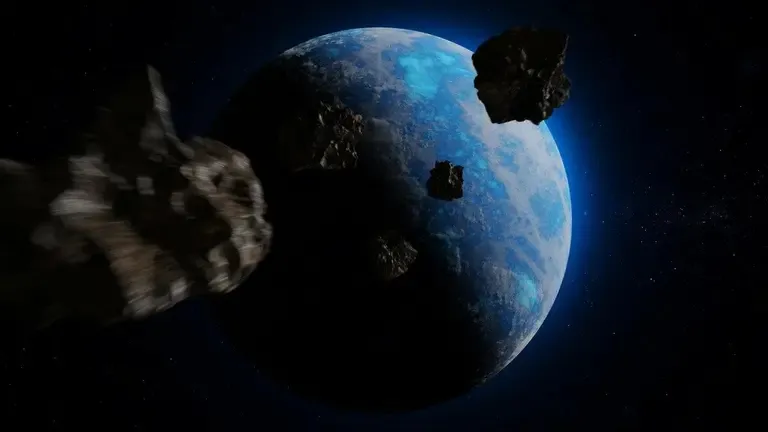
This weekend, the large asteroid 1997 NC1 will fly past Earth, and although it is considered potentially hazardous, it actually poses no threat to the planet. It will pass at a distance of more than 2.5 million kilometers, but for scientists, this will be a rare opportunity to study it closely. Astronomers are already preparing observations to determine its size and properties.
On Saturday, June 27, Earth will receive a unique “cosmic visit”—asteroid 152637 (1997 NC1), classified as a potentially hazardous object, will fly past the planet, but there’s no need to worry this time, as its flight path is completely safe. Despite its high-profile status, it will pass at a vast distance and has absolutely no chance of colliding with Earth.
According to scientists’ estimates, the minimum distance will be about 2,560,000 kilometers—more than six times farther than the Moon—which makes the flyby safe, though quite rare for such a large object. Astronomers note that such a close approach occurs only once every several decades, and the next time the asteroid will come close to Earth will not be until 2133.
Experts explain that the main interest lies not in the “encounter” itself, but in the opportunity to better understand the nature of the asteroid, since its dimensions have not yet been precisely determined—estimates suggest its diameter could range from 750 to 1,650 meters. Such a large discrepancy arises due to the unknown properties of the surface: darker objects appear smaller, while lighter ones appear larger, even though in reality they may have completely different dimensions. To gain a more accurate understanding, NASA plans to use the Goldstone radar, which allows scientists to “scan” the asteroid with radio waves and determine its actual shape, structure, and dimensions. As the space agency noted, “We plan to use radar observations to help resolve discrepancies regarding diameter, spectral class, and optical albedo.”
The European Space Agency also emphasizes that such flybys are an important part of planetary safety, as they allow for the refinement of catalogs of near-Earth objects and a better understanding of potential future risks. ESA representatives explained, “An object of this size approaches Earth only once every few years,” highlighting the scientific value of the observation. The asteroid will be visible with binoculars or a small telescope, though observations will be hampered by the nearly full Moon, which will illuminate the sky at the moment of closest approach. The best viewing time is expected to be on June 27 at approximately 2:14 p.m. Kyiv time, and for those unable to observe it on their own, online broadcasts by astronomical projects are scheduled.
Scientists add that such objects are constantly being closely monitored, and although Earth regularly “crosses paths” with large asteroids, most of them pass by at safe distances. At the same time, approximately half of all space objects larger than 350 meters remain undetected, so monitoring systems continue to be actively improved. This was reported by IFLScience.
Twenty-nine sets of dinosaur fossils, which had been illegally smuggled out of the country by traffickers about 20 years ago, have been returned to Mongolia.


