
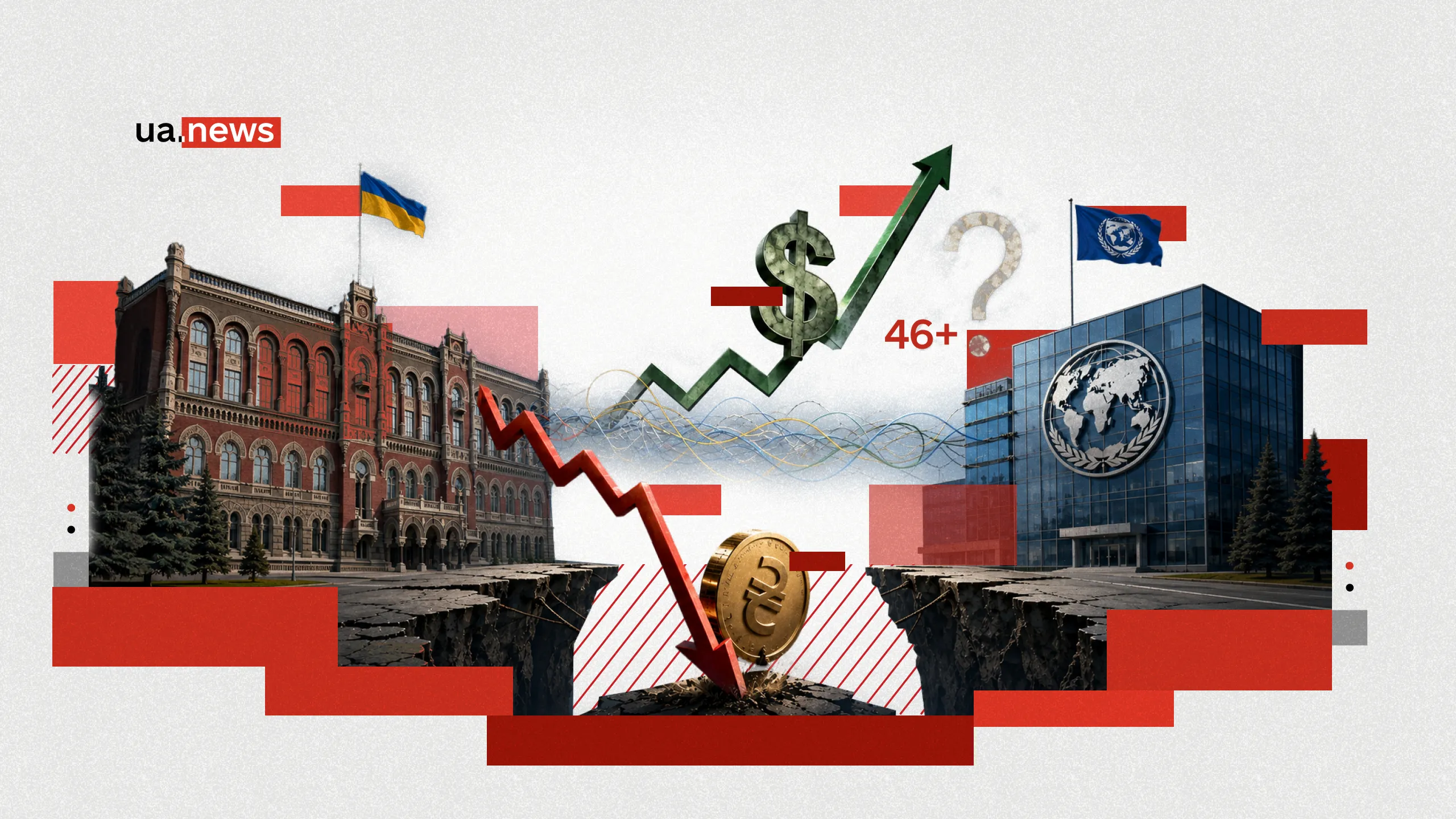
Yesterday, Tuesday, June 9, the official dollar exchange rate set by the National Bank jumped by 33 kopecks at once—from 44.5129 UAH/$ to 44.8437 UAH/$. For those following the trend, this is not just a number, but the latest in a series of consecutive days of steady downward movement, which has caused the hryvnia to weaken by 64 kopecks in just two trading sessions. The situation on the interbank market is even more telling: Tuesday’s final trade was recorded at 44.9950 UAH/$—practically right up against the psychological barrier of 45 UAH, which until recently seemed like a real but still distant prospect.
The cash market reacted instantly. Banks have already set the dollar for sale at 45.40 UAH/$, and the card exchange rates of some institutions have reached 45.50 UAH/$.
A logical question arises: what is actually happening with the exchange rate, why is the hryvnia devaluing, and why has the regulator, which for years kept the exchange rate under fairly tight control, suddenly allowed such a sharp move? UA.News, together with experts, examined the issue.
From managed stability to creeping devaluation: the NBU’s logic
In recent years, the National Bank of Ukraine has demonstrated extreme caution in its exchange rate policy. Daily fluctuations of 3–5 kopecks in either direction became a familiar backdrop, creating the illusion of stability. People have grown accustomed to the predictable, in a sense “linear,” appreciation of the dollar, which was perceived more as a statistical anomaly than as a warning sign. However, the events of recent days are shattering this paradigm.
The sharp acceleration in the pace of devaluation is neither a spontaneous glitch nor market panic. It is, in fact, a deliberate decision by the regulator, underpinned by deep economic rationale. The key to understanding the situation lies in the context of Ukraine’s cooperation with the International Monetary Fund.
The IMF mission, which has just concluded its work in Kyiv, left the country without a signed memorandum and without clear agreements on the next tranche. The reason is simple: Ukraine has not fulfilled a number of basic structural requirements that were a prerequisite for continued financing.
In this situation, the devaluation of the hryvnia becomes a tool that serves several functions at once. First, it automatically increases the hryvnia equivalent of foreign exchange revenues to the state budget—customs duties, taxes from importers—thereby partially closing the gap that cannot be covered by external borrowing. Second, it sends a signal to international partners: we are doing what you have long recommended—allowing the exchange rate more flexibility. Third, it serves a macroeconomic function of balancing the balance of payments in a situation where other mechanisms—such as administrative import restrictions or sharp cuts in budget spending—are politically unacceptable or technically impossible.

Why now? Anatomy of the June Spike
For a deeper understanding of what is happening, it is worth looking at the structure of the foreign exchange market and the behavior of its participants. Trading volume on Bloomberg on June 9 was $242 million—less than the previous day, when it was $266 million. In other words, demand for the currency is not rising but is actually declining slightly.
Yet the exchange rate is rising. This is a classic sign that the market is not driven by panic demand, but by supply—more precisely, by its administrative regulation through National Bank interventions. In other words, the NBU is simply allowing the exchange rate to creep up faster than before by buying fewer hryvnias from the market or spending fewer reserves on support.
This change in tactics is no coincidence, particularly in June. Traditionally, the summer months in Ukraine are a period of increased imports (fuel, equipment, preparations for the new agricultural season, etc.), which puts additional pressure on the balance of payments. In addition, the end of the heating season means that large volumes of gas pumped into storage facilities must be paid for, which also requires foreign currency. If we add to this the chronic foreign trade deficit that Ukraine has been facing for several years now, it becomes clear: the seasonal factor overlaps with the structural one, and the regulator decided not to spend reserves on fighting objective economic laws.
The euro deserves a separate mention. On June 9, the official exchange rate for the European currency was raised from 51.3545 UAH/€ to 51.8976 UAH/€. This is almost at the historical high recorded on April 22—at 51.91 UAH/€.
It is important to understand that the hryvnia’s dynamics against the euro largely depend on the euro/dollar cross-rate in global markets, but the general trend toward the national currency’s weakening makes the euro even more expensive for Ukrainians. The cash market has already reflected this trend: some banks were selling euros at 52.50–52.74 UAH/€, which is yet another all-time high.

Outlook for the future: 45 UAH/$ is not a ceiling, but a new norm
If we analyze current signals, it becomes clear that the 45 UAH/$ mark is far from the final stop. It is rather a new springboard from which the regulator will continue its gradual movement.
The logic here is simple. First, there is currently no political will whatsoever for a sharp increase in taxes or a reduction in budget expenditures, which could reduce the need for monetary financing. Second, agreements with the IMF appear to be postponed indefinitely, and therefore, there is no point in counting on rapid external financing. Third, the very logic of a managed devaluation implies that the process is drawn out over time to avoid shocks, but it certainly does not stop.
Will we see an exchange rate of 46 UAH/$ by the end of summer? It is quite likely if the pace of devaluation continues. However, it is important to understand that the National Bank is not an independent player in this process. It is caught between a rock and a hard place: on the one hand, the need to finance the budget deficit and comply with unspoken external recommendations; on the other, the threat of triggering an inflationary spiral, since every penny of the dollar’s rise is factored into the cost of imported goods and fuel, and thus hits citizens’ pockets. Therefore, the regulator will most likely stick to the same tactic: a few days of accelerated movement, then a slight pullback to calm the market, then another push, and so on ad infinitum. This policy allows for achieving the desired macroeconomic effect without causing undue panic among the population.
The cash market, which always runs slightly ahead of the official market, has already set this trajectory. The difference between the interbank non-cash rate and the cash rate at banks has begun to grow again, which is an indicator of underlying market nervousness. However, it is definitely too early to speak of a full-scale crisis of confidence in the hryvnia: trading volumes on the interbank market are not showing explosive growth—and thus, businesses and the public have not yet rushed to buy up currency in a panic. This gives the NBU room to maneuver.
Expert Opinions
Economist and Director of the Economic Discussion Club Oleg Pendzin notes: there is no market in this situation. Devaluation is purely a strategy of the NBU, since it is the sole seller of currency in Ukraine and the sole regulator.
“There can be no surprises here. The NBU is responsible for inflation. It has two tools at its disposal: the discount rate and the exchange rate. What they are doing should be viewed as a mechanism to curb inflation. In the summer, food prices usually go down. The main component of inflation disappears. And the NBU gains the technical ability to weaken the exchange rate. Let me remind you that the budget is based on an annual exchange rate of 45.7 UAH per dollar. Therefore, this is a completely normal process without any complications. The moment something changes, the NBU will also respond by adjusting the exchange rate. In other words, in this situation, the National Bank is using the exchange rate as a tool to curb inflation. So that is exactly how this process should be viewed,” Oleg Pendzin is convinced.
Economic expert Yuriy Gavrylechko notes: The 2026 budget is based on an average annual exchange rate of 45.7 UAH per dollar. And we are gradually approaching that rate due to both objective and subjective factors.
“As for the former, this is a natural result of the structural imbalance between how much currency Ukraine earns and how much it spends. The problem with the NBU’s exchange rate policy is that it increasingly relies on selling currency from reserves rather than on restoring export capacity, attracting investment, or structurally improving the balance of payments. Simply put: the NBU “supports” the hryvnia every month by spending billions from its reserves. Without these interventions, the exchange rate would be significantly worse—but the reserves themselves are not funded by export revenues, but primarily by new debt. However, this has not prevented a 5% devaluation since the start of the year.
If the government receives a “loan tranche” from the EU by the end of June, the foreign exchange market will receive significant support in the form of euro inflows. This will temporarily ease the pressure on the NBU to sell reserves and may even slightly strengthen the hryvnia. However, this will not fundamentally change anything. Worse still, the adoption of new fiscal changes raising taxes on SMEs and further manipulations involving the reclassification of employees will contribute to the economy’s slide into recession, which will undoubtedly have a negative impact on exchange rate stability,” says Gavrylechko.
As for other factors, first and foremost, it is worth mentioning the NBU’s plans to calculate a reference exchange rate for the hryvnia against the euro as of 12:00 p.m. starting September 1, 2026 (currently, such an indicator exists only for the dollar). In practical terms, for the average Ukrainian, this means the following: if your expenses and income are tied to the euro (for example, you receive remittances from relatives in the EU or have obligations in euros)—your “reference point” has already de facto changed, the expert notes. As for everyone else, banks and currency exchange offices are increasingly orienting themselves toward the euro as the main “hard” currency in Ukraine (the so-called “new benchmark”), which will also contribute to the hryvnia’s devaluation.
“What to expect? Three ‘scenarios.’ Base (most likely): during the second week of June, the dollar exchange rate will fluctuate between 44.5 and 45.2 UAH, while the euro will show a wider range of 51–52.5 UAH. Surprises are unlikely: despite potential risks, the situation will remain under control. After the first tranche from the EU is received, a short-term strengthening of the hryvnia is possible, but the structural deficit will not disappear. Optimistic: if the dollar begins to weaken on global markets and Ukraine receives sufficient external financing, the hryvnia could strengthen further—the dollar could fall to 43.5–44.2 UAH. Pessimistic: If loan funds do not arrive, then a large-scale withdrawal of NBU reserves and a sharp devaluation of the hryvnia are possible. “There are no real prerequisites for a dramatic improvement in the balance of payments, even if hostilities cease, because the Verkhovna Rada, the government, and the NBU are doing everything possible to cool down Ukraine’s already ailing economy,” Yuriy Gavrylechko asserts.
In summary, the situation we are currently observing in the foreign exchange market is a logical continuation of long-standing economic processes, exacerbated by a political factor—the unsuccessful conclusion of negotiations with the IMF. The official exchange rate of 44.84 UAH/$, the cash rate of 45.40 UAH/$, and the card rate of up to 45.50 UAH/$ are not a temporary spike, but a new economic reality in which the hryvnia will continue to weaken slowly but steadily.
The reasons for this process are complex. On the surface—failure to meet the demands of international creditors and the resulting pause in financing. Deeper down—structural budget imbalances, which devaluation helps to temporarily offset. Even deeper lies the Ukrainian economy’s long-standing dependence on external borrowing, which, when this resource dries up, shifts the burden of adjustment onto the national currency’s exchange rate.
The outlook for the coming months remains generally pessimistic. In the absence of a breakthrough in negotiations with the IMF and without real domestic reforms capable of reducing the budget deficit, the dollar will continue its upward trend. The only question is whether the National Bank will be able to keep this process under control and prevent a shift from “creeping” devaluation to a collapse. Not only the well-being of Ukrainians but also the country’s overall macroeconomic stability in the near term will depend on this.


