
Photo: A woodcock was spotted in the middle of the road in the Chernobyl Nature Reserve

An unusual incident occurred at the Chornobyl Radiation and Ecological Biosphere Reserve: a wood snipe “stopped” a security patrol car right in the middle of the road.
Reserve researchers documented this amusing encounter in the evening after it had rained.
According to experts, the bird stood in a puddle for quite some time, resting and showing no sign of moving out of the way.
Even the bright light of the car’s headlights didn’t particularly alarm the woodcock. The bird merely turned its head away and continued to sit calmly in the water.
After a brief photo session, the nocturnal traveler finally decided to make way. The snipe moved aside and then flew off in search of another puddle, the researchers said.
Experts attribute the bird’s unusual behavior to the heat and drought, which have significantly dried up the woodcocks’ traditional habitats this year.
After the rain, a small puddle formed on the road, becoming a sort of “oasis” in the middle of the parched forest.
“Why a puddle, specifically? This year’s heat and drought have significantly dried out the wood snipe’s traditional habitats. And here, after the rain, a small puddle formed—a true ‘oasis’ in the middle of the parched forest. Moist soil and mud provide exactly the kind of environment where this wader can forage for food with its long, slender bill,” the experts explained.
According to the researchers, the woodcock is primarily nocturnal.
At dusk and at night, it leaves its forest hideouts and sets out in search of food in open areas—meadows, pastures, and fields.
Another distinctive feature of the woodcock’s behavior is its reaction to bright light.
According to ornithologists, a strong, directed light in the dark can temporarily disorient the bird, causing it to freeze in place.
Researchers take advantage of this trait when capturing woodcocks at night for subsequent banding.
The wood snipe has a very distinctive head structure. Its eyes are set high and set back.
This gives the bird an exceptionally wide field of vision—it can monitor not only the space in front of it, but also to the sides and even behind it.
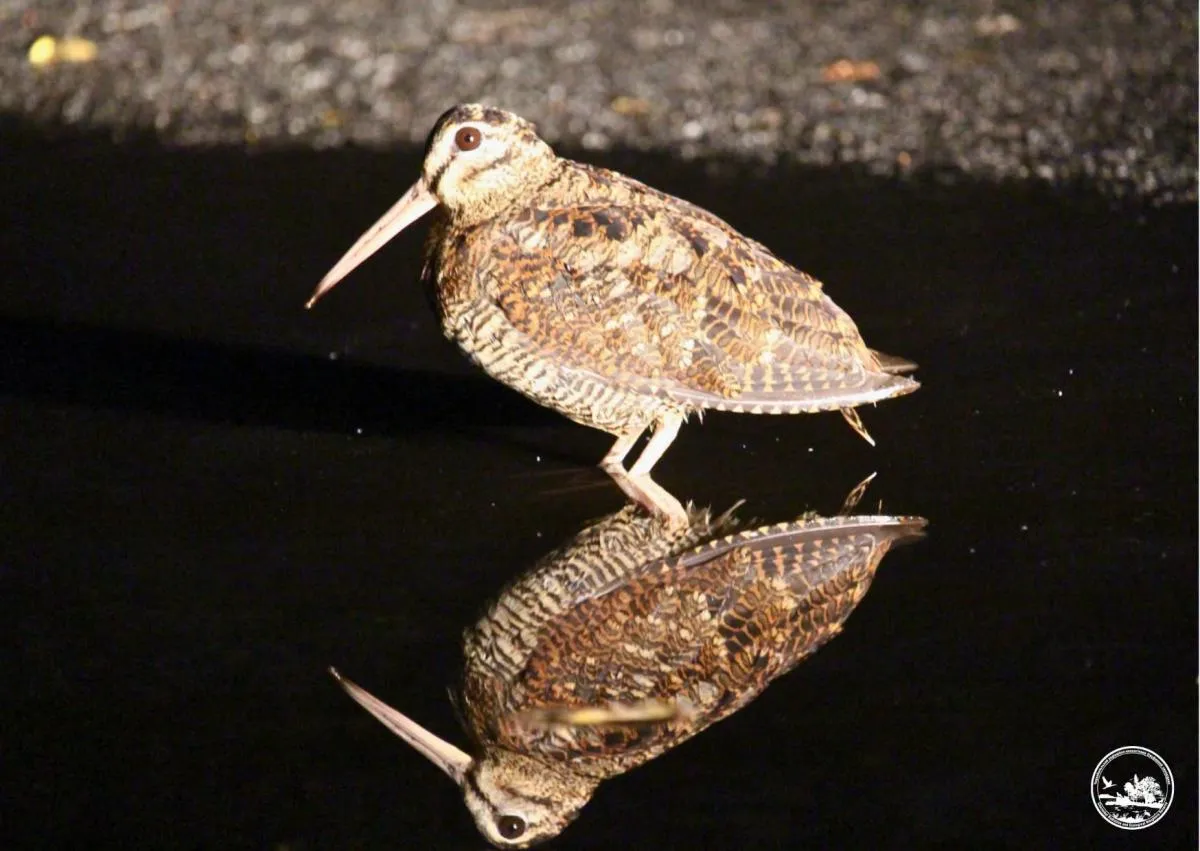
This feature is an important adaptation that helps the woodcock spot potential predators in time.
An unusual encounter in the Chornobyl Nature Reserve has once again demonstrated just how fascinating wildlife is in the Exclusion Zone.
Earlier, pink and curly pelicans were spotted in the “Tuzlivski Limany” National Nature Park in the Odesa region.
In the Poltava region, the stork Odarka returned to her nest and attacked Lelya and Kvitka.
Storks have begun returning to the Chernobyl zone.


