
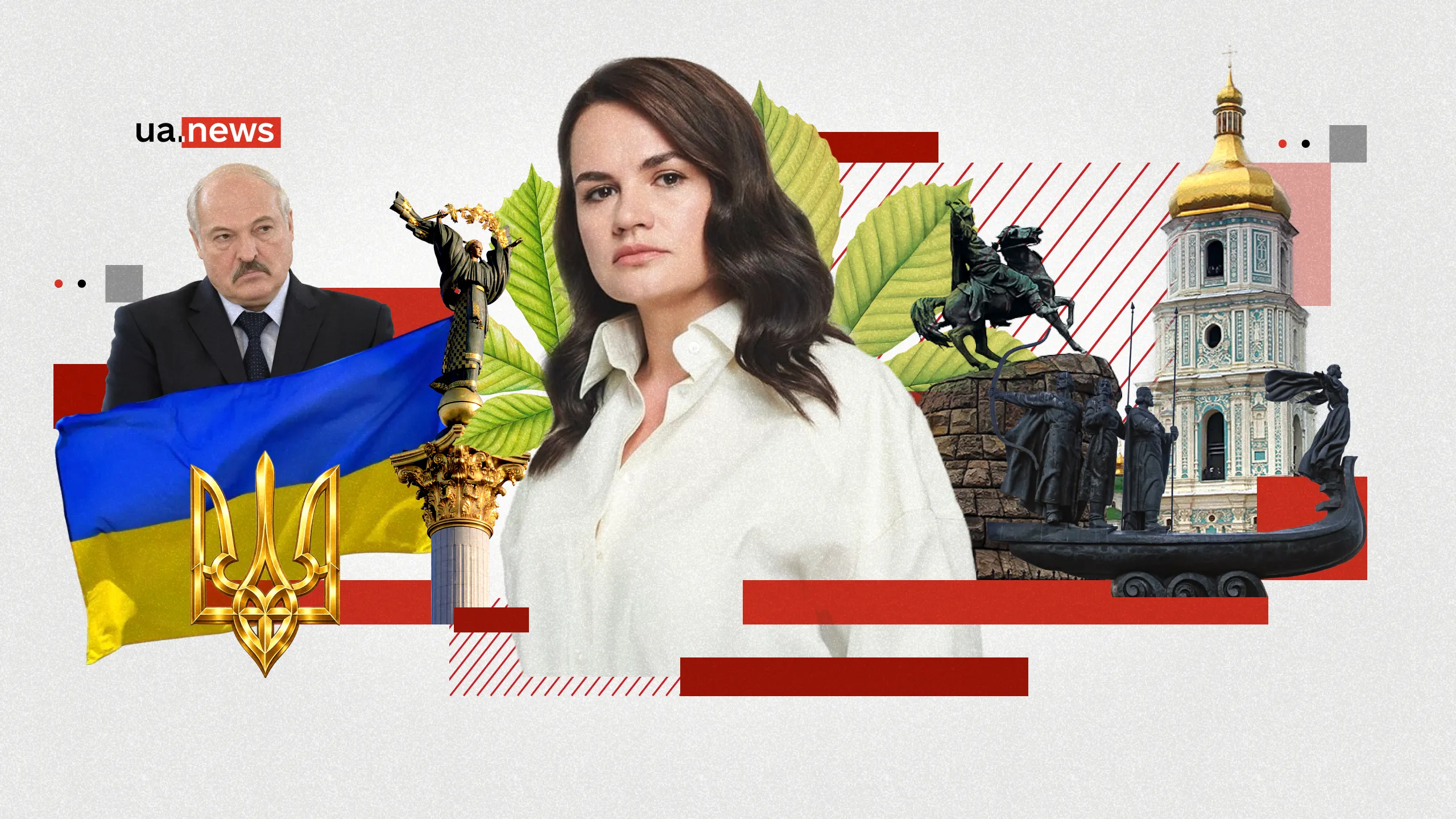
Against the backdrop of deteriorating relations with Belarus (though one might wonder how things could get any worse) and persistent claims of a possible invasion from its territory, Sviatlana Tsikhanouskaya arrived in Kyiv on May 25, 2026.
Her status is difficult to describe in a single word. For the West, at least for Europe, she is the leader of the Belarusian democratic opposition. A number of countries, such as Lithuania, Germany, and Poland, effectively recognize her as president-in-exile. Others, while not recognizing the legitimacy of Alexander Lukashenko, consider Tsikhanouskaya simply the official representative of the Republic of Belarus (but not the president). This rather strange and uncertain legal status is somewhat reminiscent of the situation with Juan Guaidó in Venezuela, when the international community was divided over the question of who was the true leader: him or Maduro.
Where did this woman, who is challenging the Belarusian dictator, come from in the first place? Why did Ukraine decide to invite her right now, effectively demonstrating disregard for the recent “peace initiatives” in Minsk? And what does this visit mean in terms of real politics, rather than symbolic gestures? UA.News political analyst Mykyta Trachuk, together with experts, examined the issue.
From housewife to protest leader: who is Sviatlana Tsikhanouskaya
Until 2020, Sviatlana Tsikhanouskaya was known only to a small circle of people—as the wife of blogger and opposition figure Siarhei Tsikhanouski. She was born in 1982, graduated from the philology department of a pedagogical university, worked as an English translator, and led the life of an ordinary Belarusian housewife, managing the household and raising two children.
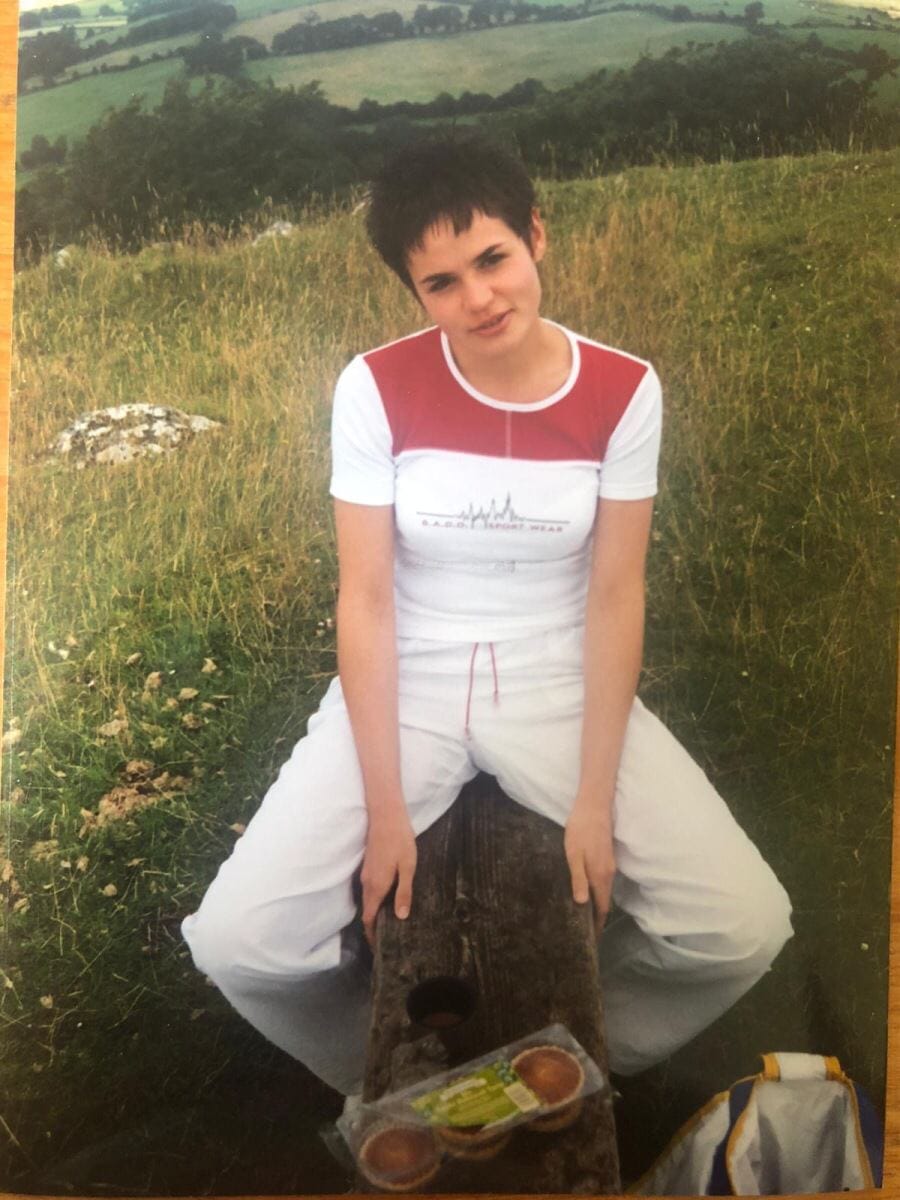
Everything changed in May 2020. At that time, her husband Sergei, who was planning to run for president, was detained right in the middle of a signature-gathering rally and later sentenced to a long prison term. After the Belarusian Central Election Commission refused to register his initiative group, Svetlana made a decision that would forever change her fate: she herself submitted documents to register her candidacy for the presidency.
Then, as often happens in history, “opinions were divided.” The official results of the August 2020 election showed, of course, a decisive victory for Alexander Lukashenko. However, opposition figures, independent observers, and Tikhanovskaya herself claimed widespread fraud, asserting that she had actually received the majority of the votes. Disputes over the exact figures continue to this day, but the fact remains: there was indeed large-scale fraud in those elections, and it was Sviatlana Tsikhanouskaya who subsequently became the leading figure of the protest that shook Belarus.
Those events, unfortunately, came to nothing. The protest, which united millions of Belarusians, was brutally suppressed. Mass arrests and repression began; thousands of people were sentenced to prison terms and subjected to torture in jails. Under pressure from the circumstances, Tikhanovskaya fled to Lithuania, where she continued her struggle, becoming the leader of the Belarusian democratic forces abroad and the head of the Coordination Council. In 2023, Lukashenko’s regime sentenced her in absentia to 15 years in prison, which only cemented her status as a major threat to the dictatorship in Minsk. Thus, a former housewife became a symbol of resistance for millions.

Why Did Tsikhanouskaya Come to Kyiv
Sviatlana Tsikhanouskaya’s visit to Kyiv was not spontaneous. It was announced back in late January 2026, when the first official meeting between Volodymyr Zelenskyy and the Belarusian opposition leader took place in Vilnius. It was then that the President of Ukraine invited her to visit the Ukrainian capital.
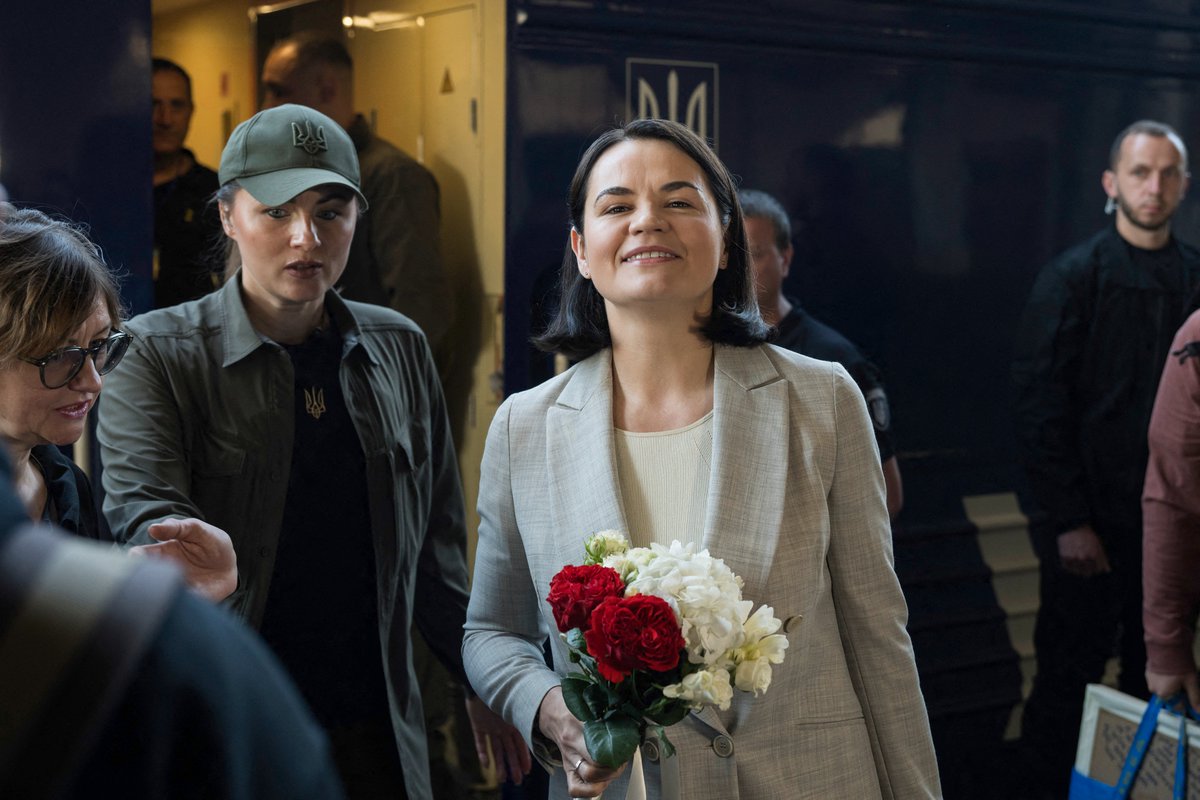
The itinerary was deeply symbolic. Straight from the train, without even stopping at a hotel, Tsikhanouskaya went to the Lukyanivskyi Military Cemetery to pay her respects to Maria Zaitseva—a 24-year-old Belarusian activist and volunteer with the Ukrainian Armed Forces who died in Donbas defending Ukraine.
“The first thing I did when I arrived in Kyiv was to visit Maria Zaitseva’s grave. It symbolizes not only our resistance to dictatorship but also Ukrainian-Belarusian solidarity,” Tikhanovskaya said.
In addition, the Belarusian guest was shown the sites of recent Russian strikes in Kyiv. The visit, it should be noted, took place just one day after a massive Russian missile and drone attack on the night of May 24. After surveying the destruction, Tsikhanouskaya spoke out strongly on her social media accounts.
“Every such strike reveals Putin’s true nature. And Lukashenko’s regime bears its share of responsibility for this, because it allowed Belarusian territory to be used for aggression, for launching missiles,” the opposition figure noted.
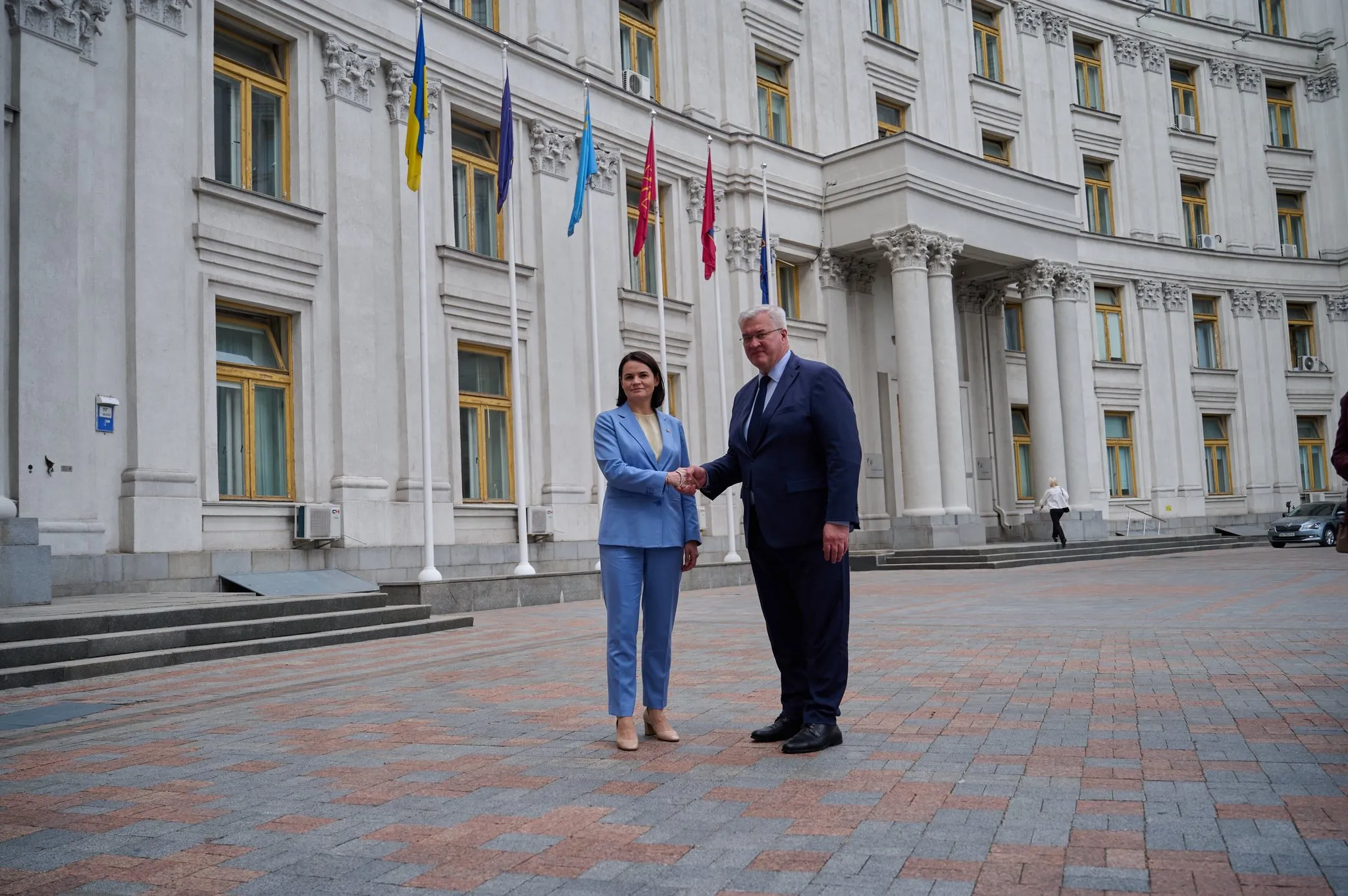
The political part of the visit included talks with President Zelenskyy, Foreign Minister Sybiga, the leadership of the Verkhovna Rada, and EU diplomats.
It is worth noting that the overall situation in which this visit is taking place is extremely tense. In recent weeks, Ukrainian authorities have repeatedly warned of the risks of Russia using Belarusian territory for potential military operations, particularly an offensive against Ukraine’s northern regions. President Zelenskyy regularly states that Russia is attempting to more actively draw Minsk into the war and that an attack from the Belarusian side may be expected.
Against this backdrop, the following aspect is particularly telling. Just recently, Alexander Lukashenko stated that he is open to negotiations with Zelenskyy and is even willing to travel to Kyiv for this purpose. However, the latter’s reaction was demonstratively negative: Foreign Minister Sybiha, commenting on Lukashenko’s proposal, announced a visit by Tsikhanouskaya, emphasizing that Kyiv “has someone to talk to on all issues regarding Belarus.”
This, of course, was a deliberate political slap in the face. Lukashenko’s proposal was not merely ignored—it was demonstratively trampled upon by inviting his enemy instead. To understand the extent of this humiliation for the Belarusian dictator, imagine a hypothetical situation: suppose Zelenskyy himself had proposed negotiations and even expressed a willingness to visit Belarus. In response, Lukashenko would have brought Viktor Yanukovych to Minsk, declaring that it is with him, as the “legitimate leader of Ukraine,” that he would conduct the dialogue. This is roughly the same thing.
Thus, the overall context of the meeting is a clear demonstration that Ukraine is placing its strategic bet not on Lukashenko, but on his direct political enemies, hoping for democratic transformation in the neighboring country and a new generation of Belarusian politicians.

Tikhanovskaya’s visit in the context of realpolitik: symbolism versus reality
Ukraine’s intention is quite clear, as is the message it sent to Lukashenko. And overall, from a moral standpoint, this is the right approach: one should bet on democratic leaders who share European and, more broadly, universal human values, rather than on autocrats who are, moreover, complicit in aggression.
But there is one “but” that turns this noble gesture into a potential problem: we are constantly being told about the very real possibility of an invasion from Belarusian territory, about the risks of an attack on Kyiv and other regions, about the Kremlin preparing several scenarios involving the use of a Belarusian bridgehead, and so on. Ukraine is fortifying its northern borders, preparing for defense, and so on. And against this backdrop, it is negotiating with… Sviatlana Tsikhanouskaya.
She may, without a doubt, be a wonderful person, a charismatic leader, and anything else you like—except for one thing: she is not the de facto leader of Belarus and does not make decisions. The Belarusian army, the KGB, the security services, the police, the border troops, and so on do not answer to her. She can assure Ukraine a thousand times over of friendship, love, and support, and promise close cooperation sometime in the future—but, unfortunately, Tikhanovskaya simply has no influence on the situation here and now.
The decision on whether missiles and drones will be launched from Belarusian territory, whether occupation forces will withdraw from there, or whether a new front will open will be made personally by Alexander Lukashenko. Because he is, de facto, the president who controls the security apparatus. And although Ukraine, along with many Western countries, does not recognize this, the reality remains unchanged. Lukashenko’s legitimacy may be zero in the eyes of Ukraine and the Western world, but his monopoly on violence within the country remains absolute. After all, he is fully recognized by the U.S., China, Russia, and most countries of the Global South.
Given the current situation, it is necessary to maintain contacts with Tsikhanouskaya and her team “just in case.” It certainly won’t be a waste—because who knows how the situation will unfold in the future? When Lukashenko’s regime comes to an end—and this will happen sooner or later—Ukraine will have established relations with those who may succeed him. In this context, Tikhanovskaya can be seen as a sort of “visitor from the future,” from a future Belarus—one that is open, non-aggressive, democratic, and friendly toward Ukraine and Europe.
But in the short term, and all the more so if the threat of invasion is real, might it be worth talking to the person who actually runs a state that poses a potential threat to us? In real politics, one sometimes has to engage in dialogue even with those one despises and hates—simply because they hold the keys to war and peace. History, unfortunately, is full of such examples.
Expert Opinions
Political scientist and director of the Institute of World Policy Yevhen Magda notes: Sviatlana Tsikhanouskaya’s visit to Ukraine had been discussed for a long time. Back in late January, Volodymyr Zelenskyy met with her in Vilnius and invited her to Kyiv at that time. And now, four months later, Tsikhanouskaya has finally arrived.
“The fact that this visit is definitely a source of irritation for Lukashenko stems, in reality, from his own psychological traits. Because he generally does not accept women in politics and does not accept Tsikhanouskaya—this is a well-known fact. But he also doesn’t accept, say, Latushka, who came to Kyiv with Sviatlana Tsikhanouskaya. In other words, believe me, no one is going to look to Lukashenko for guidance on these matters—that’s an absolutely clear and unambiguous point… Politics is always the art of the possible. And regardless of what goals we pursued in our desire to host Sviatlana Tsikhanouskaya in Kyiv, we must understand that this visit is very important to her. And for Ukraine—well, we need to demonstrate, if you will, the scope of the political game. That we have things to discuss with the Belarusian democratic forces and should seek reliable allies among them. “This seems quite obvious to me,” noted Yevhen Magda.
Political analyst and director of the “Third Sector” Center, Andriy Zolotaryov, is certain: the situation with Tikhanovskaya’s visit is indeed a troll against Lukashenko. However, the wisdom of such a policy remains questionable.
“We understand that his years in the ‘club of the merry and resourceful’ haven’t been in vain. And we’re seeing a sort of ‘captains’ contest’ with jabs and trolling directed at Lukashenko. Tikhanovskaya is the self-proclaimed leader of the opposition, because initially Lukashenko’s main rival in 2020 was considered to be Babariko, the head of the Belarusian branch of Gazprombank, whom the Kremlin was backing. But Lukashenko quickly threw him in jail. Next, it was Tikhanovskaya’s husband’s turn. And while her husband was in prison, she stepped into the role of opposition leader. Since she was essentially appointed to this role, it’s hard to talk about any electoral prospects for a competitive race—if there are ever truly competitive elections in Belarus—Tikhanovskaya will most likely lose.
We need to bet on a sure thing. And Tikhanovskaya is a completely different matter. And if we want to have normal relations, we still need to sit down and negotiate. If only because we share a thousand kilometers of border with Belarus, and reserves are desperately needed in Donbas, Zaporizhzhia, and elsewhere. Tension on the Belarusian border will result in 3–4 brigades being sent there to provide cover. I consider this rational factor to be the main one… Whatever Lukashenko may be like, maintaining normal relations (as far as possible) is a matter of common sense. And Tikhanovskaya came for a day, gave a speech, and went on her way. Remember Juan Guaidó in Venezuela, who was also declared the election winner and opposition leader, but has since disappeared. And even after the Americans “abducted” Maduro, he didn’t reappear on the political scene—there are entirely different figures there now. This is precisely the future that most likely awaits Tsikhanouskaya,” stated Andriy Zolotaryov.
In summary, Sviatlana Tsikhanouskaya’s visit to Kyiv is an unprecedented step that takes relations between Ukraine and Belarusian democratic forces to a qualitatively new level. It is a bold political gesture that clearly defines Ukraine’s values. It inspires Belarusians fighting for freedom and demonstrates that Kyiv envisions a future for this country without a dictator who has been in power for four decades (!) in a row.
However, there is often a gulf between beautiful symbolic gestures and real politics. And the main question hanging in the air after this visit is this: what specifically can Tikhanovskaya do for Ukraine here and now, and how can she help in the context of a potential war with her homeland? The answer remains open.


